
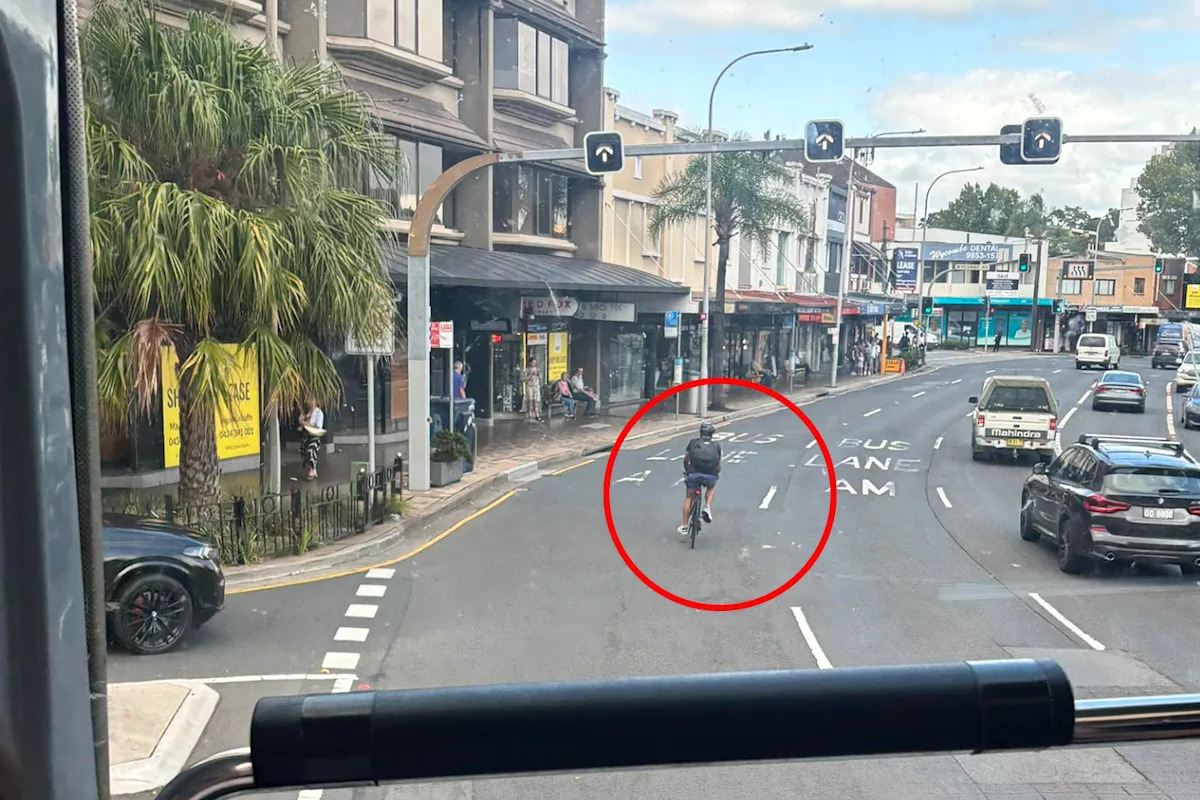
A debate has erupted among commuters over the age-old issue of cyclists on the road, with an image taken this week showing a rider in front of a bus appearing to stall traffic. One impassioned Sydney local claimed the cyclist was “inconveniencing hundreds” during peak hour, but the law tells a different story.
On the city’s Lower North Shore on Wednesday, a commuter riding the B1 bus to the city through Neutral Bay criticised the cyclist for what they described as holding up traffic.
“If you had a B-Line bus up your butt from Spit Bridge to Neutral Bay, at great risk to your life while also inconveniencing hundreds of people, why would you not step aside at any of the red lights you had to stop at to let the bus take off first?” they said.
The poster said it “was harrowing to watch” the rider “weave in and out of belting traffic and stay in front of the B-Line for many kilometres”.
They said he looked “totally oblivious” to the conditions behind them.
Yahoo News contacted Transport for New South Wales (TfNSW) for clarity over whether the rider was entitled to use the lane.
A spokesperson confirmed riders are allowed to travel in bus lanes with a few caveats.
Cyclists can ride in transit, truck and bus lanes, but not in tram-only or bus-only lanes, they said.
When riding in a bus lane, riders must be aware of other vehicles, particularly near intersections.
All vehicles may enter a bus lane when turning left, and cyclists must obey the main traffic lights and cannot proceed on a green “B” bus signal — they must wait for the main green traffic light.
But that didn’t stop hundreds from discussing the matter online.
The initial post attracted more than 500 responses, with people from right around the city flocking to weigh in.
“Bus drivers must get so frustrated playing leapfrog with cyclists,” one woman said. “Cyclists put their lives at risk in Sydney traffic. Crazy”
Dozens branded the cyclist “entitled”. But, on the other side of the spectrum, many also leapt to his defence.
“The rider is considered a vehicle. There is no obligation to stop and let anyone pass. No rider is going to do this ever. Momentum is king in cycling. Even if they did stop, they would just slow down the next bus behind,” a man wrote.
“Cyclists are entitled to use the bus lane and the bus can decide if they want to overtake,” said another.
A lack of cycle lanes is partly to blame for bikes and vehicles mixing in dangerous road conditions. Source: Bicycle NSW
Australia’s ongoing battle between cyclists and drivers
More broadly, the incident highlights long-running tension on Australian roads, where cyclists, buses and motorists are often forced to share infrastructure in heavy traffic volumes.
Road safety experts consistently point out that cyclists are legally considered vehicles and are entitled to occupy a lane, even if they are travelling more slowly than surrounding traffic.
From a safety perspective, remaining visible and predictable, rather than repeatedly pulling over, re-starting or merging back into traffic, is often safer for riders, particularly near intersections where most serious crashes occur.
Transport data shows cyclists are most at risk when being overtaken across their path.
Many motorists and public transport users assume slower road users should automatically give way, while cyclists argue that fragmented cycling infrastructure leaves them with few safe alternatives.
Transport planners have acknowledged that limited, discontinuous cycling infrastructure in Sydney, in particular, can contribute to conflict between cyclists and other road users, particularly during peak periods.
In response, some councils around the city are expanding their cycle lane networks.
In the inner-city, for example, the City of Sydney has seen considerable success after opening new bike lanes.
Do you have a story tip? Email: newsroomau@yahoonews.com.
You can also follow us on Facebook, Instagram, TikTok, Twitter and YouTube.