
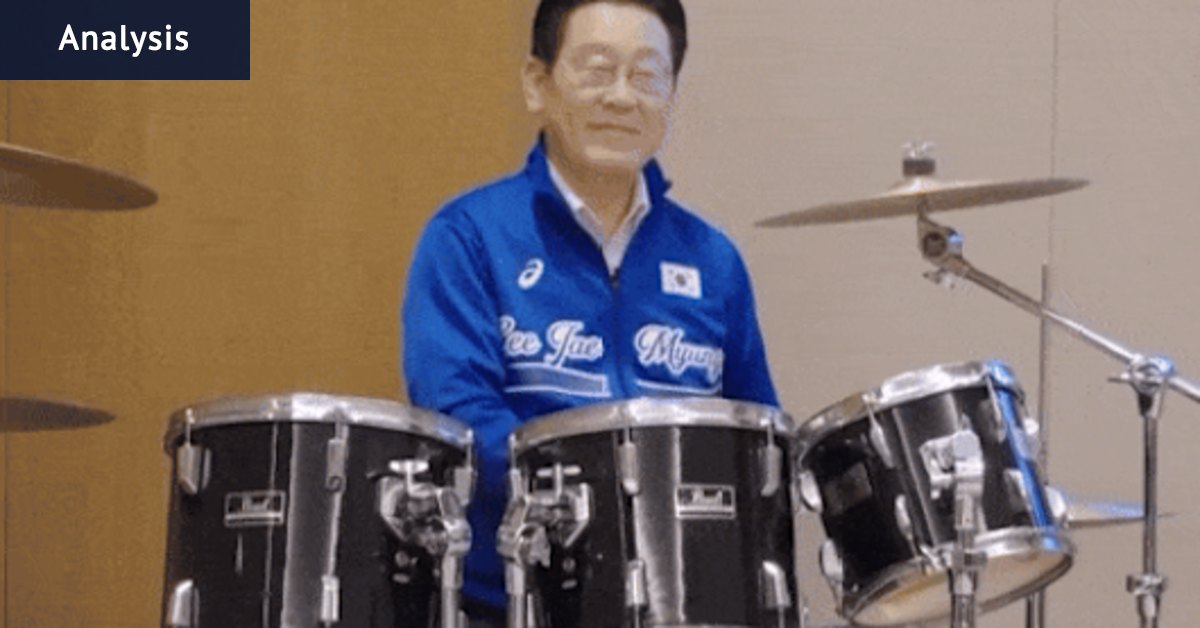
The two leaders, both relatively fresh into their posts, are navigating how to best position their countries in an increasingly turbulent international system in which the United States under President Donald Trump has become an unreliable partner, creating a vacuum for China to flex both its diplomatic outreach and muscle.
The pair make for unlikely friends. Takaichi is a hard-nosed conservative who wants to beef up Japan’s defensive posture, while Lee hails from the political left and is carving out a foreign policy strategy based on engagement with difficult neighbours in China and North Korea.
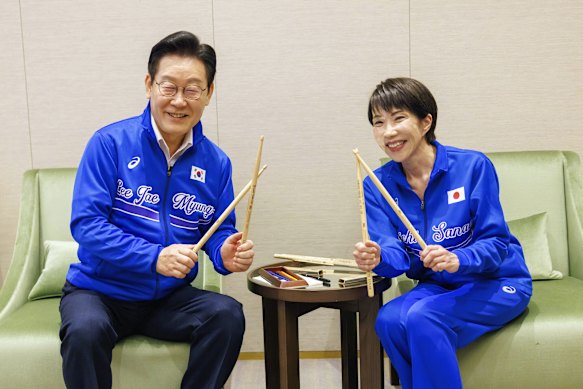
Japanese Prime Minister Sanae Takaichi (right) and South Korean President Lee Jae Myung (left) pose for a photo at their music session.Credit: AP
Japan-South Korea ties are infused with unresolved grievances, stemming back decades to Japan’s brutal occupation of the Korean Peninsula between 1910 and 1945, and the enslaving of “comfort women” by the imperial Japanese army.
But the two countries share many similarities, not least of which is that they are East Asia’s linchpin democracies allied with the US, buffeted by autocracies, and have mutual concerns about a nuclear-armed North Korea’s growing heft in an anti-democratic bloc with China and Russia.
For Takaichi, the two-day summit with Lee doubled as an opportunity to add dimension to her “Iron Lady” image, projecting herself as a friendly yet deft diplomatic player to the world and a domestic audience, both of which are accustomed to Japan’s leaders being serious men in suits.
Loading
She is widely expected to soon call a snap election for early February in a bid to capitalise on her domestic popularity and strengthen her government’s mandate, which had been crippled to minority positions in both houses of Japan’s national parliament by her predecessors.
Then there’s Beijing. Takaichi’s drum diplomacy contrasts with the belligerence Beijing has relentlessly hammered her with since November, when she canvassed the possibility that Tokyo could get involved in a military crisis over Taiwan. It has plunged Sino-Japan relations to their lowest ebb in years.
China’s latest measure to try and force a backdown from Takaichi has been to restrict Tokyo’s access to its rare earths supplies. It adds to a mounting list of coercive moves that includes warning Chinese tourists not to travel to Japan. Such bully-boy tactics may prove only to strengthen Takaichi’s support at home, and ultimately at the ballot box, by enabling her to tap into nationalistic sentiment and appear a defiant leader refusing to cower to external aggression.
China’s response “has had paradoxical short‑term effects, exacerbating Japan’s economic problems while also boosting domestic support for Takaichi’s right‑wing politics, which emphasise high military spending and surveillance and suspicion of foreigners,” Cornell University historian Kristin Roebuck says. This moment “may be the perfect time for Takaichi to hold a snap election”.
As for Lee, he is positioning South Korea as a neutral player in the China-Japan feud, while broadly looking to firm ties with Beijing after they soured under his conservative predecessor.
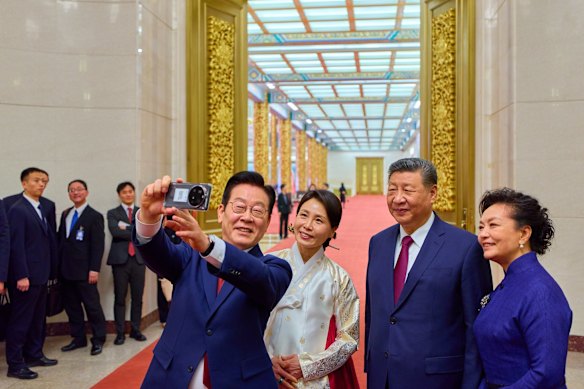
South Korean President Lee Jae Myung snaps a selfie with Chinese President Xi Jinping and their wives in the Great Hall of the People in Beijing on January 5, using the Xiaomi smartphone Xi gifted him at a summit last year. Credit: X – @Jaemyung_Lee
Not to be left behind in the performative diplomacy stakes, Lee took a selfie with Chinese leader Xi Jinping during his visit to Beijing in early January using the Xiaomi smartphone that Xi had gifted to him when the pair met at APEC.
At the October summit, Xi had joked that Lee should “check if there is a backdoor” in the phone – referring to cyber-hacking software that enables third-party monitoring – a rare public moment of levity from the Chinese president.
Loading
“It is evident that Chinese President Xi Jinping holds a very negative view of Japan’s position on the Taiwan issue,” Lee told Japanese broadcaster NHK on Monday.
“But for me, I believe this is a matter between China and Japan, and not one in which we should be deeply involved or intervene.”
Get a note directly from our foreign correspondents on what’s making headlines around the world. Sign up for our weekly What in the World newsletter.