
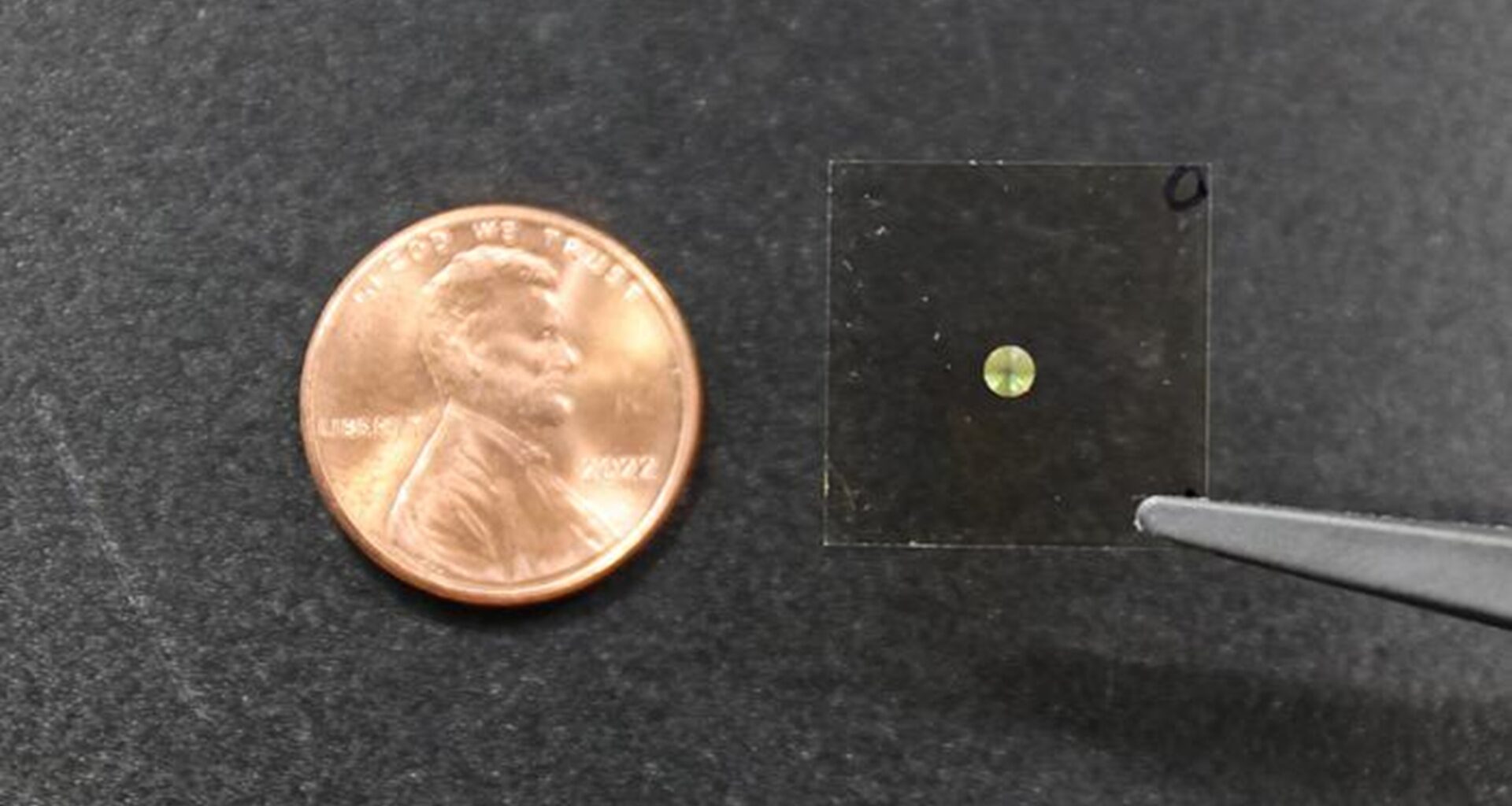
Researchers in the US have developed a new technique that could allow quantum computers to scale to well above 100,000 qubits by merging two highly powerful technologies, including optical tweezers and metasurfaces, into a single platform.
Led by Sebastian Will, PhD, and Nanfang Yu, PhD, associate physics professors at Columbia University, the team combined the two technologies to greatly expand so-called neutral-atom arrays.
Neutral-atom arrays utilize atoms trapped in place by tightly focused laser beams known as optical tweezers in 1D, 2D, or 3D configurations. They are one of the most promising platforms to create advanced quantum computers, as each atom can act as a qubit.
“We are laying critical groundwork to enable quantum computers with more than 100,000 qubits,” Will explained. The team successfully trapped 1,000 strontium atoms, confirming the approach is viable at scales far beyond today’s systems.
A new quantum approach
As each atom is fundamentally identical, there is no need for extensive calibration or synchronization, a process that becomes increasingly difficult for fabricated qubits as their numbers grow.
However, even though scientists have been trapping atoms for a decade, the main limitation until now has been controlling them on a large scale. Meanwhile, current optical tweezers rely on bulky, expensive parts such as spatial light modulators or acousto-optic deflectors, which limit the array size.
The California Institute of Technology recently reached 6,100 trapped atoms using these methods. “Their report is an amazing achievement,” Will elaborated. Still, the feat is still far short of what will be needed for practical quantum advantage.
 An illustration of a neutral-atom array.
Credit: Will Lab, Columbia University
“With our metasurface tweezer array approach, we hope to scale neutral-atom arrays even further, perhaps even beyond 100,000 atoms,” Will revealed. For the study, the team replaced those systems with metasurfaces, which are flat, ultra-thin optical devices made from millions of nanoscale “pixels.”
According to the team, when a single laser beam passes through a metasurface, the pixels shape the light into thousands (or hundreds of thousands) of tightly focused laser spots simultaneously.
“The metasurfaces used in this work can be considered a superposition of tens of thousands of flat lenses over the same plane and differing in their focal spot location,” Yu said. “Upon the incidence of a laser beam, one metasurface can simultaneously produce tens of thousands of focal spots.”
A massive advance
Made from silicon nitride and titanium dioxide, the metasurfaces can withstand extremely powerful lasers with optical intensities of more than 2000 Watts per square millimeter (W/mm2). This is approximately a million times more intense than sunlight as it reaches Earth.
“The high-power handling capability of metasurfaces coupled with the scalability of cleanroom nanofabrication of ever larger and more precise devices makes our platform uniquely capable of realizing massively scalable optical tweezer arrays,” Yuan Xu, a graduate student working on the project, noted in a statement.
The physicists demonstrated the versatility of the metasurface optical tweezer platform by trapping atoms into a number of highly uniform 2D arrays.
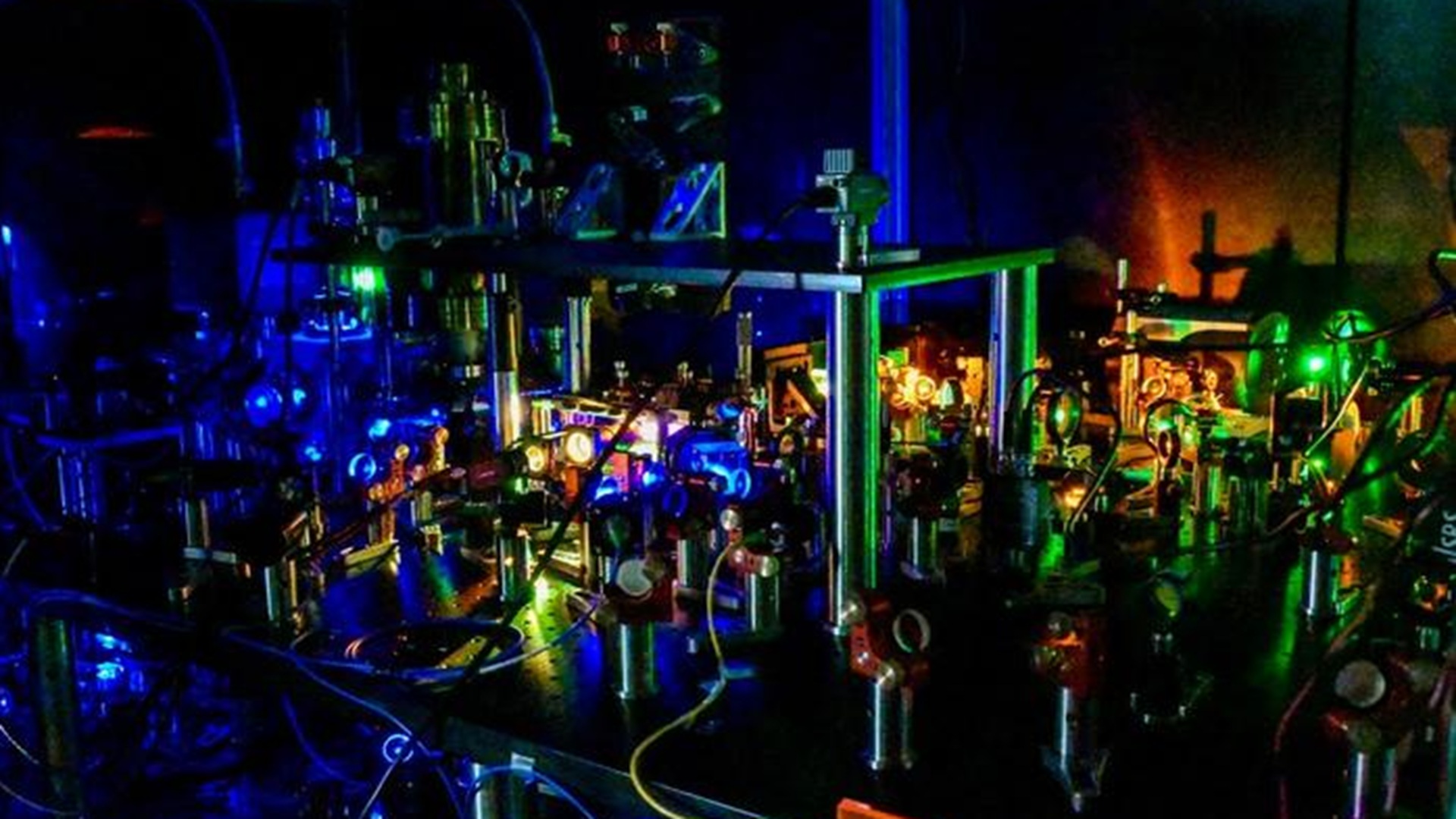 Experimental setup in which metasurface atomic tweezer arrays are created.
Credit: Will Lab, Columbia University
These patterns included a 1,024-site square lattice, quasicrystal, and Statue of Liberty patterns with hundreds of sites and a circle with atoms spaced just under 1.5 microns apart.
They also created a 3.5-millimeter-wide metasurface containing more than 100 million pixels, capable of generating a 600-by-600 array, or 360,000 optical tweezers in total. That is two orders of magnitude beyond existing technologies.
As per the researchers, neutral-atom arrays have a realistic path to scalability, with potential benefits extending beyond quantum computers to technologies such as quantum simulators and portable optical atomic clocks.
The study has been published in the journal Nature.
Based in Skopje, North Macedonia. Her work has appeared in Daily Mail, Mirror, Daily Star, Yahoo, NationalWorld, Newsweek, Press Gazette and others. She covers stories on batteries, wind energy, sustainable shipping and new discoveries. When she’s not chasing the next big science story, she’s traveling, exploring new cultures, or enjoying good food with even better wine.