
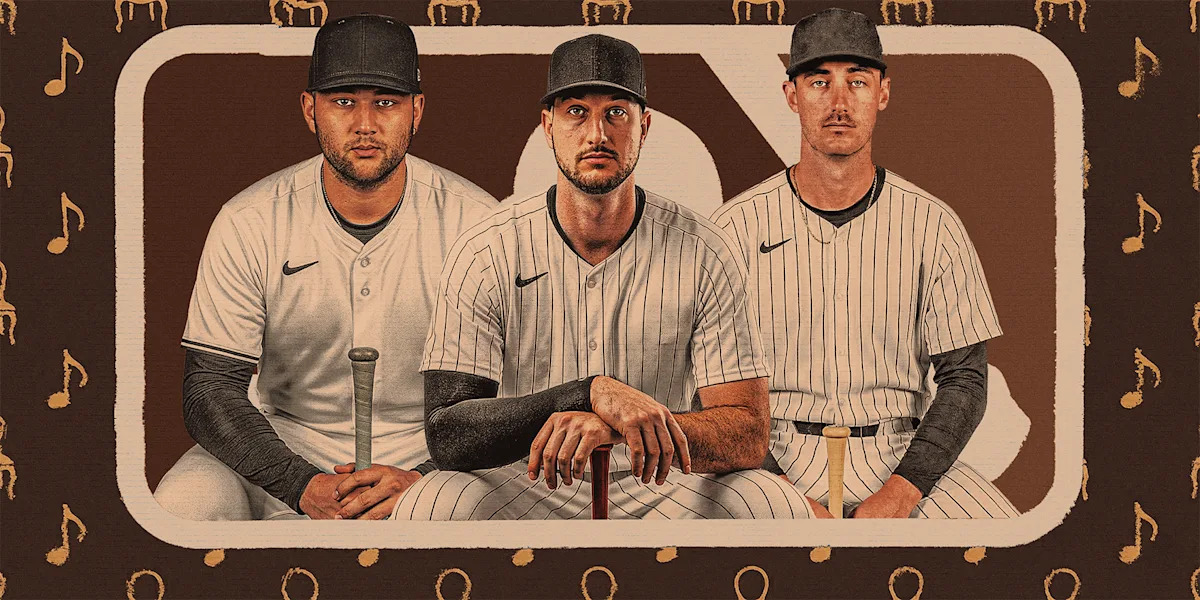
When star third baseman Alex Bregman agreed to a deal with the Cubs, he ended a weeks-long deadlock atop the free-agent hitter market. A few days later, outfielder Kyle Tucker reached a megadeal with the Dodgers, knocking this winter’s top free agent off the board.
Since sluggers Kyle Schwarber and Pete Alonso agreed to deals with the Phillies and Orioles during the winter meetings in early December, the four remaining premier free-agent bats — Bregman, Tucker, Bo Bichette and Cody Bellinger — had lingered on the open market into the new year, waiting for interested suitors to step forward with sufficient offers. The Cubs surprised many in the industry by being the first team to pounce, landing Bregman with a five-year, $175 million deal with heavy deferrals. That sparked an intriguing response from Bregman’s former team, the Red Sox, with their reported five-year, $130 million deal with left-hander Ranger Suárez.
Advertisement
Bregman’s decision — and Boston’s pivot to more pitching — offered some clarity on the priorities of the big-market teams involved, in turn providing a narrower selection of potential landing spots for Tucker, Bichette and Bellinger. Tucker clarified things further with his deal with L.A. And with pitchers and catchers scheduled to arrive at their respective complexes in Arizona and Florida in four weeks, reports indicate that we are rapidly approaching a resolution for the last two unsigned star hitters.
With that in mind, here’s the latest on each of their markets and the scenarios still in play for this high-stakes game of musical chairs.
Kyle Tucker
Unlike the ultra-hyped sweepstakes for Shohei Ohtani and Juan Soto the past two winters — both of which wrapped up by mid-December — Tucker’s free agency as the top player available plodded along without much buzz until this week. Then the news dropped that Tucker had agreed to a four-year, $240 million deal with the Dodgers. They appear to have beaten the Blue Jays and Mets for the star outfielder.
Advertisement
The Blue Jays were the first team linked to Tucker when he reportedly visited their spring training complex in Dunedin, near Tucker’s hometown of Tampa, in early December. Evidently, that was merely an initial step. But in the month-plus since, Toronto’s interest sustained, and after the Jays signed third baseman Kazuma Okamoto earlier this month, it became clearer that Toronto was prioritizing pursuing Tucker over retaining homegrown star Bo Bichette.
As Toronto loomed, the baseball world wondered if and when serious competition for Tucker would emerge. The deep-pocketed Mets and Dodgers were the obvious candidates for different reasons. The Dodgers’ outfield was a rare weak spot on their star-studded roster, and the Mets haven’t meaningfully improved their roster after a ton of high-profile exits. Still, it was unclear the lengths either club was willing to go to land Tucker.
At first, reports highlighted a basic discrepancy: Toronto was willing to offer a long-term contract, while Los Angeles and New York preferred a shorter deal with a higher average annual value. But it was not until this week that we got a better idea of just how different those offers could be. While we now know Tucker ended up with a four-year deal, including reported opt-outs after the second and third seasons, several reports indicated that the Mets offered Tucker a short-team deal of at least three years with an annual salary averaging around $50 million. It turns out he got $60 million per year in L.A. Meanwhile, ESPN’s Jeff Passan said Wednesday on Sportsnet that Toronto was willing to offer Tucker a deal as long as 10 years at a far lower AAV with a much more substantial total amount. Given such a stark difference in the structure of the offers, what Tucker chose says a lot about his priorities.
Now that he has made his decision, some key questions arise. Just how high will the payroll climb for the Dodgers? Will there be additional moves to offload other salary? Now that Tucker is headed to L.A., will the Blue Jays and Mets pivot to Bellinger? Will Toronto reengage with Bichette?
Advertisement
With Tucker off the board, the urgency for his suitors to do whatever it takes to sign one of the remaining free agents ramps up. Which brings us to …
With Kyle Tucker (center) headed to the Dodgers, Bo Bichette and Cody Bellinger — Yahoo Sports’ No. 4 and No. 7 free agents this winter — still need new teams with a month to go before spring training.
(Hassan Ahmad/Yahoo Sports)Cody Bellinger
At the outset of the offseason, there were three top-end free agents whose incumbent teams expressed strong intentions to retain them: Schwarber, Bregman and Bellinger. Bellinger is the only one who remains unsigned, but as the other two situations indicate, stated goals of keeping stars in-house don’t always come to fruition in the wild world of free agency.
In the case of Bellinger and the Yankees, it still feels more likely than not that he returns, but the negotiations seem to be at something of a standstill. The biggest sticking point appears to be the length of the deal, as Bellinger and his agent, Scott Boras, are reportedly seeking a seven-year contract, while the Yankees’ most recent offer was five years with an AAV in excess of $30 million, bringing the total north of $150 million guaranteed. That would be right in line with, if not even a bit higher than most industry projections — MLB Trade Rumors and FanGraphs’ Ben Clemens both projected five years, $140M for Bellinger; ESPN’s Kiley McDaniel had six years, $165M; The Athletic’s Tim Britton had seven years, $182M — but Boras and Bellinger evidently aren’t satisfied yet.
Advertisement
It’s unclear what would motivate the Yankees to increase their offer if their competition for Bellinger remains murky at best. This is where Tucker’s decision looms large, as it’s possible Boras was waiting for a Tucker resolution to spark added interest in Bellinger from teams that fell short with Tucker. That’s a reasonable course to take from a negotiation standpoint, but it’s also plausible that Bellinger is set on staying in the Bronx and the Yankees just need to stretch a bit further — perhaps compromise at six years — to seal the deal.
Bo Bichette
And then there’s Bo. Bichette now occupies an interesting position atop the market post-Bregman, as the number of teams that both have the spending power to land a star free-agent such as Bichette and are in the market for an infielder is surprisingly small.
Advertisement
The Red Sox looked like natural candidates to pursue Bichette after Bregman bolted, but their agreement with Suárez indicated otherwise, and at this point, Boston appears more likely to add to its offense via trade than with a high-dollar hitter in free agency. And the Sox aren’t the only team that fits that description; other contending clubs such as the Mariners, Giants, Guardians and Royals seem more focused on exploring the trade market for upgrades in the infield, with Brendan Donovan and Nico Hoerner both bandied about as potentially on the move. The Yankees have reportedly checked in on Bichette, too, perhaps as a backup plan for Bellinger, but his fit in the Bronx would require some maneuvers that don’t seem likely at this stage.
With the incumbent Blue Jays focused on adding an outfielder — infielders Ernie Clement and Andrés Giménez are both under contract for three more years, whereas there’s long-term uncertainty in the outfield, with Daulton Varsho and George Springer both slated to hit free agency after this season — a reunion with Bichette does not look especially likely, barring a drastic, late change of plans. As such, Bichette’s longstanding sentiments about wanting to stay a Blue Jay don’t seem to be reciprocated by Toronto enough to make that a reality.
Fortunately for Bichette, an attractive alternative to start a new chapter has emerged late in the process: the Philadelphia Phillies. At first glance, Philadelphia is fairly set in the infield, with superstar anchors Trea Turner and Bryce Harper flanked by Alec Bohm and Bryson Stott at third and second base, respectively. But Bohm is entering the final year of his contract, and the Phillies have been exploring trading him for quite some time. Stott, meanwhile, has blossomed into a steady presence at second for Philadelphia, but he also has experience at third, which could allow Philadelphia to sign Bichette to handle second — an expected transition off his natural shortstop — move Stott to third and trade Bohm.
Add the recent hire of Don Mattingly, with whom Bichette grew close during Mattingly’s three-year stint as Toronto’s bench coach, and Philadelphia offers a level of familiarity and comfort that other suitors cannot. Bichette and the Phillies reportedly had a productive meeting earlier this week. So barring any late entrants here, it might be just a matter of constructing an offer worthy of Bichette’s signature. President of baseball operations Dave Dombrowski usually succeeds in landing his top targets; we’ll see if Bichette becomes his latest superstar addition in a legendary front-office career chock-full of them.