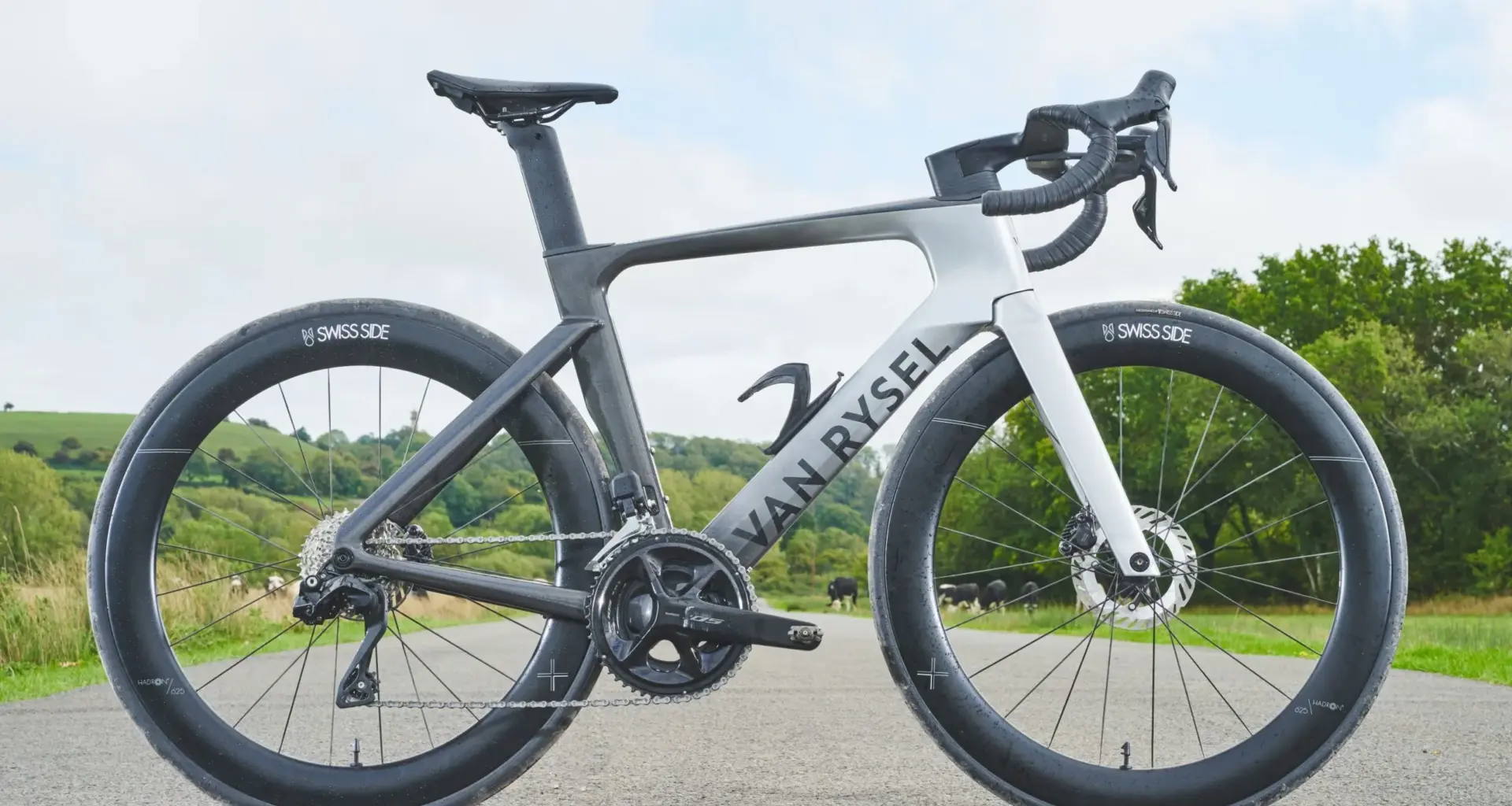
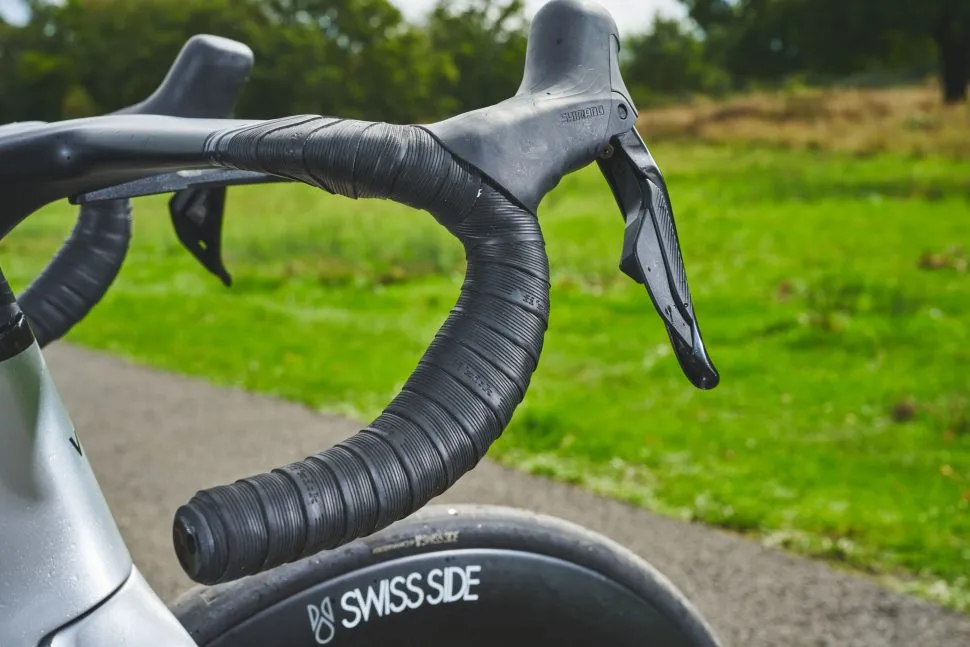
The first thing you need to know about the Van Rysel RCR-F is that it has the best-shaped drops I have ever held in my hot little hands, and likely the best drops ever made. That might seem like an odd detail to start on, but it’s so unusual to see actual innovation on one of the major contact points of a bike that it merits attention.
Developed in partnership with component maker Deda, the RCR-F’s Ergodrops look much like any other one-piece bar at a glance, but the drops themselves feature an ovalised cross-section that fits perfectly inside the hand, providing exceptional purchase. Grabbing them elicits one of those ‘why aren’t all bikes like this?’ reactions, and sets the tone for a well thought-out piece of design.
The RCR-F is Van Rysel’s full-blown WorldTour-level aero bike. It is singularly focussed on serving the needs of the Decathlon–AG2R La Mondiale team including the likes of Irish sprinter Sam Bennett and Austrian Felix Gall, who took fifth in the 2025 Tour de France.
With a primary focus on aero rather than weight, Van Rysel says the bike is best suited to race courses that climb less than 1,500m per 100km. According to road product manager Jérémie Debeuf, ‘every line of the RCR-F was drawn to reduce drag as much as possible’.

Quick Van Byke
 Joseph Branston
The RCR-F’s development included extensive CFD work, wind-tunnel time using 3D printed prototypes, and working with team riders to get real-world feedback, which Debeuf says mainly influenced the final design’s frame stiffness as well as the ergonomics and dimensions of the cockpit.
Debeuf is coy about specific comparisons to rival aero bikes, but claims that ‘it was the fastest bike in the WorldTour’ during development. He also points to independent wind-tunnel testing by Germany’s Tour Magazin, in which the RCR-F narrowly beat rivals from Canyon, Cervélo and Scott among others, coming close to achieving an all-time best performance.
 Joseph Branston
Van Rysel’s own PR focusses entirely on comparisons to the RCR-F’s counterpart, the RCR. The new bike apparently saves 13.6 watts at 45 kmh against the all-rounder, and on a hypothetical 268km race course with 2,250m of climbing – you know, just your regular Sunday club ride – you’d get to your destination one minute and 30 seconds earlier.
There are vast numbers of variables when it comes to aero comparisons and results can vary dramatically between different riders, but the RCR-F certainly does tick off every one of the modern aero bike tropes. It’s unapologetically chunky, without the gawky weirdness of bikes like the Cervélo S5, the sharp angles of Ridley’s new Noah Fast, or the sci-fi-adjacent speed hole of the Trek Madone.
 Joseph Branston
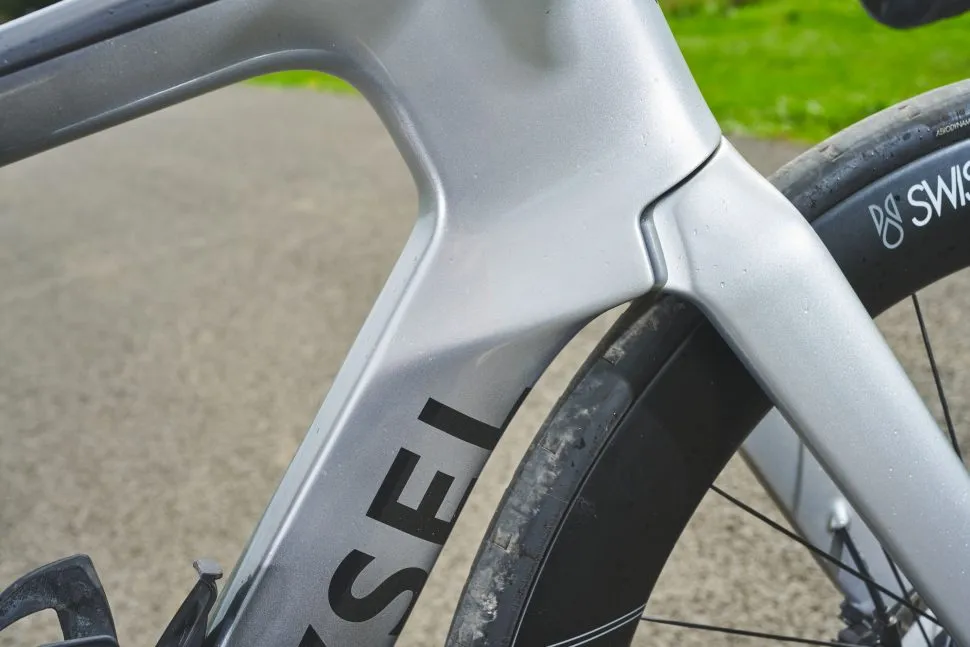
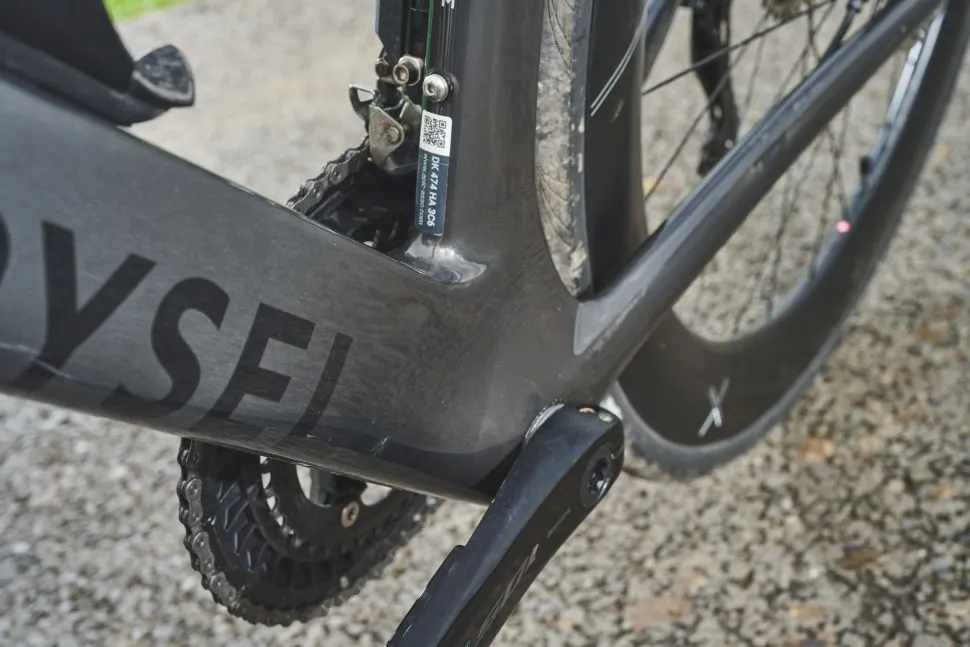
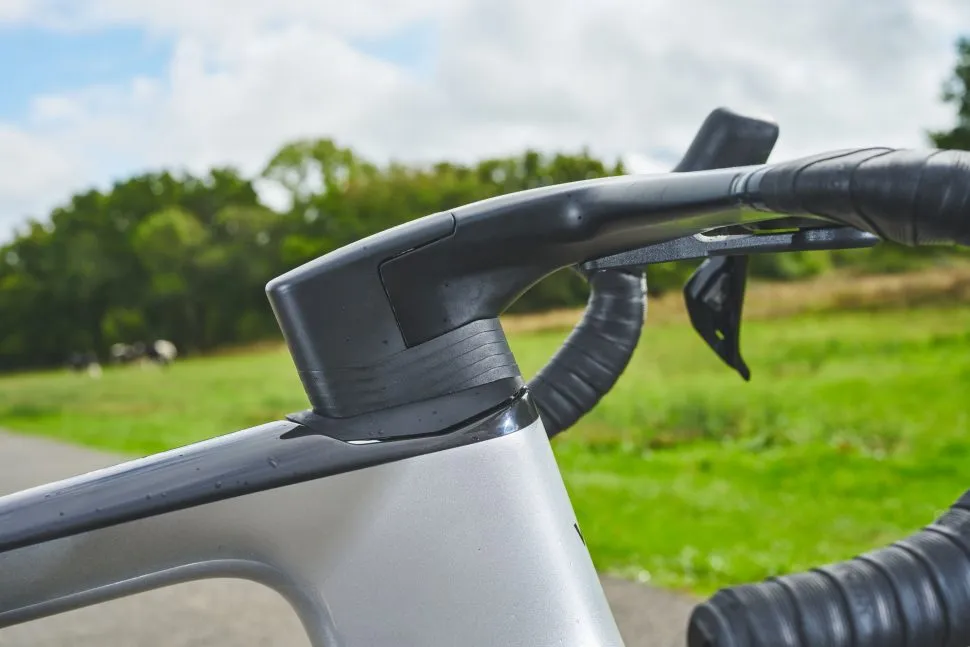
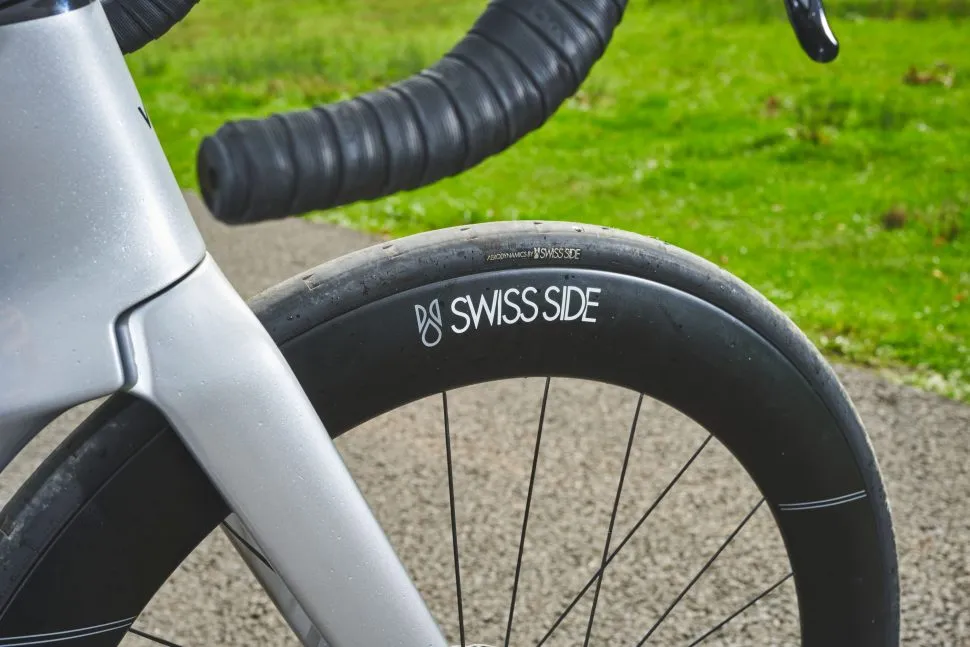
Every part of the Van Rysel seems to feature a long, slippery cross-section – the deep-but-slender fork legs, the immensely deep bar top, the substantial down tube, the seat tube and seatstays, and of course the wheels, which come courtesy of aero specialist Swiss Side.
The fork crown blends neatly with the upper end of the down tube and the immense head tube, creating a swage line effect that carries across to the top of the seatstays in an aesthetically gratifying manner.
 Joseph Branston
The integrated cockpit is well executed too. Its fasteners are all hidden, but removing the cover over the stem bolts involves simply turning the bar sideways to reveal a bolt on the underside of the headset top cap – clever stuff.
Of course the integration still complicates maintenance to an extent and makes fit adjustments much more involved than with a traditional setup, but that’s the case with all pure aero designs and it’s a downside go-fast riders are typically content to live with.
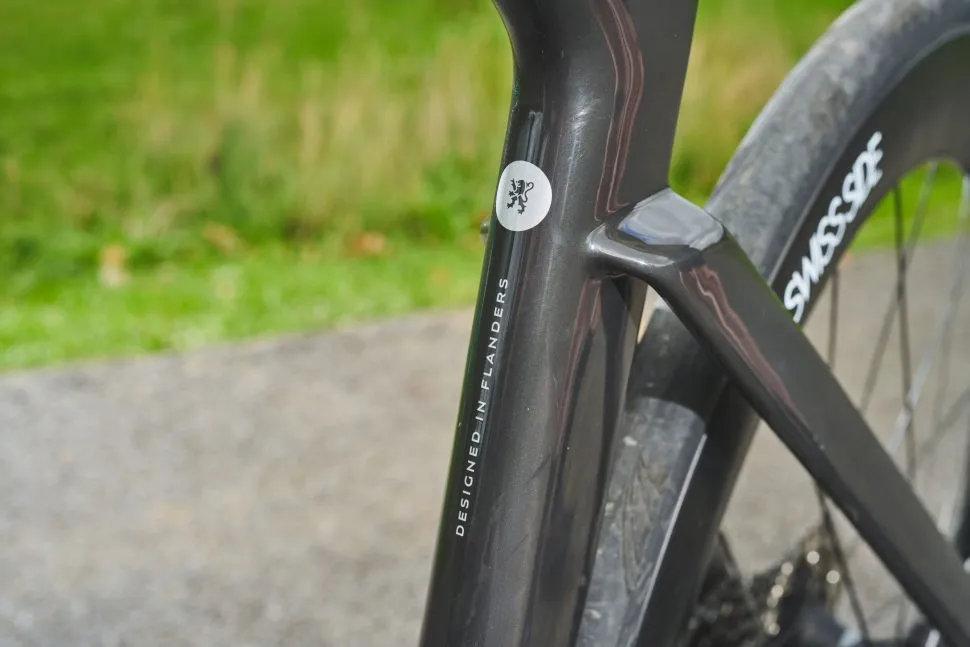
At a claimed 1,010g for a size medium, plus 490g for the fork, the RCR-F frameset is competitive on weight with other pure aero bikes like the Cervélo S5 (1,006g claimed for the frame), if a little porkier than the top spec Canyon Aeroad CFR (960g claimed).
Swiss roll
 Joseph Branston
With a full Shimano 105 Di2 groupset and Swiss Side Hadron2 625 wheels, the RCR-F weighs 8.2kg, which doesn’t sound particularly light but is on par with other mid-priced aero bikes.
There’s virtually nothing to nitpick on the spec, save to highlight that the wheels are actually an older model – they launched circa four years ago – and their internal width of 20mm is a tad stingy by current metrics (Debeuf says he chose ‘the fastest wheels’, without elaborating). Van Rysel has specced the 28mm Continental Grand Prix 5000 S TR tyre on the rear – fine and normal – but the front is the quirky Conti Aero 111 in 26mm, a tyre that features a unique drag-reducing tread pattern developed in partnership with Swiss Side.
Surprisingly, given the connection with the wheel maker, the tyre actually measures up slightly narrower than its nominal width on the Swiss Side rim. No doubt there’s a marginal aero gain here – but like most road riders these days I’d prefer at least a 28.
Riding the Van Rysel RCR-F
 Joseph Branston
Van Rysel says it ‘designed the RCR-F to naturally promote an optimal posture, combining aerodynamics and comfort during effort’. It shows. As well as a fairly low stack and long reach (535mm and 392mm respectively on a medium), that handlebar favours a sustained aero tuck with horizontal forearms and hands canted inwards.
The nominal bar width of 420mm sounds huge on paper, but that’s the measurement across the tips of the drops. The centre-to-centre measure where your hands rest on the hoods is around 350mm, making for a narrow but surprisingly comfortable riding position that feels purposeful and efficient on flat and rolling terrain.
 Joseph Branston
This is a bike that wants to be ridden quickly and feels right when you do. It’s firm without being punishing, and stiff without quite matching the extraordinary unyielding solidity under pedalling of bikes like the Specialized Tarmac or Pinarello Dogma F. Nevertheless, it still offers a spirited climbing experience despite not being especially feathery.
While you’ll go fastest by spending most of your time on the hoods, those funky profiled drops are truly a delight for sprinting and descending, fitting in the hand like no bar I’ve ridden before. It’s such a simple thing, but so noticeable compared to a conventional round cross-section design.
Van Rysel RCR-F review verdict
 Joseph Branston
Van Rysel’s biggest problem is the Canyon Aeroad CF SLX, which in the closest comparable spec (105 Di2, DT Swiss carbon aero wheels) is £800 cheaper than the RCR-F at the time of writing. The Canyon’s wheels are a couple of millimetres wider internally, making them better suited to bigger tyres, and the Aeroad is also lighter than the RCR-F and likely to hold its value better too, if that matters. Saying all that, there’s some evidence to suggest the Van Rysel might be faster in the real world, although as ever we’re talking about minute differences and your precise setup will determine whether or not that’s the case for you.
There’s one unique selling point the RCR-F definitely has in its favour – it’s closer to the bike the pros actually ride. Where Canyon, and indeed most of the competition, give their mid-range models a detuned frame with heavier layups, the 105-equipped Van Rysel on test here has exactly the same frameset as the top-spec Dura-Ace model, but costs half as much. In a world where electronic shifting has obliterated meaningful differences between groupsets that go beyond counting grams, that looks like a bit of a bargain.
However you slice it, the RCR-F is a seriously quick bike that hits its marks and has a true pro pedigree. It’s ready to race out of the box and riders who regularly pin on a number will love it. Oh and the bar is phenomenal, did I mention that?
The reviewed spec
Model: Van Rysel RCR-F Pro 105
Price: £5,000
Weight: 8.2kg (medium)
Groupset: Shimano 105 Di2
Wheels: Swiss Side Hadron 2 625
Tyres: Continental Grand Prix 5000 S TR 28mm rear, Continental Aero 111 26mm front
Bar/stem: Van Rysel Ergodrops
Seatpost: Van Rysel RCR-F
Saddle: Van Rysel Road
Buy now: decathlon.co.uk