
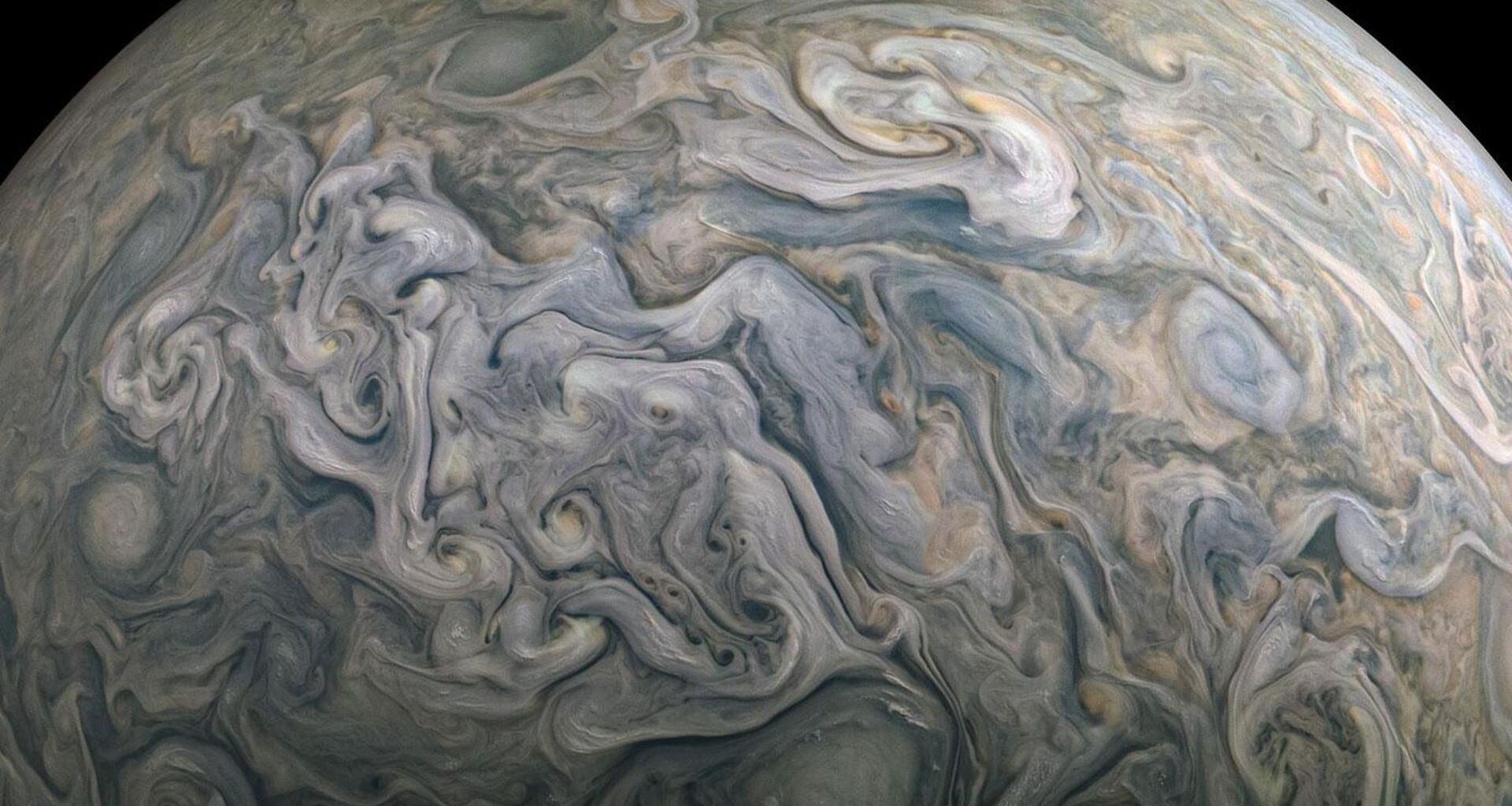
Deep beneath Jupiter’s stormy skies lies a crucial clue to how all the planets in our solar system formed.
In a new study, scientists used advanced computer models to peer beneath Jupiter’s dense swirling cloud tops and tackle a question that has lingered for decades: How much oxygen does the gas giant actually contain? The study suggests that Jupiter holds about one and a half times more oxygen than the sun, helping explain not only the gas giant’s origins, but also the early history of the solar system.
You may like
Observations dating back more than 360 years show that Jupiter’s skies are dominated by immense, long-lasting storms, including the iconic Great Red Spot, which is bigger than Earth. However, directly measuring Jupiter’s deep atmosphere is extremely difficult. Spacecraft like NASA’s Juno mission can probe the planet’s gravity and magnetic fields, while past missions have sampled only the uppermost layers of gas. But oxygen on Jupiter is mostly locked away in water, which condenses deep below the visible clouds, far beyond the reach of instruments in orbit around the gas giant.
To get around that problem, researchers from the University of Chicago and NASA’s Jet Propulsion Laboratory developed the most detailed simulations yet of Jupiter’s interior atmosphere. Their models combine atmospheric chemistry with hydrodynamics, tracking not just which molecules are present but how gases and cloud particles move through the planet over time.
That combination turned out to be key. Earlier studies often treated chemistry and atmospheric motion separately, leading to wildly different estimates of Jupiter’s water and oxygen content. By modeling both together, the new analysis shows how water vapor, clouds and chemical reactions interact as material slowly circulates from deep, hot layers to cooler higher altitudes, according to the statement.
The results point to a Jupiter that has about 1.5 times more oxygen than the sun. That finding supports formation models in which Jupiter grew by accreting icy material early in the solar system’s history, likely near or beyond the so-called snow line, where water ice was abundant. Forming so far from the sun’s warmth would have allowed Jupiter to naturally incorporate more oxygen-rich material locked in frozen water than the sun itself.
The simulations also suggest Jupiter’s deep atmospheric circulation is slower than previously assumed, with gases taking weeks — not hours — to move between layers. That insight could reshape scientists’ understanding of how heat, storms and chemistry interact inside the planet.
Planets preserve chemical fingerprints of the environments in which they formed, making them time capsules of planetary history. Understanding which conditions give rise to different kinds of planets not only clarifies the solar system’s evolution, but also helps guide the search for habitable worlds beyond our own.
Their findings were published Jan 8 in the Planetary Science Journal.