
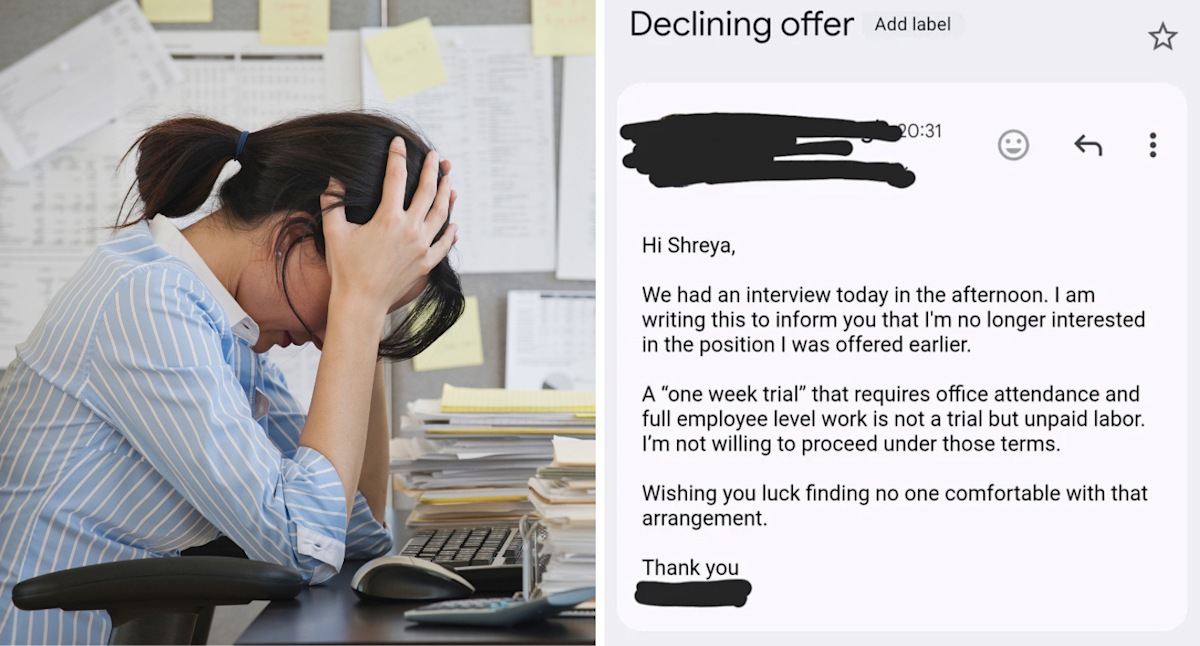
 Trial interviews are designed to test applicants and gauge their suitability for the role, but they’ve received backlash from some job seekers online. (Source: Getty/Reddit)
A controversial job interview request is set to become more commonplace across a range of industries in Australia in the coming years. Trial interviews are already widely accepted in the hospitality industry, where prospective employees come in for a trial shift before they are offered the job.
It’s designed to put applicants to the test and gauge their suitability for the role. While it’s already a popular practice among tech firms in the US, the concept of a “72-hour job interview” where people come in for three (or even five days) in the office is now happening in Australia.
Recruitment expert Roxanne Calder told Yahoo Finance she has seen trial interviews popping up in the tech space. Other industries like operations, engineering and marketing have also already jumped on the trend.
RELATED
“People will do this. Of course they will, because they’ll be attempting anything to fix their recruitment issues or their retention issues or their skills issues, and they’ll potentially look at this,” the EST10 recruitment agency founder said.
An AI start-up in Sydney, for example, recently had a worker complete three to four traditional interviews followed by a 72-hour trial.
The trial involved the worker being given a brief for a project that involved creating a new AI product line, marketing it and getting the first customer. He successfully landed the job afterwards.
Do you have a story to share? Contact tamika.seeto@yahooinc.com
While trial interviews can work in the hospitality industry due to the casual nature of the workforce, Calder said applying it to white-collar, knowledge workforces would prove more challenging.
“When you’ve got unemployment levels at the levels that we’re at, and when you’ve got a skills shortage, your skilled worker who’s interviewing with you is likely employed, so how are you going to do a trial?” she said.
“One, they’ll need to take annual leave. Two, they’re probably in breach of their contract if they did that. There are some real complications with trying to do this.”
Trial interviews have already raised eyebrows from job applicants globally.
One job seeker recently went viral after they were told during a job interview that they would need to complete a one-week unpaid trial in order to secure the job.
They immediately withdrew their application.
Story Continues
“A ‘one week trial’ that requires office attendance and full employee level work is not a trial but unpaid labour. I am not willing to proceed under those terms,” the worker shared on social media.
Commenters called it a “red flag”, with one calling the request for the unpaid trial “ridiculous” and another “insulting”.
Recruitment expert Roxanne Calder believes trial interviews with become more common in Australia, but raised doubts about whether they are good idea. (Source: Supplied)
While it’s unclear where in the world the worker was located, in Australia, Calder said the majority of trial interviews she’d seen so far had been paid.
“But it depends on the circumstances. So if it’s seen as an extension of the interview, then it’s not a paid circumstance,” she said.
“If it’s, we think we’re going to hire you and we want you to come in and work with us and you’re actually adding some value in the workplace for us, then it is paid.”
Fair Work notes unpaid work trials may be unlawful where it isn’t necessary to demonstrate the skills required for the job, or has continued for longer than is actually needed; where it involves more than just demonstrating the person’s skills; and where the person is not under direct supervision for the trial.
“I would hasten to advise any companies that are looking to do that over a longer period of time that you would want to pay whoever is coming in,” Calder said.
Calder said trial interviews could have advantages for some sectors, such as hospitality, but she believes the extension to other sectors will ultimately be a “fad”.
“When you dig further and put it into knowledge workers, it is very hard for you to judge someone in one day or in five days. I don’t believe that you can really see that,” she said.
The method also puts anxiety and pressure on applicants, as employers are “putting the spotlight” on applicants to perform with no guarantee of a job at the end of it.
“I think it’s a little bit one-sided, because all of the anxiety or fear sits with the person who’s coming in for the whole day, the whole week, whatever that might be,” Calder said.
“I don’t know that it gets the best out of the person that you’re looking to hire … I think you’ve got to be really clear on what you’re looking for and what you’re trying to achieve by using this model.
“It has a place. I just don’t think it’s as clear-cut as what people think it is.”
Get the latest Yahoo Finance news – follow us on Facebook, LinkedIn and Instagram.