
Mark Savage Music Correspondent
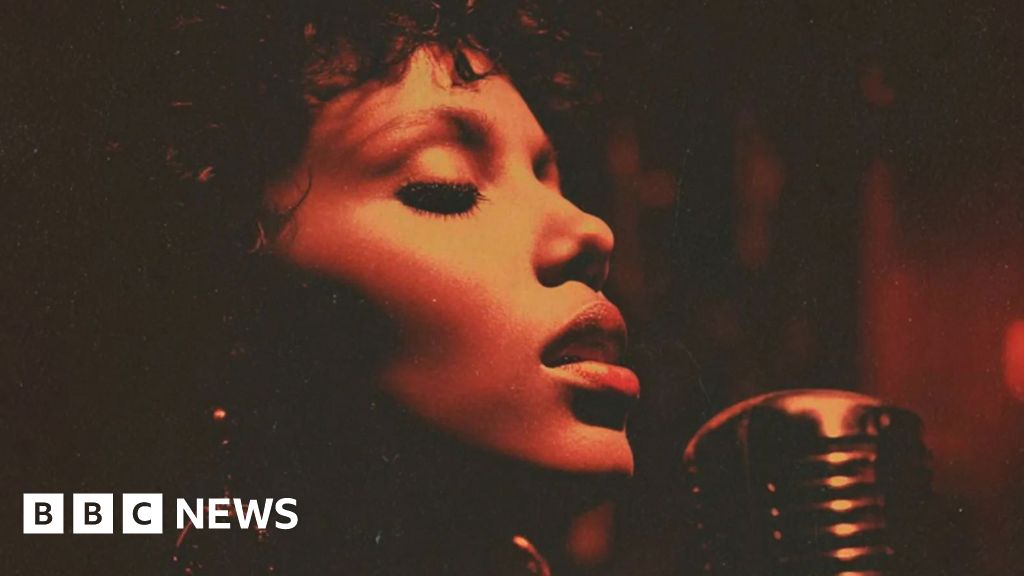
 Sienna Rose

Sienna Rose has almost three million monthly listeners on Spotify
Sienna Rose is having a good month.
Three of her dusky, jazz-infused soul songs are in Spotify’s Viral Top 50. The most popular, a dreamy ballad called Into The Blue, has been played more than five million times.
If she continues on this trajectory, Rose could become one of the year’s hottest new stars.
There’s only one problem: All the signs indicate she’s not real.
Streaming service Deezer, which has developed tools to tackle AI music, told the BBC that “many of her albums and songs on the platform are detected and flagged” as computer generated.
Look closer and you’ll see the indications of an AI artist. Rose has no social media presence, has never played a gig, has no videos, and has released an improbable number of songs in a short space of time.
Between 28 September and 5 December, she uploaded at least 45 tracks to streaming services. Even Prince, an artist known for restless creative mania, would have struggled to match that figure.
Her Instagram account, which is currently deactivated, featured a strangely homogenous series of headshots, all showing the gauzy, unreal lighting that’s characteristic of AI image generators.
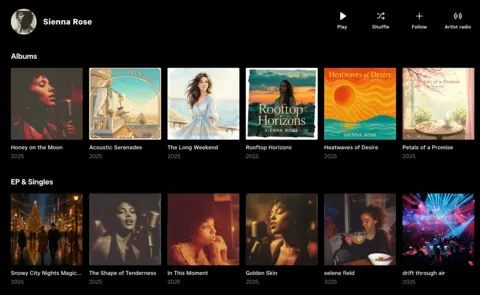 Tidal
Tidal
On streaming service Tidal, Rose is also credited with albums of folk and ambient music, all uploaded last year, with different singers pictured in the artwork
Then there’s the music itself. Songs like Into The Blue and Breathe Again sit neatly next to Norah Jones or Alicia Keys, full of jazzy guitar lines and buttery smooth vocals.
But many listeners have noted what they have identified as “AI artefacts”.
Play Under The Rain or Breathe Again and you’ll hear a telltale hiss running throughout the tracks.
That’s a common trait of music generated on apps like Suno and Udio – partly because of the way they start with white noise and gradually refine it until it resembles music.
It’s this quirk that enables Deezer to flag AI songs.
“When the [software] adds all the layers and the instruments, it introduces errors,” explains Gabriel Meseguer-Brocal, a senior research scientist for the streaming company.
“They’re not perceptual, we cannot listen to them, but they’re easy to spot if you do a few mathematical operations.”
The errors act like a fingerprint, Meseguer-Brocal says, with a “unique signature” that means it’s possible to detect which piece of software was used to create any piece of music.
 Sienna Rose
The mystery surrounding the singer poses bigger questions around AI-generated music
For casual listeners, there are other signs: Inconsistent drum patterns, bland lyrics, and a singer who never strays from the melody or lets rip on the final chorus.
That “generic” sound has been the biggest clue for some of Sienna Rose’s listeners.
“I was like, ‘I like this’, but there was something that was very ‘uncanny valley’,” said TikTok music critic Elosi57.
“So I went to look [at her profile] and I was like, ‘This is AI’.”
Another user posted on X: “Started listening to Olivia Dean (fantastic). Within two days Spotify recommended Sienna Rose, who has a similar, but more generic sound. Took me a few songs to realise she’s AI.”
Broadcaster Gemma Cairney told BBC Radio 4: “The photographs of her do look a little bit unreal… And having listened to the music, is there just some of the soul in the soul missing?”
To be fair, many others have fallen for Rose’s songs.
Among them is pop star Selena Gomez, who used the Rose track Where Your Warmth Begins as the background for an Instagram post about Sunday’s Golden Globes.
The song was later removed when questions about Rose’s identity spread online, but Gomez’s post took interest in Rose and her identity to a new level.
And many of the listeners who’d been playing Rose’s music reacted with dismay when they learned she might not exist.
“Please tell me she’s real,” pined one on Threads.
“I’m disappointed cuz a couple of her songs came on and the music isn’t BAD,” agreed another on Bluesky. “[But] somebody said once you know then it sounds soulless’ and I agree.”
AI music ban
Of course, it’s entirely possible that everyone has got it wrong, and Sienna Rose is a real singer who shuns the limelight. Maybe she’s in witness protection. Perhaps she’s a real singer, stuck in a contractual dispute with her label, and releasing music under a pseudonym.
If so, I’m sorry. It must be crushing to have your music labelled as soulless “slop”. But that’s indicative of the problem facing the entire music industry right now.
AI software is becoming so sophisticated that clone artists are competing with genuine musicians.
In Sweden this week, a chart-topping song was banned from the charts after journalists discovered the artist behind it, Jacub, didn’t exist.
There are many people – both in tech companies and the business side of the music industry – who want to see AI succeed.
The costs of launching an act like Sienna Rose are practically zero, but her music is making an estimated £2,000 in royalties per week.
Compare that to the K-Pop industry, where labels invest an average of $1m (£750,000) per member of a girl or boy group per year, and you can see the attraction.
Interestingly, several of Rose’s songs are credited to New York indie record label Broke – who have a track record in turning viral artists like bbno$ and Ndotz into chart stars.
If you visit their website, Rose isn’t listed as one of their signings – but British dance act Haven are.
If that name rings a bell, it’s because they got into trouble late last year for creating a song using an AI clone of Jorja Smith’s voice.
Their song, Run, was removed from streaming services after record industry bodies issued takedown notices, alleging the track violated copyright – but was re-recorded with human vocals, and entered the UK Top 10 two weeks ago.
The BBC has contacted Broke to ask about their relationship with Sienna Rose, but has yet to receive a reply.
The BBC has also contacted another label, Nostalgic Records, which lists Rose on its website.
Nostalgic Records’ biography claims she is “London-based” and says she is “not just a performer, but a storyteller of the heart”.
 Reuters
The pop star Raye says fans prefer genuine, heartfelt music over computer-generated emptiness
Deezer says 34% of the songs uploaded to its streaming service – about 50,000 per day – are AI-generated.
“Eighteen months ago, it was around 5% or 6%,” says Meseguer-Brocal. “It’s kind of shocking how quickly it’s increasing.”
Still, Deezer hasn’t gone as far as online music store Bandcamp, which this week announced it was banning all AI-generated music.
In a statement, Spotify defended the presence of artists like Rose on its playlists.
“It’s not always possible to draw a simple line between ‘AI’ and ‘non-AI’ music,” a spokesperson said. “Spotify does not create or own any music, and does not promote or penalise tracks created using AI tools.”
In the meantime, a backlash against AI music is growing.
Last year, artists including Paul McCartney, Kate Bush, Damon Albarn, the Pet Shop Boys and Annie Lennox released a “silent album” protesting against companies who train their AI models on copyrighted work without permission.
Speaking at the Ivor Novello Awards in 2024, pop star Raye told me she believed fans would always choose real music over algorithmically-generated filler.
“There’s no reason to feel a threat,” she said. “I don’t write because I’m trying to be the best writer. I write because I’m trying to tell my story.
“I’m trying to lift off some weight I’ve been carrying or I’m trying to express myself and feel better.”
At the same event, Kojey Radical said he wasn’t worried about AI when he couldn’t even trust his washing machine to start at the right time.
“Why is everyone trying to make me scared of the robots?” he laughed.
“I’m not scared of the robots. I will win.”