
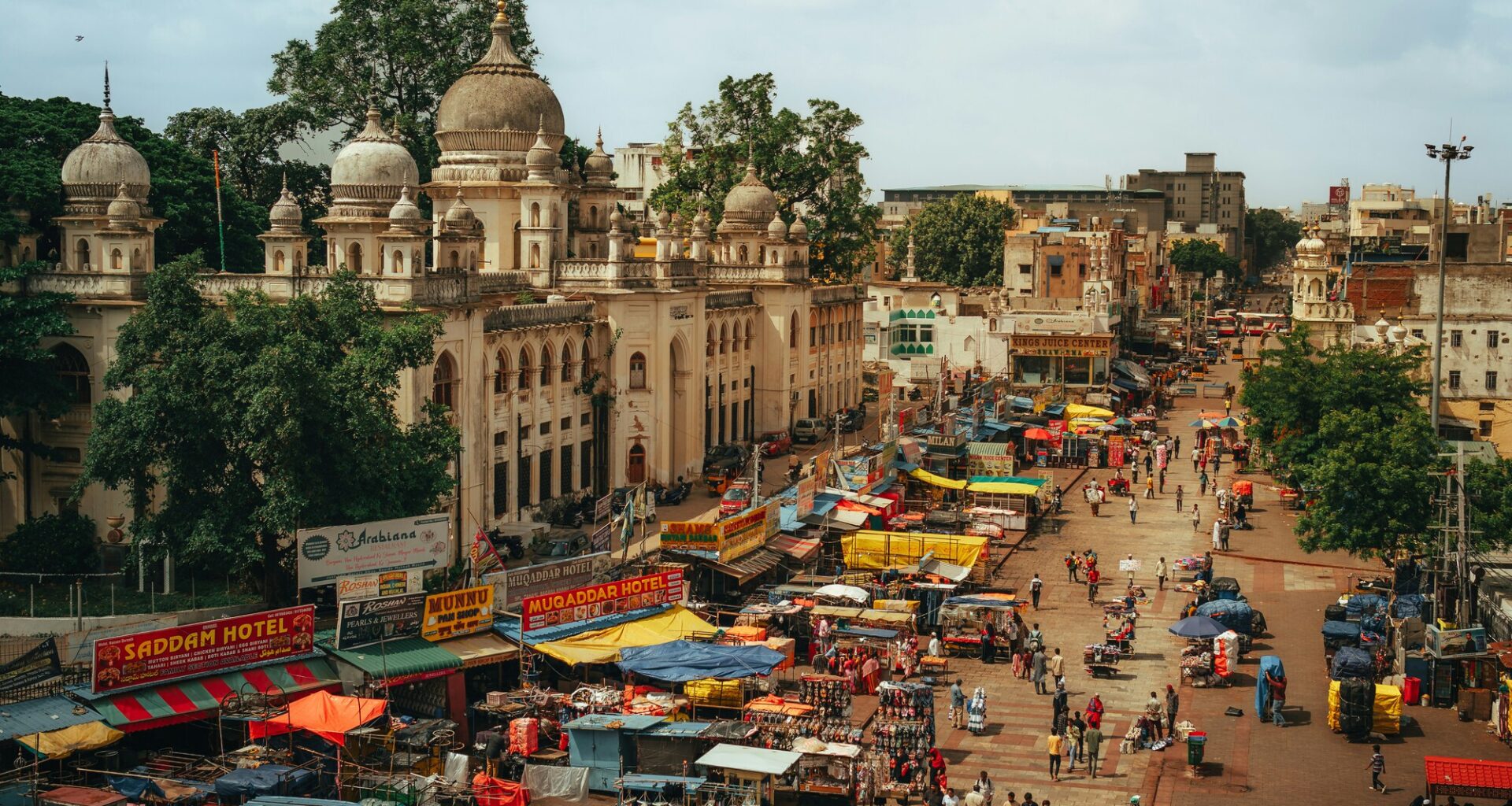
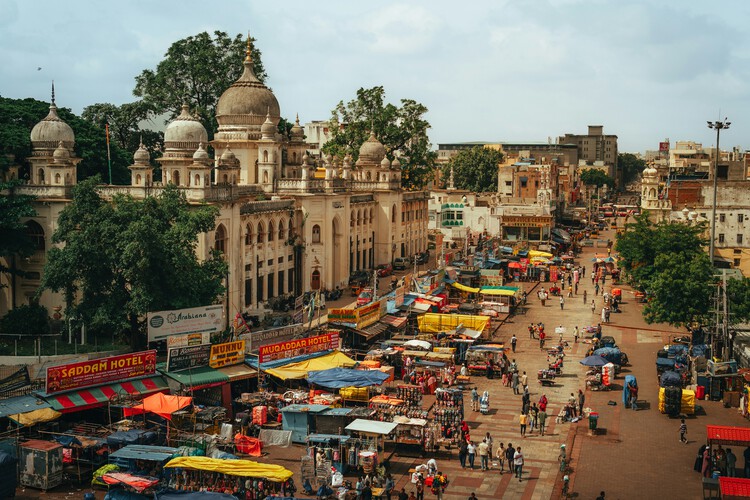
 Bazaar in Hyderabad, India. Photo by Kanishq Kancharla on Unsplash
Share
Or
https://www.archdaily.com/1037781/a-day-in-the-bazaar-when-architecture-is-observed-in-time
Architecture is most often represented as a stable object: a building captured at a moment of visual clarity, isolated from surrounding contingencies. Plans, sections, and photographs promise legibility by suspending time. Yet many of the world’s most enduring public environments resist this mode of representation altogether. They are not designed to be read instantaneously, nor do they reveal their logic through form alone. Their spatial intelligence emerges gradually, through repetition, occupation, and duration.
The bazaar belongs firmly within this category. It cannot be understood through a single drawing or a finished elevation. Its organization is not fixed but rehearsed. What sustains it is not purely architectural composition, but shared timing, collective memory, and long-standing patterns of use. Togetherness in the bazaar does not arise from formal design decisions; it is produced through repeated encounters, negotiated proximities, and social familiarity accumulated over time.



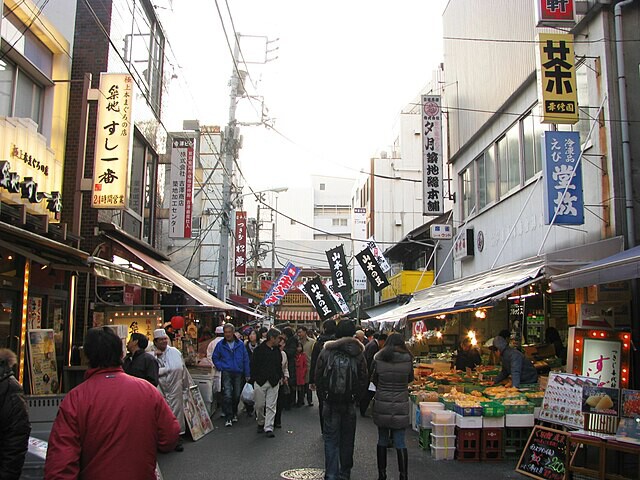 Tsukiji Outer Market – Tokyo, Japan, Photo by Aimaimyi. License Creative Commons Attribution-Share Alike 4.0 International
To observe a bazaar carefully is to recognize architecture operating as a temporal system. Markets do not function continuously in a uniform manner. They assemble, intensify, pause, transform, and dissolve, often within the span of a single day. From the midnight activity of Dadar Flower Market in Mumbai, to the early-morning precision of Tsukiji Outer Market in Tokyo, these environments are governed less by spatial enclosure than by temporal coordination.
Related Article Designing the Public Market: Architecture for Gathering, Trading, and Belonging
Regulation is achieved through repetition rather than enforcement, and wayfinding relies on familiarity rather than signage. Memory performs the role that walls and boundaries typically assume. Across the course of a day, conventional architectural tools begin to lose relevance. Plans struggle to account for movement; zoning diagrams fail to register overlap. In their place, a different form of spatial reading becomes necessary, one that recognizes time as an organizing framework and behaviour as a primary architectural material.
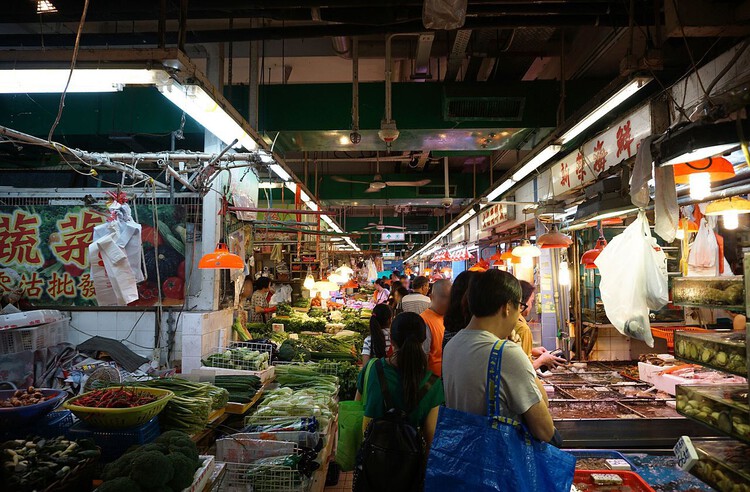 Kowloon City MSB Wet Market, Photo by Exploringlife. License Creative Commons Attribution-Share Alike 4.0 InternationalAssembly Before Visibility
Between midnight and early morning, many markets take shape beyond the attention of the city at large. At KR Flower Market, this temporal logic is inseparable from Bengaluru’s role as a regional agricultural and trading hub. Flowers arrive overnight from surrounding districts and neighbouring states, timed to meet early-morning wholesale demand while avoiding daytime congestion and heat. The market occupies a dense urban precinct, layered with transport routes, religious institutions, and long-established trading streets. Its assembly follows habit rather than formal allocation.
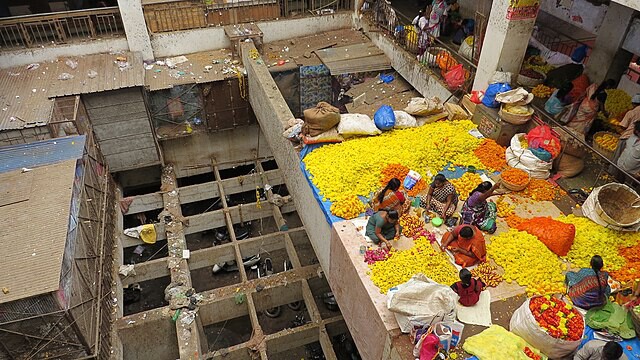 Flower-garland makers starting early – Bengaluru, India. Photo by Fi11222. License Creative Commons Attribution-Share Alike 4.0 International
Temporary surfaces are laid out. Bundles of flowers establish edges and pathways. There are few permanent stalls in the conventional architectural sense, yet spatial boundaries are clearly understood. Vendors return to the same locations each day, guided by long-standing social recognition rather than physical demarcation. Territory is maintained through continuity, not ownership. Spatial order is enforced collectively, without visible infrastructure or centralized control. In this phase, the bazaar reveals a form of architectural intelligence rarely acknowledged in formal practice: environments constructed through repetition rather than permanence, and legibility sustained through memory rather than material enclosure.
Peak Density as Calibration
By early morning, activity intensifies. Wholesale exchange, retail purchase, transport logistics, and ritual procurement converge within a tightly compressed timeframe. The market’s proximity to its surrounding commercial streets situates it within a historically layered urban fabric where trade, worship, and circulation have overlapped for generations. From an external planning perspective, the resulting density is often interpreted as congestion or disorder. On the ground, however, the space operates with notable precision. Movement follows informal protocols shaped by time of day and type of transaction. Bulk deliveries are completed before retail activity peaks.
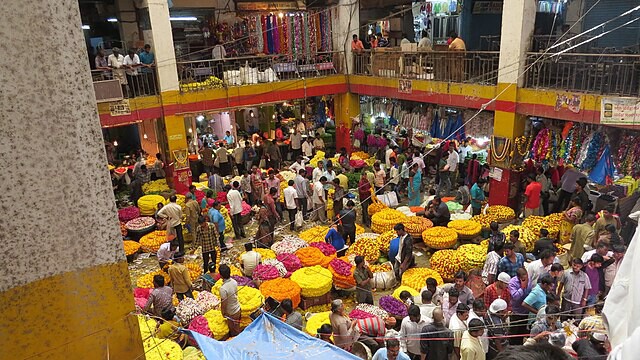 KR Market Underground level Peak Hours – Bengaluru, India, Photo by Fi11222. License Creative Commons Attribution-Share Alike 4.0 International
Pedestrian flows adjust continuously around handcarts, scooters, and porters. Certain paths widen and narrow according to volume rather than physical dimension. Thresholds shift function without architectural alteration. What appears chaotic from above operates as a calibrated system sustained through habit, familiarity, and mutual adjustment. Here, density does not signal the failure of planning, but the success of temporal sequencing. Architecture functions less as a means of separation and more as a framework that permits continuous negotiation.
Midday Slack
As the day progresses, the market’s intensity recedes. Activity slows, and the emphasis shifts from transaction to rest, maintenance, and informal social exchange. In places such as Mapusa Market, in India’s western state of Goa, this deceleration is not incidental but structural. The market’s rhythm is tied less to daily retail demand and more to weekly agricultural cycles, village schedules, and seasonal variation. Peak activity concentrates in the morning, after which the market deliberately loosens its pace.
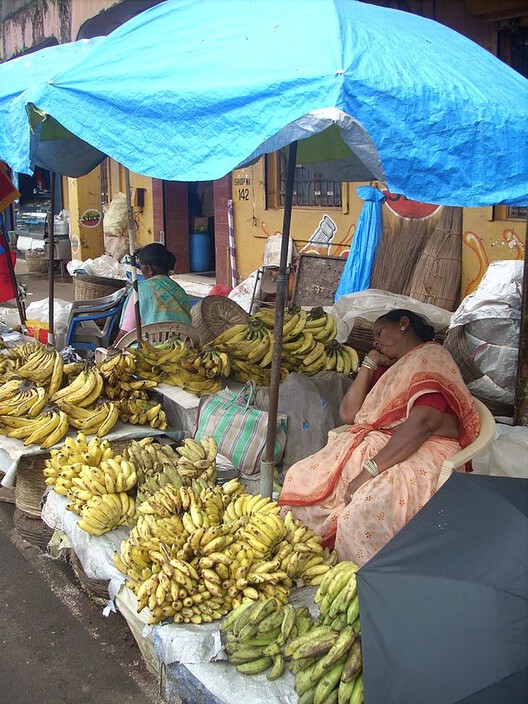 Fruit Vendors at Mapusa market in the afternoon, Photo by Fredericknoronha. License Creative Commons Attribution-Share Alike 4.0 International
During these hours, the market expands and contracts temporally rather than spatially. Built form provides shade, edges, and durable surfaces, but architectural elements recede into the background. Spatial organization is governed primarily by timing and mutual expectation. Vendors wait and goods remain in place, partially covered or loosely guarded. Conversations lengthen, shifting away from negotiation toward familiarity. Informal seating emerges where none was designed. The market continues to occupy space without actively producing material exchange. This interval is not residual or inefficient; it allows the system to recover and recalibrate. By accommodating rest alongside activity, the market sustains intensity without exhaustion. Slack becomes a form of spatial intelligence, ensuring continuity across weeks and seasons rather than maximizing output within a single moment.
Program Without Fixity
As commerce tapers toward evening, many markets undergo a gradual but profound transformation. Spaces once organized around exchange loosen into environments of public life. At Rome’s Campo de’ Fiori, the withdrawal of stalls reveals a civic plaza without requiring physical transformation. The same ground plane that supported crates, scales, and circulation routes in the morning accommodates sitting, gathering, and leisure by evening.
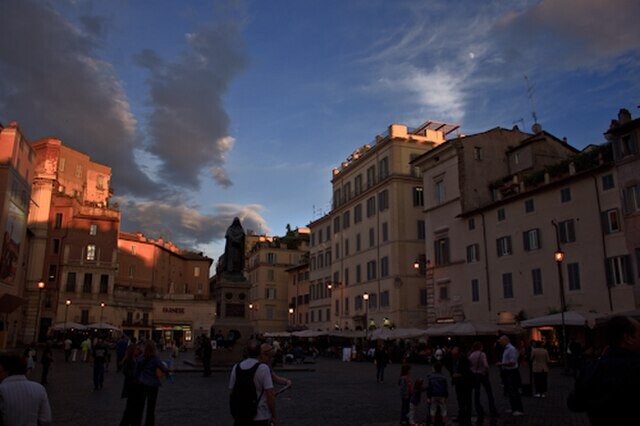 Campo de’ Fiori at Sunset, Photo by Brian Mattix. License Creative Commons Attribution-Share Alike 4.0 International
This shift occurs without architectural intervention or formal reprogramming. Program changes, but spatial memory persists. The traces of the market remain legible, even in absence. People continue to recognize where activity once occurred, orienting themselves through familiarity rather than signage or design cues. The space does not need to announce its new function; it absorbs it. The success of such environments lies not in flexibility as a designed feature, but in the absence of restriction. Architecture remains open enough to host multiple social conditions across time without asserting permanence or hierarchy. By refusing to fix use too precisely, the market enables continuity between commerce and public life, demonstrating how architecture can remain relevant by allowing programs to evolve rather than insisting on stability.
Persistence Through Rehearsal
By night, the bazaar dissolves almost entirely. Temporary structures are removed. Goods disappear. In markets such as Palermo’s Ballarò Market, as in Indian bazaars, little physical evidence remains. Yet the spatial order is not lost. It exists in collective memory, ready to be reactivated. The market does not depend on documentation or preservation. It survives through daily rehearsal. Its endurance is cultural rather than material, sustained through shared knowledge rather than architectural authorship.
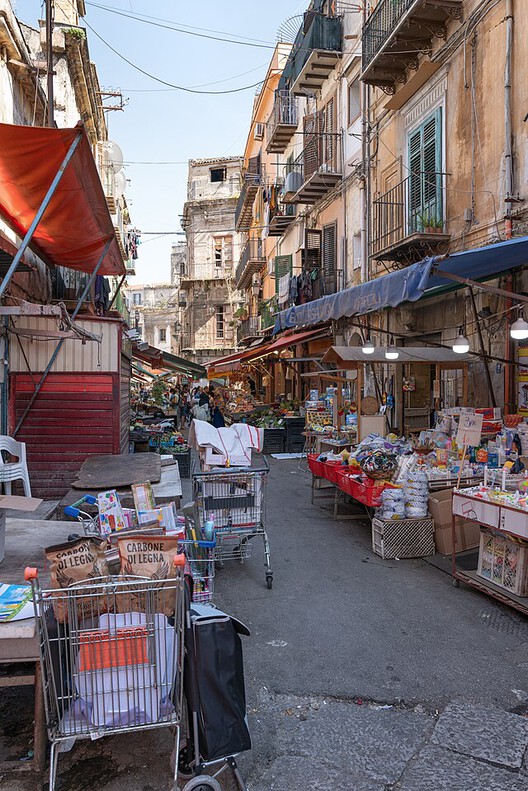 Ballarò Market – Palermo Italy, Photo by Giorgio Galeotti. License Creative Commons Attribution-Share Alike 4.0 International
Over time, the question shifts. Rather than asking how markets should be designed, it becomes more relevant to ask how markets shape spatial behaviour. The bazaar trains its participants in negotiation, timing, and coexistence. It produces togetherness not through form-making, but through sustained use. This is not an argument for romanticizing informality or ignoring the challenges these environments face. Instead, bazaars invite architecture to reconsider its modes of observation. When space operates inseparably from time, representation must account for duration, repetition, and behaviour. Plans must acknowledge sequence. Analysis must include use. The bazaar does not demand better architecture. It demands better ways of seeing architecture as it is lived.
This article is part of the ArchDaily Topic: Coming Together and the Making of Place. Every month we explore a topic in-depth through articles, interviews, news, and architecture projects. We invite you to learn more about our ArchDaily Topics. And, as always, at ArchDaily we welcome the contributions of our readers; if you want to submit an article or project, contact us.