
The history of rugby league in France includes a long and bitter battle over the right to call itself rugby at all. Now, some are suggesting it either no longer matters or could hinder future progress.
I’M always looking for expressions which can sum up the situation of rugby league in today’s France easily.
And recently, one ancient one came back to my mind; “Pax Romana” or the Roman peace.
That period of history where under the occupation of the Romans, my ancestors, the Gauls, would live under the guidance of the occupants, without necessarily losing all their customs, language or even religion. Following the rules of Rome, but being allowed to keep a part of their identity, as long as they didn’t challenge the power of Rome. Some Gauls could choose the complete assimilation and become Roman citizens and even work directly for the Roman Empire.
A period which is said to have benefited Gaul and helped her becoming the present France we know. The Gauls would never be the same according to the Romans, the victors, who wrote the history of their own conquest.
I had the opportunity to think about that recently when I listened to the French Rugby League Federation (FFR XIII) President Dominique Baloup’s interview given on Radio France Bleu, on 11th November. Among different things what he said was almost revolutionary, especially if you know the history of our game and its past fights (for example thanks to authors like Mike Rylance).
Baloup said, “The fact is that it seems to me that recovering the name rugby for our sport in the late nineties (sic) was, well, I don’t know, I’m asking myself, if it was really a good thing? Because with “Jeu à XIII”, we knew that it was different from rugby union. With “rugby”, one only talks about rugby à XV”.
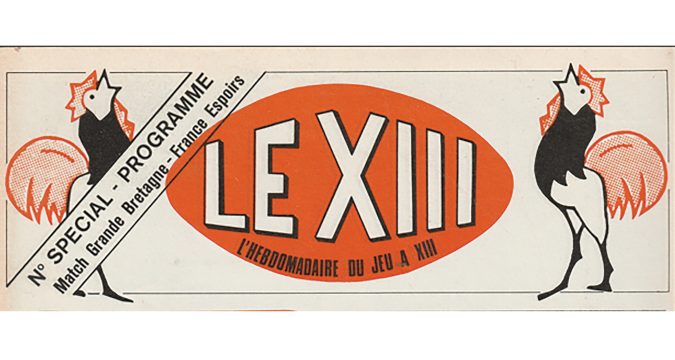
Baloup referred of course to the successful legal battle led by the Federation in the 1980s and in the early 90s. After the end of the second world war, rugby league in France lost the right to be called “rugby”. And “Jeu à XIII” (thirteen-a-side-game) was the only possible official description.
According to historians like Robert Fassollette, this issue regarding the name was to prevent Treizistes from reclaiming the properties confiscated by the Vichy regime. The “FFJXIII” (Fédération française de Jeu à XIII) had to go to court and won their case and got back the name “rugby” to the displeasure of the controversial rugby union president Albert Ferrasse.
The fight against the name “Jeu à XIII” has been an important historical marker for French rugby league for decades.
A French rugby league history which is appreciated abroad, and has brought sympathy from both the UK and Australia to our game and which also attracted some sympathy amongst the French public, even if, within the Treiziste community, some regard this remembrance as a way to deny the economic realities of sports in France. As if knowing your own history could prevent you from thinking about a strategy for rebuilding rugby league’s stature and profile in France.
Regarding Vichy, we had a first weak signal about a possible change of vision at the press launch in 2021 for France’s (subsequently withdrawn) bid to host the next Rugby League World Cup, when the then FFRX III President Luc Lacoste was questioned by a pair of Anglophone journalists.
The question in itself showed already a gap between the vision about our own history abroad and in France.
They were indeed the only ones to ask Lacoste if, for the French republic, backing the FFR XIII in the organisation of the three World Cups was some kind of compensation for Vichy’s ban of rugby league.
Even if Lacoste didn’t deny this historical period, he didn’t answer directly and he ended his answer by saying that he was the kind of person who likes to go forward without looking too much in the rear mirror.
The chairman of the World Cup organising committee was more factual underlining that the city of Vichy (head of the so-called “Etat français” during the Nazi Occupation) itself was candidate for hosting games. A way to turn the page.
We all know what happened next. France had to give up the organisation. But the words remain.
And since then, the Vichy period or even the legal fight to recover the word “rugby” are no more in the federal narrative. Whereas in fact, they were popular themes in the 90s, especially thanks to an organisation called “XIII actif”.
Therefore, Baloup’s recent comments on the matter were very interesting even if it is too soon to see if it was merely a personal comment or the confirmation of a change in communication strategy. Baloup is not just anyone in French rugby league, he’s the president of the Federation! Interestingly Lacoste, the former president, and Baloup the present one, have many points in common. They were both born in a deadly pro-union area (Gironde), they both have a past in union (Lacoste at USAP, Baloup at SC Albigeois) and probably still have connections with rugby à XV.
It has also to be noticed that there are also more and more signs of co-operation between French union and French league (joint training sessions, league clubs promoting union clubs on social media and vice versa). But one of these signs may surprise you. Before the World Cup qualifier between France and Jamaica, the Chanticleers were symbolically given their match jerseys by the famous Stade Toulousain union club coach, Ugo Mola! (funnily, Mola was also born in Gironde).
French rugby league is also in a paradoxical situation. As I have mentioned in previous articles, French RL is probably the only one in the world being covered by union magazines “Midi Olympique” and “Rugby Rama”. And the Baloup interview I mentioned above was part of a programme devoted to a south western rugby union club “100 percent UBB, l’émission”.
Are Treizistes no longer persona non grata in the union strongholds?
All this may benefit rugby league in France, as some of the union fans could be interested in watching our code. But is it at a cost of an historical “cleaning up”?
Union fans are now able to hear our history, without being alienated. They know of course about the Vichy period and not all of them are fans of Albert Ferrasse, the number one enemy of the FFJ XIII during the legal battle to recover the name “rugby”. Generations are changing too.
Yet, I am asking myself if we’re not living in some kind of “Pax Rugby-Unionis” here.
Saying that rugby union is dominating the media today in France is an understatement.
Their games are now even televised by TF1, the first free-to-air private channel in France. Guess what, they are not satisfied, targeting one of the commentators with criticism so harsh that TF1 had to come to their defence.
They do control the narrative of rugby in France. They can manage their communication.
And perhaps unlike in the UK, the social gap between union fans and league fans is closing. In the same family, you may have players (boys or girls) of both codes. Being a Treiziste today has more to do with the place where you were born or where you live, rather than your wallet.
Union players and coaches are getting more and more interested in rugby league and sometimes make discreet visits to league clubs, getting new techniques.
Hopefully, it may pay some dividend in terms of communication, or for sharing top quality training equipment? Or for social networking? Difficult today to see what French rugby union can bring to French rugby league, except maybe a little more attention? Yet, in his interview, Baloup suggested the existence of a collaboration with Ugo Mola and compared it to the one with Trent Robinson. But honestly, and my question is not rhetorical: what techniques can Mola bring to French rugby league?
Meanwhile, if coping peacefully with union presence is inevitable for French Treizistes, they may not have to abandon the stories of their previous fights to be accepted.
So, no use playing with the historical markers of our code. Especially, if they are the still the inspiration of many Treizistes.
First published in Rugby League World magazine, Issue 516 (January 2026)