


January 18, 2026 — 9:00am
Save
You have reached your maximum number of saved items.
Remove items from your saved list to add more.
Save this article for later
Add articles to your saved list and come back to them anytime.
Got it
AAA
Australia’s rooftop solar love affair has a dirty secret, with nearly 4 million discarded panels being sent into landfill every year.
But the Albanese government is now finally moving to tackle the underground waste problem with a national recycling scheme that experts say could generate billions of dollars, prevent the loss valuable materials like silver, copper, aluminium and glass, and encourage even greater uptake of solar panels in the years to come.
 Carolyn Ingvarson, pictured at her rooftop-panelled Melbourne home, says the current lack of recycling is a big barrier to many people installing panels.Luis Enrique Ascui.
The federal government has funded the first rooftop solar panel pilot recycling program, committing $24.7 million to create 100 collection sites across the country.
Solar panels soak up the sun on more than 4 million of the nation’s 11 million homes. But Carolyn Ingvarson, the deputy chairwoman of community action group Electrify Boroondara, said concerns about solar panel waste was one of the biggest barriers to greater take-up.
Related Article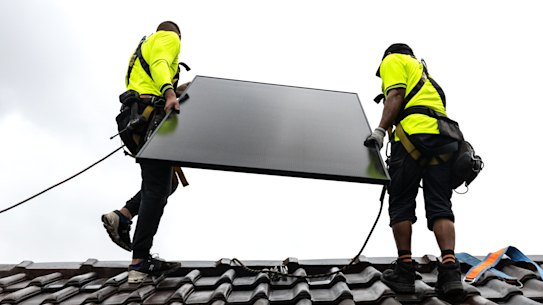
“It’s a surprisingly strong view that when people approach me about the potential for putting solar and batteries on their household, the first reaction is: ‘I wouldn’t touch solar panels because they’re a horrible thing to recycle and they do damage to the planet’,” said Ingvarson, a resident of Canterbury in Melbourne.
Ingvarson’s home has solar panels fitted, and at the age of 83, she said it was likely her 10-year-old panels would outlive her. She said it was “absolutely essential” that the government made the recycling industry viable.
“There are ways of doing this that are already known and we just need to fast track [recycling] because it’s a false fear,” she said.
“These sort of pilots are crucial for showing a way forward.”
Until recently, up to 2 million rooftop panels were shipped each year from Australia to mostly developing economies, where they were on sold. But rising transport costs and the ever-diminishing price of Chinese-made panels collapsed the reuse market.
Treasurer Jim Chalmers and Environment Minister Murray Watt announced the initiative on Friday and have begun work on a stewardship program that would force manufacturers, importers and retailers of solar panels to take responsibility for the disposal of their products.
The Smart Energy Council said that while official figures were not available, there were at least 4 million solar panels coming off rooftops and from large-scale solar farms each year – the vast majority from residential premises.
Rooftop panels can last for more than 25 years, but those that are being scrapped to landfill are an average of eight years old, as home owners upgrade their systems to the vastly more efficient and cheaper units that are now on the market.
The Productivity Commission released a report on Friday on the circular economy, outlining the opportunities to reuse materials.
Related Article
It said that the reuse market could deliver economic benefits worth $7.3 billion.
However, the commission warned that even if components like metal frames were removed and reused, nearly all old panels wound up in landfill, creating pollution risks for the water table if toxic materials leached out.
“Some [are] illegally dumped on roadsides or in bushland,” Productivity Commission said.
Smart Energy Council chief executive John Grimes said the solar industry welcomed a stewardship scheme for discarded rooftop panels.
“The 10 million people who go to sleep beneath panels each night want to know that they’ll be recycled once they reach end-of-life, or are upgraded,” he said.
“Four million panels are being decommissioned each year, but only a fraction of those are being recycled … the industry stands ready to fix the problem.”
Watt said solar panels contained materials that were too valuable to throw out.
“These materials can be repurposed to support the clean energy transition and help reduce what we send to landfill, improving out natural environment,” the environment minister said.
Energy Minister Chris Bowen said on Saturday that the government’s popular battery rebate scheme had reached the milestone of 200,000 installations since it kicked off in July, which he said would reduce demand on the power grid as people stored energy from their solar panels.
“This is great for those 200,000 Australian families. It’s also good for the grid because fewer people calling on [coal fired power plants] in the evening means that our grid is more reliable and prices are cheaper because coal and gas are the most expensive form of energy and renewables are the cheapest,” Bowen said.
The government also released the top locations for battery installations across the country. The top postcode was 2155, taking in Kellyville in northwest Sydney. Postcode 2765, around Riverstone in western Sydney, was next, followed by postcode 3029 around Hoppers Crossing in south-west Melbourne.
Get to the heart of what’s happening with climate change and the environment. Sign up for our fortnightly Environment newsletter.
Save
You have reached your maximum number of saved items.
Remove items from your saved list to add more.
 Mike Foley is the climate and energy correspondent for The Age and The Sydney Morning Herald.Connect via email.From our partners