
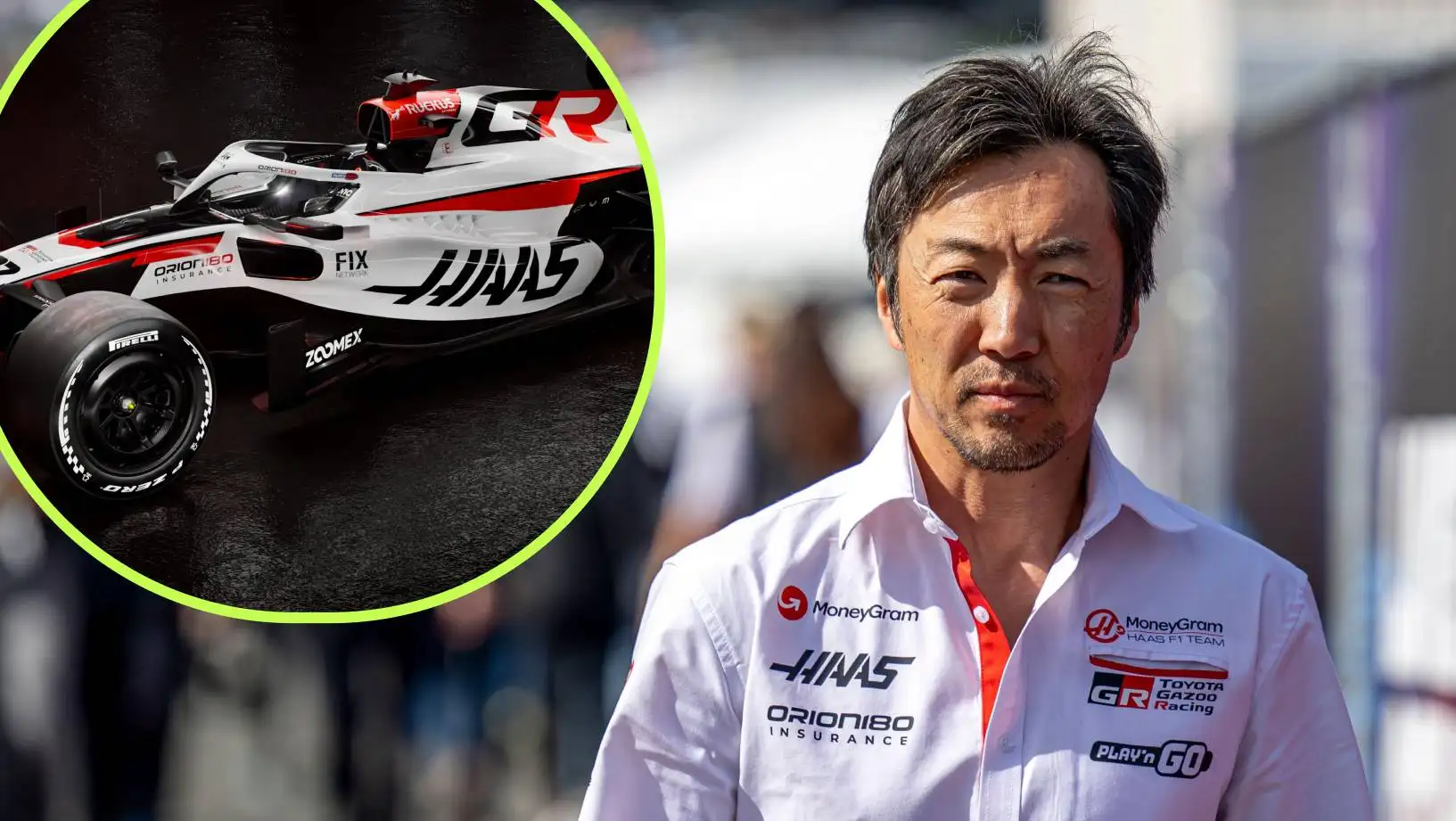
Haas’ team boss Ayao Komatsu has identified a key target for his team in the early races of the F1 2026 season.
With Formula 1 introducing revolutionary new regulations for the chassis and power units this year, getting to grips with management of the power unit will be critical to success, believes Ayao Komatsu.
Ayao Komatsu: PU energy usage will be ‘biggest thing’ during testing
Want more PlanetF1.com coverage? Add us as a preferred source on Google to your favourites list for news you can trust
F1’s launch season continued apace on Monday as Haas revealed its newlook VF-26 to follow on from the Red Bull and Racing Bulls reveals late last week.
While Audi and Cadillac have already managed to hit the track for the first time by way of using a filming day, most of the teams will wait until the first official pre-season test to shake down their new cars.
This test takes place over five days between January 26th and 30th, with all 11 teams permitted to drive on track for three of those five days.
This closed-door test is followed by two open collective tests in Bahrain in mid-February.
With a maximum of nine days testing before the first race in Australia, the teams face a steep learning curve with their brand-new machines as both chassis and power unit regulations have been completely overhauled for F1 2026.
Alongside significant chassis changes that include the introduction of active aero, the engine formula has changed to increase electrification to a near 50/50 split with the internal combustion engine, alongside the introduction of fully sustainable fuels.
While the task of creating the first power units for the new engine cycle is nearing completion, with the five power unit manufacturers required to submit homologation dossiers to the FIA by March 1st, the next challenge for the teams is in understanding how best to use the new engines and maximise energy harvesting and deployment.
This challenge, Haas‘ team boss Ayao Komatsu believes, will be a key focus for everyone during the testing programme and in the early races.
“Before we go racing, and even testing, we need to get on top of energy management, that’s the huge one,” he said in Haas’ pre-season preview.
I don’t know if we all understand the full extent of the challenge because we don’t know what we don’t know.
“For the first few races, rather than setting a sporting target, it’s more a target for us, first and foremost, get on top of PU management, then aerodynamic development.
“If we have to change direction or look at different concepts, again, we’ve got to do that promptly.
“To be able to implement certain things quickly, you’ve got to work as a team and have clarity on communication. These are things we’ve been doing the last couple of years, and that’s going to be tested even more, but I feel like we’re prepared.
“Between Barcelona shakedown week and the final Bahrain test, you will see very different cars across the grid focused on their aero package, because on the PU side of things, the hardware is pretty much set.
“How we’re going to use that PU, that’s the biggest thing. In Barcelona, everybody is going to be focused on how best to optimise energy usage, and that needs to develop very quickly for everyone.
“With aero development, we’re reasonably happy with what we’ve done so far, but as with all new regulations, the question will be, is the target we’ve set good enough? When we get testing, I’m sure we’re going to see different concepts, and if we’ve missed something, we need to get on it very quickly.”
More on F1 2026’s power units
Explained: How F1’s new ‘overtaking mode’ will work in 2026
Explained: F1’s complex power unit upgrade system
Andrea de Zordo: Regulations have changed the balance
In recent years, with power unit performance relatively equal between the manufacturers, the main competitive difference between teams has been in aerodynamic efficiency and downforce.
For 2026, however, this is likely to change, as Haas’ technical director Andrea de Zordo explained.
“For sure, the new regulations will change the balance between aero and energy management,” he said.
“Initially with the PU, as it’s all so new, there is – not necessarily more to gain, but a lot more to lose if you don’t do well. To understand how it works and how to maximise that will probably be the most important part.
“After a certain time, when drivers, teams, and also power unit suppliers learn more about this new way of racing, then gradually the performance on the energy side will converge between competitors. The main differentiator will then go back to being on the aero side, but I think initially, managing that energy side will be critical this year.”
Part of this challenge will be for the drivers to quickly get to grips with how best to manage energy recovery, and Komatsu said both Esteban Ocon and Ollie Bearman have been in the simulator to get as much learning done as possible before taking to the track.
“It’s early days, but we held a simulator session before Christmas, and we’re conducting another, more in-depth one this week,” he said.
“What the question will be for everyone is what’s possible for drivers to manage around a single lap and for a racing scenario over multiple laps, how precisely can you control various things – so that’s going to be a lot of what we’re doing in Barcelona.
“We’re definitely in the homework phase of prepping all these scenarios – and there are so many permutations – and that will be included in the sim sessions.”
Want to be the first to know exclusive information from the F1 paddock? Join our broadcast channel on WhatsApp to get the scoop on the latest developments from our team of accredited journalists.
You can also subscribe to the PlanetF1 YouTube channel for exclusive features, hear from our paddock journalists with stories from the heart of Formula 1 and much more!
Read Next: Haas unveils striking VF-26 for F1 2026 as Toyota partnership begins