
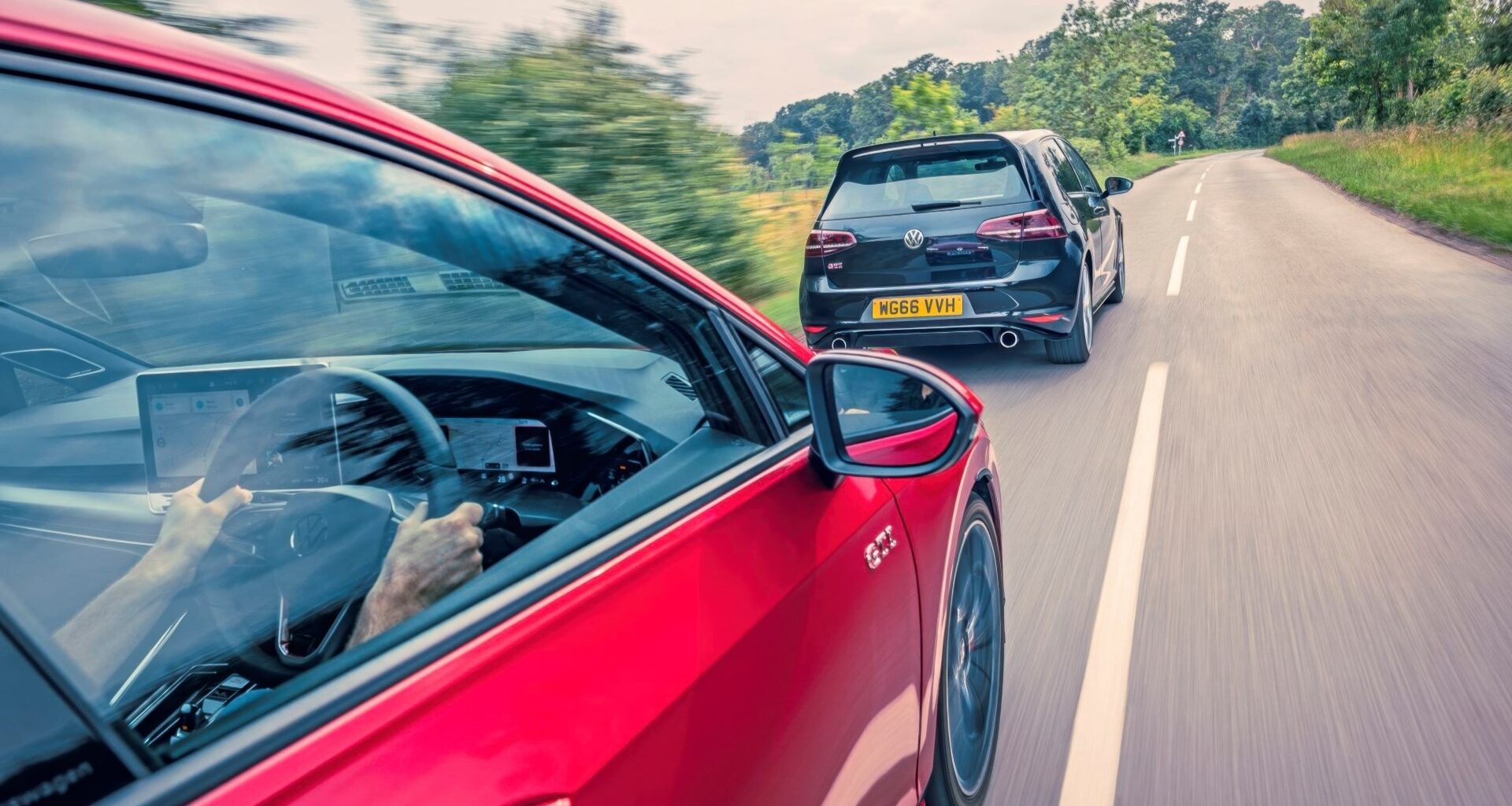
► Living with a Golf GTI Clubsport
► How does it stack up to the Mk7 Clubsport S?
► Read month 3
If you’re fond of performance Volkswagens, you’ll probably know Andrew Chapple. Andrew’s moved in VW circles since the early 2000s when he founded Volkswizard, a one-man operation that still prepares and sells mostly VW Group vehicles from a Warwickshire base, complemented by a YouTube channel. He’s appeared in CAR before, becoming one part of our ‘You Drive Our Cars’ mini feature when Jake Groves ran an Up GTI in 2019.
Years since we met, Andrew remains my go-to for VW buying advice, so when he offered up his original Mk7 Golf Clubsport S for comparison with our long-term Mk8.5 Clubsport, I suggested we connect for an evening of Golf-based chat at Caffeine & Machine.
The Clubsport S will be a decade old in 2026 and still looks fantastic when Andrew rolls up in his Deep Black Pearl Effect example, even in the elevated context of C&M machinery. Parked alongside our new Mk8.5 Clubsport, it looks restrained if purposeful, with enough visual punch to set it apart for those in the know – key telltales being 19-inch Pretoria alloys, subtle decals, and a new front bumper matched to a larger rear spoiler.
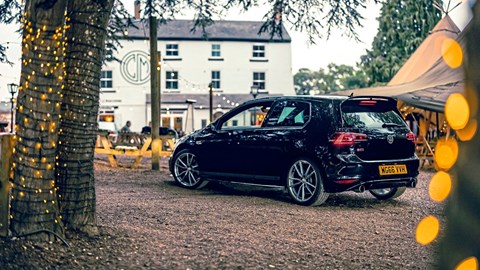
Mk7 Golfs also have the advantage of being the final generation available as a three-door, which simply looks better.
There’s real depth to this car’s engineering beyond mere details, however, helping to elevate the S above the more rounded Clubsport model it was based on. The EA888 2.0-litre turbo engine matches the same era Golf R’s 306bhp and actually beats our long-termer’s by 10bhp. It’s paired only with the six-speed manual which, a decade on, now seems oddly perverse for a track special.
Other Clubsport S highlights include an aluminium front subframe, adaptive dampers, uprated brakes, bespoke caster and camber, and unique suspension knuckles. From the factory they also wore Michelin Cup 2 tyres, though this car is on less aggressive Goodyears.
Weighing 1285kg, a Clubsport S is over 150kg lighter than our Mk8.5. There’s some generational weight gain in that, but VW did remove most things behind the Clubsport S’s driver, including rear seats, boot floor, parcel shelf and noise insulation. It all helped the Clubsport S secure a front-drive Nordschleife record of 7min 49.21sec.
Andrew hands me his keys while he heads out for a refresher in the CAR long-termer; he has previously owned a Mk8 Clubsport and driven the Mk8.5.
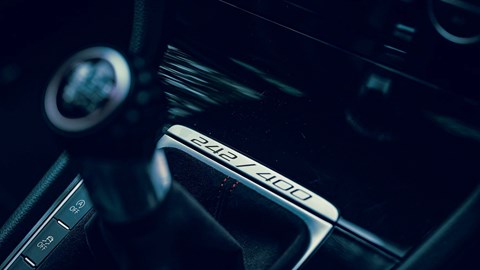
His car’s interior gets things off to a great start – you slot down into lovely fabric seats that combine relatively firm, figure-hugging bolsters with soft centres, and grip a gorgeously tactile steering-wheel rim. A usable if focused feel permeates this cabin, with only the infotainment truly dating it. A plaque above the gearlever reveals it to be number 242 of just 400 cars – 150 of which came to the UK.
On the move, the Clubsport S has energy like a pot of water just about to boil and works brilliantly on B-roads – especially with Individual mode configured to max-attack engine calibration and the most supple suspension setting.
The engine has a lovely juicy midrange, excellent throttle response, and rips round the dial in a manner that demands you chase peak rpm. An exhaust some 10mm larger as stock helps bring out more of the EA888’s fruitiness too. Gearshifts are slick, and complemented by well weighted and placed pedals, again encouraging an attacking style.
Power is nicely matched to the chassis, like performance is trying to burst from the seams while just about being contained, so that you neither crave nor need any more. The damping, too, is fantastic, giving the Clubsport S a limber stride as it compresses, extends and carves its way over this rolling landscape. Combined with a positive front end, malleable rear, and fixed-ratio steering defined by its light, natural and highly textural detail, it’s an engaging car to hustle – and yet still feels highly liveable day to day.
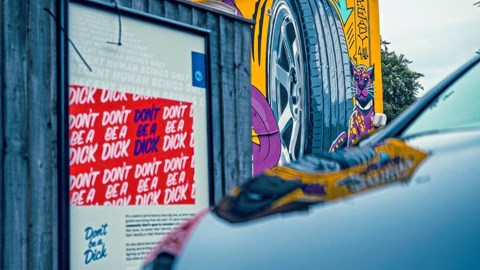
We head back to Caffeine & Machine to swap notes, with the picnic tables and stretch tents now looking particularly cosy under the creeping glow of warm yellow lighting. The car park’s also filling up with all sorts of interesting metal – a group of Aston owners, a lone Porsche 911 GT3 RS, and a retro pick-up that clunks into gear like it’s packing a sequential gearbox beneath its utilitarian bodywork. You never know round these parts.
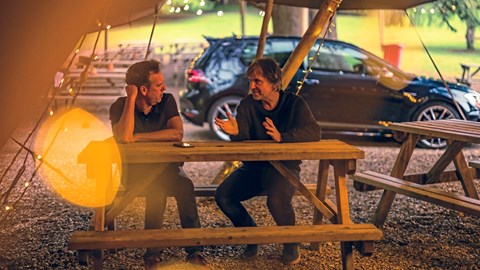
Still, both our Clubsports are drawing glances. This is Andrew’s second example, the first bought new in 2016 for £33,995 and sold for identical money nearly two years and 5000 miles later. He subsequently bought this car in 2023 for £33k with 12,000 miles on the clock. Today Ss are advertised from a low of £30k to up to high £40k for delivery-miles cars –not profitable for owners who bought new, given the cost of maintenance, ownership and inflation, notes Andrew, but a mark of the high regard in which VW enthusiasts hold them.
For Andrew, the Mk8 Golf’s lukewarm reception reminds him of his early days in business, when a significant portion of customers viewed the Mk3 as a retrograde step over the Mk2.
‘I think the Mk8 had benefits over the Mk7.5 facelift dynamically, but they tended to be ignored because of all the negatives surrounding the infotainment,’ he notes, referencing oddly unintuitive control logic (that he thinks was sometimes over-exaggerated), not to mention occasional full system crashes.
He preferred his own Mk8 Clubsport over the Mk7.5 Golf GTI TCR model (basically equivalent to a Mk7 Clubsport), finding its steering crisper and the entire car simply more capable. Besides, he notes, the glitchy infotainment appears to be remedied for 2023-on cars, possibly because of the enforced pause over semiconductor chips giving VW time to start afresh.
‘I bought my 21-plate car brand new and drove it out of the dealership with a warning on the dashboard about the parking sensors not working,’ he says. ‘But I’m getting 23-plate cars now and they’re just perfect.’ (Our Mk8.5, meanwhile, has a new and greatly improved system of its own).
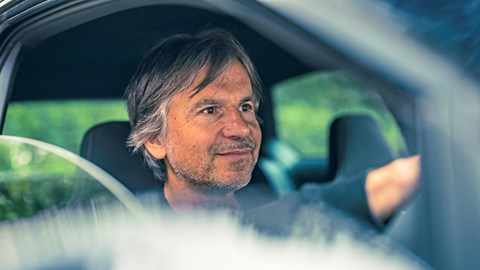
And my long-term Clubsport? ‘They’ve definitely made some steps to make it more hardcore [compared with the TCR], which has taken away some of the usability but made the car more rewarding to drive. But the suspension can be quite crashy, even in Comfort mode.’
Ah, the damping. It smooths out nicely with speed but can be tough around town. The S certainly feels more supple. Otherwise, I think our long-term Clubsport feels similarly quick to the S despite an inferior power-to-weight ratio. It’s more usable and has infinitely better infotainment. It’s also a very enjoyable car to drive, but it can’t quite match the inherent pep – both in response and agility – that defines the Clubsport S. That’s the benefit of its significantly lower weight and more focused chassis, no doubt. I also prefer the old car’s more natural steering – the variable rack in our long-termer lags before waking up.
It’s important to note that the two cars are not exactly like-for-like, a closer successor being the new Clubsport Edition 50, which adds more power and specific chassis tuning. It’s also the first hot Golf to declare a Nürburgring lap since the Clubsport S.
Perhaps tellingly, its 7min 46sec is only three seconds faster than the 2016 Clubsport S with the same driver and over the same 12.9-mile layout. Almost a decade on, the original remains a very special car. No wonder Andrew is hanging on to his.
Logbook
Price: £43,215 (£47,830 as tested)
Performance: 1984cc turbocharged four-cylinder, 296bhp, 295lb ft, 5.6sec 0-62mph, 168mph
Efficiency: 37.4mpg (official), 30.5mpg (tested), 168g/km CO2
Energy cost: 19.6p per mile
Miles this month: 2077
Total miles: 5289