
Nationals holding party room meeting amid anger over hate speech vote Tom McIlroy
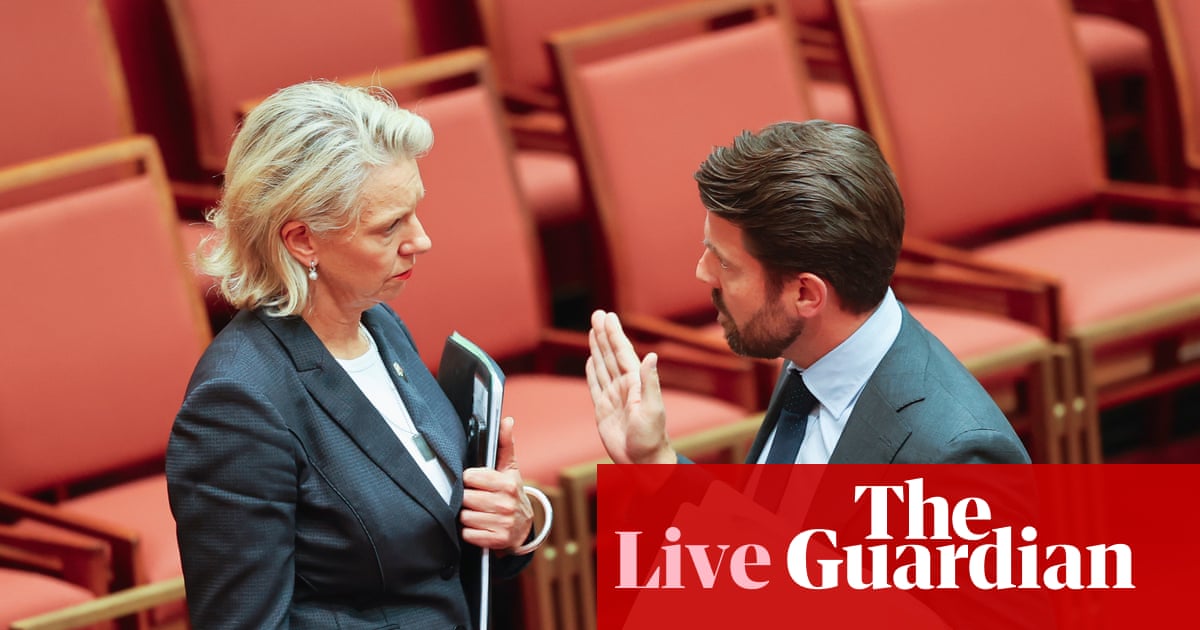
The Nationals are holding another party room meeting this morning, amid anger at a group of frontbenchers who voted against the party’s position on Labor’s hate speech bill last night.
Shadow ministers Bridget McKenzie, Susan McDonald and Ross Cadell voted against the bill, despite the opposition leader, Sussan Ley, and shadow cabinet opting to support Labor’s watered down measure.
Convention requires frontbenchers to vote in line with shadow cabinet or resign their position. It is unclear whether Ley and Nationals leader, David Littleproud, will require the three frontbenchers to resign.
Backbencher Matt Canavan voted against the bill, but he is not bound by conventions of shadow cabinet solidarity.
Some Nationals and some Liberal MPs are angry the trio defied the shadow cabinet, despite days of negotiations about Labor’s bill and amendments agreed by Ley and the Coalition.
The legislation passed the Senate 38 to 22 votes after 11pm.
Updated at 17.32 EST
Key events
Show key events only
Please turn on JavaScript to use this feature
 Krishani Dhanji
Liberal leadership meets to discuss fate of Nationals shadow ministers
The shadow minister Ross Cadell, a Nationals senator who crossed the floor last night to vote against Labor’s hate speech bill, has said he will step down “if it is so requested”.
The fate of three shadow ministers – including Caddell, Bridget McKenzie and Susan McDonald – still hangs in the balance after the National senators last night crossed the floor to vote against Labor’s hate speech bill.
The Nationals party room met this morning in Canberra, but no decision has been made on whether the three will be forced to the backbench. The decision will ultimately be made by the Coalition leader, Sussan Ley.
Ross Cadell. Photograph: Mick Tsikas/AAP
The Liberal leadership group is meeting currently where the decision could be made. The leadership group includes Jonno Duniam, who negotiated with Labor on the bill, as well as Ley’s deputy, Ted O’Brien, Senate leaders Anne Ruston and Michaelia Cash.
Speaking to Sky News, Cadell says if he survives and remains a shadow minister next week, “it is because of the understanding tolerance and leadership of Sussan Ley”:
I am willing to take my medicine.
Updated at 17.55 EST
Albanese says he’s been focused on politics at home when asked about Trump’s ‘board of peace’
The prime minister was also asked about Donald Trump’s Gaza “board of peace” invitation.
Albanese said:
We’ll give consideration to those issues in line with other countries as well, but we haven’t turned our attention to those issues. We’ve been [prioritising], I think quite rightly, on what do we need to do to keep Australians safe?
Albanese remains aloof after Morrison attacks
At the press conference earlier, Anthony Albanese said Scott Morrison is entitled to make “whatever comments he likes” after the former prime minister released a blistering statement following Albanese’s remarks in parliament this week that antisemitism didn’t start when the Labor government was elected.
Albanese said in parliament on Tuesday:
Let me be very clear. All governments should have done better … the idea that antisemitism began two years ago, with the change of government, is false… Despite the surge in antisemitism on their watch, did the Morrison government appoint a special envoy to combat antisemitism?
Morrison released his own statement later that day, saying Albanese’s remarks about his own government’s actions were a “delusional and cheap diversionary” stunt.
Updated at 17.47 EST
Nationals holding party room meeting amid anger over hate speech voteTom McIlroy
The Nationals are holding another party room meeting this morning, amid anger at a group of frontbenchers who voted against the party’s position on Labor’s hate speech bill last night.
Shadow ministers Bridget McKenzie, Susan McDonald and Ross Cadell voted against the bill, despite the opposition leader, Sussan Ley, and shadow cabinet opting to support Labor’s watered down measure.
Convention requires frontbenchers to vote in line with shadow cabinet or resign their position. It is unclear whether Ley and Nationals leader, David Littleproud, will require the three frontbenchers to resign.
Backbencher Matt Canavan voted against the bill, but he is not bound by conventions of shadow cabinet solidarity.
Some Nationals and some Liberal MPs are angry the trio defied the shadow cabinet, despite days of negotiations about Labor’s bill and amendments agreed by Ley and the Coalition.
The legislation passed the Senate 38 to 22 votes after 11pm.
Updated at 17.32 EST
PM says Australians are safer because of these bills
Albanese was asked if the bills as passed would make Australian less safe after a deal with the Coalition to see them passed.
He said that was not the case:
Australians are more safe because of these bills being carried.
The racial vilification provisions, I think were, a recommendation of the special envoy’s report. The Coalition said that they supported its adoption in full. It’s up to them to explain that contradiction.
Albanese said he hopes to see Australia come together during national day of mourning
The prime minister said tomorrow’s national day of mourning will be a moment for the country to reflect and unify, saying:
Australia was born out of an instinct to unify.
We need to come together and tomorrow will be another day in which I want to see national unity. The day of mourning will be an opportunity for all Australians to stand with those who are grieving, those who lost loved ones.
This period has been one of the most difficult in our nation’s history, coming to terms with this. We continue to take action required to keep Australians safe.
The prime minister, Anthony Albanese, is speaking in Canberra after the passage of the hate speech laws.
He said the laws were not as strong as the government initially put forward, but said the laws were “no doubt” a good thing.
Albanese said:
What we were able to do, with the support of the Greens, the strengthening of firearms laws, and with the support of the Liberals and some cross-benchers as well the strengthening on hate speech.
Not as strong as we originally put forward, but no doubt, the strongest hate laws that have ever been in place in Australia. A good thing.
Jewish body calls hate speech laws ‘step in the right direction’
The Executive Council of Australian Jewry issued a statement this morning welcoming the passage of the new hate speech laws.
The body’s president, Daniel Aghion, said the bill was “another substantial step towards achieving effective laws against the deliberate promotion of hatred of groups or individuals based on their skin colour or national or ethnic origin”.
In a statement, Aghion said:
No legislation is perfect, but the provisions of this new legislation represent a substantial achievement. The speed of its passage demonstrates that our parliament can work quickly and decisively when faced with urgent necessity and that Australia as a nation will never be dictated to by terror. …
If not addressed robustly, the problem of growing racial hatred will only get worse. Whilst the Jewish community is presently the main target, every group and every individual in society is potentially at risk in the future. We urge all parties to come together without delay to reverse this scourge.
CEO of energy company behind Eraring coal power plant says extra two years will help with ‘smooth transition’
Frank Calabria, the CEO of Origin energy, spoke with RN this morning after an announcement Australia’s largest coal-fired power plant, Eraring in New South Wales, would stay open for an additional two years until 2029.
Calabria said the extension was the result of a “lot of factors,” including engaging with the NSW government, but said the main goal was to make sure “we have a smooth transition”.
Calabria said:
A lot of good progress has been made on the transition, a lot of new infrastructure, a lot of new energy assets behind the meter. This will just enable it [to be a] smoother transition. …
We’ve made lots of investments, as you would imagine, in large batteries. We’ve got large wind farms underway, so do many other players in the sector. So we’re all aligned about making progress here.
Eraring’s coal-powered station will operate until April 2029. Photograph: mikulas1/Getty ImagesShareGreens say it would have been ‘betrayal’ to support rushed hate speech laws
David Shoebridge, the Greens’ justice spokesperson, detailed his opposition to the hate speech bill in an interview with RN this morning.
He said the party remained concerned about what groups could be targeted with the hate speech laws, saying lawmakers struggled to get answers about the bill’s scope in the short timeline before it was presented to parliament. He told RN:
This was legislation that was already extremely expansive, which already had a rushed process when it was presented as draft legislation last week. And then it got radically changed by a deal between the Coalition and Labour in the last 24 hours, substantially expanded. …
I think it would have been beyond reckless. It would have been a sort of betrayal of basic sense of democracy to ram through legislation last night with such broad-ranging impacts when every legal expert we spoke to said it was reckless and dangerous and they didn’t know the scope of it.
David Shoebridge. Photograph: Lukas Coch/AAPShare
Updated at 16.23 EST
Tony Burke believes Jewish Australians will be safer after passage of hate speech laws
The home affairs minister, Tony Burke, said he believes Jewish Australians are safer after the government’s hate speech laws passed parliament last night.
“There’s no doubt about that,” Burke told RN Breakfast this morning. He went on:
Part of delivering safety is doing something about bigotry. The laws that have gone through do give us more tools to effectively to be able to combat antisemitism. They don’t give us as many tools as the government would have liked, but we have to deal with the parliament that we have.
And there’s no doubt that we now have the strongest protections Australia has ever had.
Burke was asked about the future of any other hate speech laws, but the minister said the government faced the “parliament that we have”.
If we can’t get those criminal hate speech laws through in the wake of the Bondi massacre, then I just don’t see how the situation in the parliament’s about to change. …
I wish we had tougher laws than we were able to get through, but we have to deal with the parliament that we have.
Tony Burke. Photograph: Dominic Giannini/EPAShare
Updated at 15.47 EST
Sydney says ‘final farewell’ to remaining lockout laws
NSW will officially end the final major provisions of the state’s controversial lockout laws, 12 years after they were first established.
The NSW government said it would remove remaining restrictions including the 3.30am “last drinks” rule, the mandated use of plastic cups and the requirement for RSA marshals after midnight for certain venues. It will also remove the blanket per person drink limits and a ban on the promotion of shots during late night trading.
The change comes after the state cited a downward trend in alcohol-related violence at night, with a review finding the lockout laws – imposed in 2014 – no longer fit for purpose. The government said the laws had eviscerated Sydney’s live music scene and damaged its reputation as a global city.
John Graham, the NSW minister for music and the night-time economy, said:
Twelve years to the day since they were announced, we are now declaring the lockout laws have been completely abolished. I’m delighted to say goodbye to this chapter of Sydney’s nightlife story.
The lockouts had good intentions but a diabolical impact on the night-time economy and the reputation of our city.
Updated at 15.52 EST
Penny Wong says Australia must keep going on combatting hate after new laws pass
Foreign minister Penny Wong said the hate speech laws passed by parliament this week will tackle both the spread of hate and access to guns, despite the changes made to get Coalition support.
Wong spoke to RN Breakfast this morning, saying Australia will have “the strongest hate laws the country has ever passed”. But she said in the wake of the Bondi attack, the country needed to continue to work to address antisemitism and strengthen the response to hate.
She said:
Feedom of expression is important in our country, but I think with the rise of antisemitism and in the wake of the worst terrorist attack that this country has seen on Australian soil, we really do need to continue to strengthen our response to hate and those who seek to spread hate in our society.
Updated at 15.34 EST
Good morning, Nick Visser here to take you through the morning’s news. Let’s get into it.
ShareMorrison fires back over Albanese comments on when antisemitism started rising Josh Taylor
The former prime minister Scott Morrison has fired back over comments Anthony Albanese, made in question time on Tuesday after the opposition leader, Sussan Ley, asked Albanese if he would apologise for not acting on antisemitism sooner.
Albanese told the parliament that antisemitism didn’t start when the Labor government was elected in 2022, pointing to comments from Liberal senator Andrew Bragg that antisemitism began rising in 2019, when Morrison was prime minister.
On X, Morrison posted:
Hamas never praised the actions of my Government @AlboMP, but they did praise yours.
Morrison appeared to be referring to a report in the Nine newspapers last year that co-founder and senior official Hassan Yousef had welcomed the decision of Australia to recognise a Palestinian state. The veracity of the statement, however, was disputed, and Nine later clarified that the statement came from Yousef’s office, not the man himself.
Updated at 15.25 EST
 Kate Lyons
The head of Australia’s peak body of psychologists and disability experts have warned the NDIS’s new assessment tool hasn’t been tested on a variety of disability types – including diverse autistic needs – which may lead to “tragedies” occurring, if more research is not conducted.
The NDIA called the tool the “gold standard of available, validated needs assessment tools. It has been developed over more than 20 years in the Australian context and tested through multiple research studies across a range of disability groups”.
The president of the Australian Psychological Society, Dr Kelly Gough, which represents more than 25,000 psychologists across Australia, said APS members had raised concerns that the I-CAN is “not particularly good at understanding the sorts of requirements and support needs for people in [some disability] categories” including those with acquired brain injury and psychosocial conditions.
Gough warned that if the I-CAN were to be implemented broadly without further research and validation, there could be consequences.
What will probably happen is that there will just be terrible outcomes for six months or a year and complaints … and people talking to the government and the ombudsman and whatever else and maybe a couple of tragedies and then something will get fixed.
ShareJosh Taylor
‘Not proposing to look at this again’: Labor backs down from racial vilification laws
The attorney general, Michelle Rowland, has said the government does not plan to try to pass laws targeting racial vilification in Australia after it was removed from hate speech bills in parliament on Tuesday in order to secure Liberal support through the Senate.
Rowland told ABC’s 7.30 program she understood the “frustration” from Jewish experts that those parts of the bill were removed but the government would not return to it later.
The direct response to your question, the prime minister has made it clear the time to have brought this forward and the time to have he had bipartisanship on this matter is now. We are not proposing to look at this again. And we understand the frustrations that are felt around that.
It would be something that the royal commission could examine, Rowland said, but the government would not proceed with a future bill unless there was bipartisan support.
Despite repeated questioning, Rowland would not say what other factors beyond a group accusing Israel of genocide or apartheid, and if that meant Jewish Australians feel intimidated, would lead to that group being banned under the legislation.
Updated at 14.46 EST
Welcome
Good morning. Nick Visser will be here shortly to guide you through the day’s news.
Laws to ban hate groups and establish a national gun buyback scheme have passed the Senate after the Albanese government struck separate deals with the Liberals and Greens to legislate its response to the Bondi beach massacre.
The two bills were rushed last night at the end of a special two-day sitting to deal with the political fallout of the 14 December shooting.
The hate speech laws divided the Coalition, with the Nationals splitting from the Liberals to oppose what leader David Littleproud described as a “mess” that “over-reached”.
Plus: the head of Australia’s peak body of psychologists and disability experts have warned the NDIS’s new assessment tool hasn’t been tested on a variety of disability types – including diverse autistic needs – which may lead to “tragedies” occurring, if more research is not conducted.
Stay with us.