
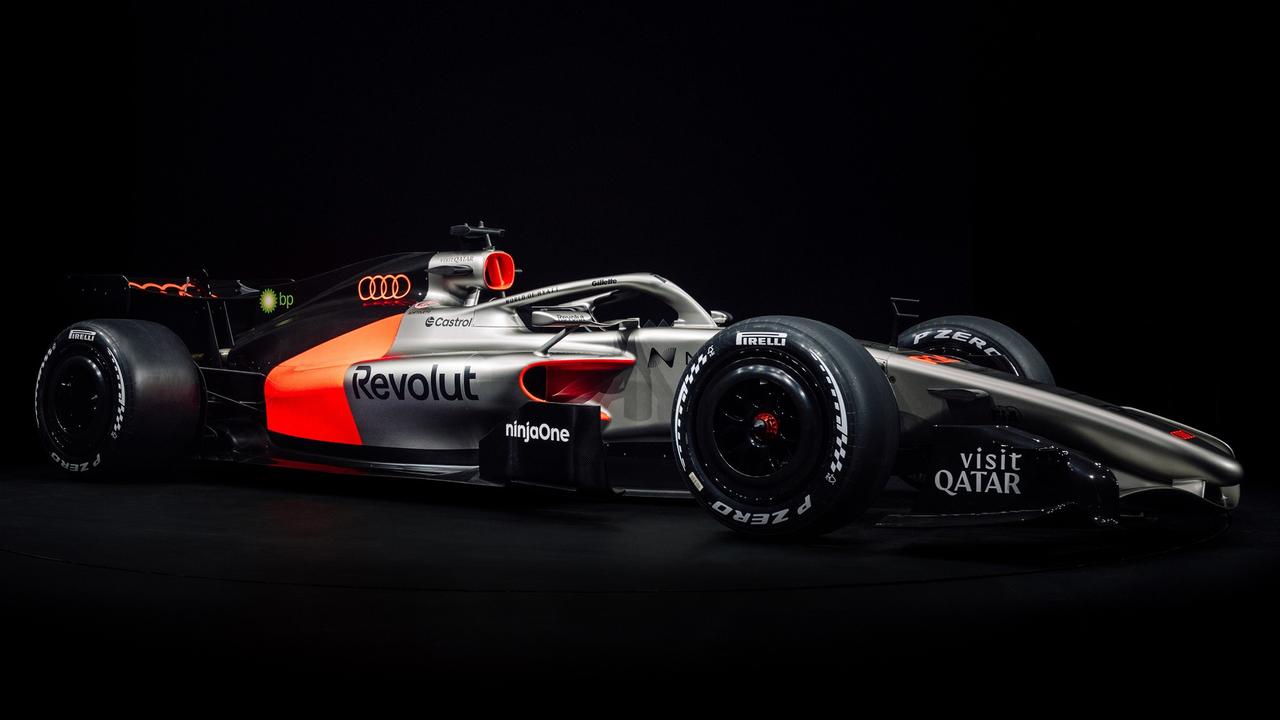
Audi has declared it’s “ahead of the game” for its debut 2026 season after getting its first Formula 1 car on track in a shakedown before its season launch event in Berlin on Tuesday (Wednesday morning AEDT).
The German automotive giant pulled the covers off a generic show car bearing its colour scheme for 2026: German racing silver highlighted by red and black on the engine cover and rear wing.
The paintwork matches the concept livery published by the team late last year.

Watch the biggest Aussie sports & the best from overseas LIVE on Kayo Sports | New to Kayo? Join now and get your first month for just $1.
Though Audi’s first world championship grand prix car, named the R26, remained unseen during the team’s elaborate launch event — the night featured choir singers, a light show and an Audi rap song — it had already broken cover during a filming day in Barcelona almost two weeks ago.
It was the first constructor to shake down its new car ahead of next week’s behind-closed-doors test — a statement of intent for a team that’s been tipped to compete near the back of the field this year with Audi’s first attempt at a Formula 1 power unit.
“It got us ahead of the game,” team principal Jonathan Wheatley said, per The Race. “It shows the ambition in the project. We’ve beaten other teams on track by some margin.”
New team Cadillac made it to the track a week later, while Racing Bulls has undertaken some preliminary running this week.
Technical director James Key said the early running was crucial for Audi given it’s the only brand-new power unit manufacturer in the sport this year.
The new power unit, which features an almost 50-50 split between internal combustion and electrical energy, is expected to be the biggest performance differentiator this year.
“As one of only two new guys on the block with this [as an engine manufacturer], you really do need a track reference,” Key said, per The Race.
“We agreed, we try and hit the track as quickly as we can. The problem with that when you think about how the development process of these cars has gone, from a technical reg [regulations] point of view, everything was speculative until 1 January [2025], when we could start doing the aero.
“Of course the aero defines the car, so you’ve got a very, very late start. You want to go [develop] for as long as possible, but then you’re running early [in 2026], so everything has been compressed massively over winter.”
Audi launches the R26, its 2026 Formula 1 car (Image: Audi F1 Team)Source: Supplied
Audi has been sober about the challenge of competing in Formula 1. Though it isn’t starting completely from scratch, the Sauber team it bought out to get on the grid has spent most of its history competing in the midfield and more recently at the back of the pack. It finished ninth in last year’s championship.
The team has nonetheless revealed a plan it calls ‘mission 2030’, which it says will culminate with winning the championship at the turn of the decade.
In what appears to be a clash of marketing and management, Audi Motorsport CEO Gernot Döllner watered down the target somewhat, declaring it was only the team’s aim to fight in the championship battle by 2030, its fifth year in the sport.
The power unit regulations are likely to change again in 2031.
“Today marks more than a launch; it marks the public declaration of a new era for Audi,” Döllner said. “Formula 1 is the most demanding stage in the world of motorsport, and we are here not just to compete, but to define the future of ‘vorsprung durch technik’ [advantage through technology, the Audi motto].
“This project is a catalyst for our entire company, a symbol of our transformation towards a more performance-driven, efficient, and innovative culture. Our philosophy is one of absolute, long-term commitment.
“We understand that success in Formula 1 demands relentless perseverance and Audi is not here to make up the numbers; we aim to be fighting for the world championship by 2030.”
Even so, Wheatley cautioned that Audi could not expect an easy ride through F1 simply by virtue of its status as an automotive giant.
“I think you have to be realistic about where you’re starting from,” he said, per Autosport. “And you also have to be humble about the challenge that’s ahead of you.
“You don’t just turn up and beat teams like Ferrari and Red Bull, Mercedes, McLaren because you’re Audi. That’s not how it works, and you need a plan.
“Our plan is to be a challenger, then a competitor and then a champion — it’s important that people understand that journey.”
Ricciardo & Max reunite for track day | 01:18
ENGINE CONTROVERSY CONTINUES BREWING
The season’s first technical controversy has been bubbling away for months, and Audi finds itself uniquely exposed in a way that could leave it languishing at the back of the pack.
Mercedes and Red Bull Powertrains are both rumoured to have found a way to circumvent the rule regulating the compression ratio of the internal combustion engine.
The compression ratio is the difference in cylinder volume when the cylinder head is at its highest and lowest points.
A ratio of 16:1 has been set for this season, down from 18:1 last year.
The accused teams, however, are believed to have exploited a loophole that sees the compression ratio measured while the engine is cold. Rumours suggest that, when the engine is hot, the compression ratio becomes more extreme.
Estimates suggest a compression ratio of 18:1 could be worth around 0.3 seconds per lap relative to 16:1 depending on the track, a considerable advantage — though it’s unclear what ratio Mercedes and Red Bull have achieved.
It could be dire for Audi, whose power unit is already expected to be the weakest in the field owing to its novice status in Formula 1.
“If it’s real, it is certainly a significant gap in terms of performance and lap time, and that would make a difference when we come to competition,” Audi chief operating officer Mattia Binotto said, per The Race. Binotto formerly headed Ferrari’s power unit division.
Audi, along with Ferrari and Honda, have written to the FIA to clarify the situation. A meeting of the power unit suppliers is scheduled later this week.
“I think if it’s sort of bypassing the intent of the regulations, then it has to be in some way controlled,” Audi technical director Jame Key added.
“We trust the FIA to do that, because no one wants to sit a season out if you’ve got a blatant advantage that you can do nothing [about] with a homologated power unit.
“I think for us, hopefully, the FIA will make the right decisions.”
Engines are homologated, with development frozen, from the first race this year, with upgrades allowed only ahead of the 2027 season.
A clampdown, however, is unexpected, potentially giving the six Mercedes or Red Bull-powered teams a year-long advantage.
Aussie Jack Doohan released by Alpine | 00:36
AUDI’S LONG AND WINDING ROAD TO F1
Though Audi predecessor Auto Union competed in grands prix in 1935–39, this will be the brand’s first Formula 1 entry of the post-1950 Formula 1 world championship era.
It’s also the first time a Volkswagen Group brand will compete in a grand prix, with Auto Union having been independent of the rival German marque in the 1930s.
Porsche won races and titles as an engine supplier for McLaren in the 1980s, but that too was before it merged with VW in the 2010s. It came close to agreeing to a deal to enter the sport in a 50-50 partnership with Red Bull Racing in 2026, but the deal collapsed at the 11th hour over an unwillingness for the F1 team to cede control to Stuttgart.
Volkswagen has been Formula 1’s white whale for decades, with the last two power unit regulation sets designed in part to try to attract the automatic giant to the sport. The German auto group is one of the world’s most prolific car manufacturers, selling fewer cars than only Toyota.
The company had long remained aloof despite occasionally being involved in rule-making discussions, but the enormous boost in the sport’s popularity after the pandemic and the 2026 power unit regulation changes convinced Audi the time was right to enter Formula 1.
Audi agreed to buy the long-time independent Sauber team during the 2022 season with a plan to formally enter the sport in 2026 as a works constructor with its own in-house power unit.
The motor has been designed at Audi’s technical centre in Neuburg an der Donau, in the south of Germany, while the team remains at its headquarters of three decades in Hinwil, near the Swiss capital of Zurich.
Audi has also opened a satellite factory in the UK — in the so-called motorsport valley northwest of London — in a bid to attract engineers from rival teams based nearby rather than attempt to woo them to Switzerland.
Despite a running start of more than three seasons, the Audi project found itself in turmoil early, with a revolving door of management figures giving the nascent team the faint whiff of crisis.
Andreas Seidl, formerly the McLaren team principal, was poached to become CEO in 2023, but by 2024 both he and Audi chief representative Oliver Hoffman had been dismissed amid rumours of a power struggle.
Their sackings came amid rumours the power unit project was falling behind and the Sauber team’s sharp competitive decline, which reports suggested was at least partly down to Audi being reluctant to invest heavily in the Swiss operation before taking full control.
Incredible scenes on Day 6 Dakar Rally | 01:18
The fracas in retrospect appears to be the shock Audi needed to reboot its F1 chances.
Rather than incrementally taking larger stakes in the Sauber team as originally planned, Audi announced in early 2024 that it would complete the purchase of 100 per cent of the team.
Later that year it received a cash injection from Qatar’s sovereign wealth fund by selling a minority stake in the operation.
Seidl was effectively replaced by former Ferrari principal Mattia Binotto, who took on the roles of chief operating officer and chief technical officer. Binotto later told The Race that he was shocked to find upon his arrival “no plans nor developments”, confirming the long-running speculation that the project had become rudderless.
The Italian engineer set a course, sacrificing some 2026 preparation to making Sauber more competitive in 2025, having described another last-place title finish as untenable for the future Audi team.
Sauber finished the year ninth after a close battle for sixth. Its 70-point haul was its biggest score in more than a decade, which Binotto has since instilled the right attitude and belief in the team ahead of 2026.
Binotto’s arrival preceded confirmation that long-time Red Bull Racing sporting director Wheatley would become team principal, with the Briton taking up the role last April.
Not only has Wheatley whipped the race team into shape, but he appears to have become a lightning rod for new hires, with rumours of considerable pull from Red Bull Racing’s Milton Keynes factory.
Together they’ve restored some much-needed credibility to the team ahead of its first season — but now it’s up to Audi to prove its worth on the track.