
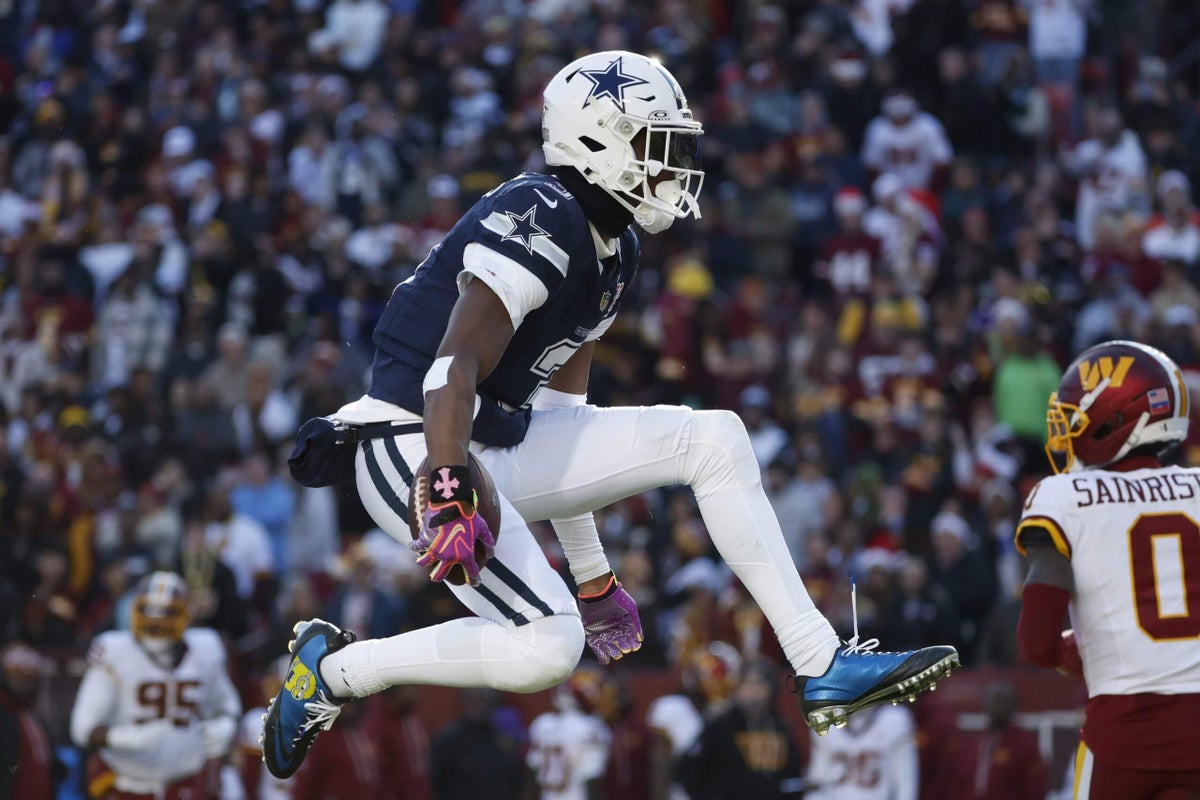
After examining what went wrong with the fantasy football running backs and quarterbacks, it’s time for wide receivers and tight ends. As with the previous piece, this isn’t only a “dang, that stinks” reaction. It’s a way to examine unexpected results to learn and improve. Interestingly, and not all too surprisingly, a lot of the receiving hits and misses hinged on the performances of their quarterbacks.
Wide receiversUnderperformers
Brian Thomas, JAX: To be fair to Thomas, starting the season with a wrist injury disappointed managers from the beginning. Many — including me — expected at least the same, if not better, success with Trevor Lawrence (vs. Mac Jones). Unfortunately, Thomas’ talent couldn’t bridge the rapport gap, and 2025 was worse. When Thomas was 100%, we saw flashes of his rookie season and upside, but never the consistent dominance — partially due to Lawrence’s comfort level throwing to his slot options.
He’s targeted the slot at a 32.5% rate since entering the NFL — ninth among 70 QBs with at least 250 attempts and fourth among full-time starters during that span (behind Lamar Jackson, Aaron Rodgers and Patrick Mahomes). Thomas dropped from a 26.9 Slot% mark to 21.4 this season, with first Travis Hunter, then Parker Washington, being the ones lining up in the slot the most. We saw how good Washington was at the end of the year, further proof of Lawrence’s comfort with those quick-decision throws to the slot.
Additionally, the arrival of Jakobi Meyers had Thomas being used as the downfield option all too often. Thomas saw a small jump from 11.6 AirYD/TGT to 12.9 this year, but once Meyers arrived, it rocketed to 17.6. That also came with just 5.2 targets per game, down from 7.8 last year.
The first part of the equation is actionable in terms of effectiveness with a different quarterback … but we knew that. A better quarterback doesn’t always mean a stock boost for everyone. The second part is deeper: Having this information on Lawrence’s slot reliance should have made managers abandon ship, even trading Thomas for a major discount on draft cost, once the Meyers trade happened, since there was no way it could get better.
Xavier Worthy, KC: Easily one of my biggest misses, as Worthy didn’t provide WR2 value, but couldn’t before even Rashee Rice’s return. Even factoring in the Week 1 injury, Worthy had just 14.6, 8.1 and 9.6 points, respectively, in Weeks 4-6, and zero double-digit games after his 14.6 showing, including just a 5.7 FPPG mark after Rice’s return — 57th among qualified WRs.
Sure, Patrick Mahomes missed the final three weeks, but Worthy was already on Bust Boulevard before that. Simply put, projecting Worthy to continue most of his late-2024 success was wrong. It’s not that we were purely chasing those final three games of last season, as Worthy had five double-digit scores before that and three more over 7.0 points.
The reason for the miss? Similar to Thomas, Worthy’s usage changed. He saw more downfield targets, which are inherently less reliable. Worthy went from a 75.0 Catchable TGT% as a rookie to 66.7%, with a deeper AirYD/TGT mark (12.9, up from 9.2). If the Catchable% doesn’t sound like a major drop, it is, as Worthy was 155th of 170 players with at least 25 routes and targets.
My assumption (and miss) was that Mahomes was too good for Worthy to fail in replacing the aging Travis Kelce as the No. 2 target earner. The targets were there — when healthy — but Worthy didn’t succeed as much downfield, which fell on Mahomes’ shoulders a bit too. Worthy replicating much of what Rice does — but not as well — was the fact not to overlook.
Justin Jefferson, MIN: Speaking of which, how about we don’t overlook just how much of a risk a quarterback can be? Even as someone who tabbed J.J. McCarthy as “J.J. McHeinicke,” I figured Jefferson was way, waayyy, too good to allow subpar QB play to stop him. After all, Jefferson could have retained his WR1 (Top 12) value with Taylor Heinicke under center, as he did with Nick Mullens and “Fugitive” villain (The One-Armed Man) Carson Wentz. It wasn’t only the decrease in targets, as Jefferson averaged 7.6 with McCarthy versus 9.9 the previous four seasons, but also how poor the targets were.
Nearly 20% (19.7) of McCarthy’s throws were off target, leading to a 52.6 Catch% for Jefferson, plus just 1.07 fantasy points per target (FPPT), well below his 1.71 career mark. I also jokingly called Jefferson “QB immune” due to his talent, but he wasn’t: He finished as WR34 in FPPG (min. 10 games) at 9.4. No one would have predicted it to be this bad, but ranking Jefferson as a WR1, let alone pushing the Top 5, did not account for the very real and very terrible QB-influenced floor.
Overperformers
George Pickens, DAL: Many of us expected the same, if not a better, Pickens as the Cowboys’ No. 2 receiving option versus being the top (only?) option with the Steelers in 2024. It turned out to be much better in Dallas. Pickens hit career highs across the board, finishing as WR6 with 14.3 FPPG and WR5 overall. It wasn’t only because CeeDee Lamb missed time either, as Pickens had a near-identical TmTGT% with (22.4) and without (22.8) Lamb on the field. You can toss in YD/REC (15.3 to 15.6), First Down per TGT% (54.4 to 51.1) and red zone target rate (0.71 to 0.53) as numbers that also barely changed. The miss in projections came down to lower REC% and YD/REC, as Dak Prescott’s numbers were actually super close (403-for-607, 4,460 yards, and 31.5 passing touchdowns, compared to 404-for-600, 4,552 and 30). I undersold Pickens’ per-play/target upside, so instead of increasing the volume with a small efficiency downtick, I should have had all of his per-target numbers pointing up … or at least holding steady.
Chris Olave, NO: A midseason QB change and trade of Rashid Shaheed were catalysts for Olave’s career-best campaign. Tyler Shough didn’t make a positive difference because of volume or OnTGT%, as both were better with Spencer Rattler (28.9 TGT% to 25.1 and 7.0 OffTGT% to 16.5). It was AirYD/TGT (9.7 to 13.5) and touchdowns (3 to 6). Shough, having more downfield ability, helped Olave climb from a volume middleman option (like Jarvis Landry of old) to a true all-around threat and Top 10 WR.
The lesson gleaned from Olave’s best season cannot be applied on draft day; rather, it applies in-season. Like when Meyers went to Jacksonville, and Jameson Williams benefited from Dan Campbell taking back offensive playcalling, buying low on Olave (as I suggested and many sent thanks for), given the upside with the change at QB and the addition of Shaheed, was the winning move.
Alec Pierce, IND: Similar to Jefferson in a different direction, no one saw Pierce’s ascendance coming, even if you predicted injury issues with the Colts’ wideouts. Pierce was all about the quarterback situation, which is a major theme here. With Anthony Richardson, Pierce saw 14.6 TGT% with a 44.4 REC% and 1.37 YPRR. With Daniel Jones, Pierce had 19.0%, 56.5% and 2.19, respectively. Those numbers dropped back with Philip Rivers’ ancient arm to 10.5%, 50.0% and 1.07, then rebounded with Riley Leonard to 22.6%, 58.3% and 3.51.
Pierce, like many of the “miss” wide receivers, has a style heavily influenced by his quarterback’s tendencies, abilities and rapport. Remember that not only for Pierce and where he plays next season, but also for any waiver grabs, given the upside or risk factors, if the backup quarterback is significantly different.
Tight endsUnderperformers
Mark Andrews, BAL: If you recall my Travis Etienne breakdown in the RB piece, one of the takeaways was not overrating half of a season. We should factor it in, particularly if it’s injury- or situational-related, but sometimes it’s just a minor factor. Once Andrews “woke up” in 2024, he was TE5 overall and in FPPG with a league-leading 11 touchdowns. Andrews’ targets and yards weren’t too far off from his norm, but the touchdown rate was astronomical. Even including a projected decrease for the 2025 season, Andrews was still pegged for nearly 8 touchdowns.
Due to his decline and quarterback play, Andrews was a major miss. I don’t like injury-related “misses” in general, and the negative impact on Lamar Jackson’s health played a part, but touchdown variance for receiving options can turn a stud into a bust rather easily.
Overperformers
Kyle Pitts, ATL: I didn’t project Pitts for the five touchdowns that kept his career progression on track — 1, 2, 3, 4 and 5 from 2021-25 — and I also didn’t project him for enough overall production, even though I was one of the few willing to give him another chance. My line of 100 targets, 63 receptions and 745 yards fell short of his actual 118-88-928 line.
It wasn’t so much QB play with Pitts as it was the Falcons finally using him to his full ability. Instead of asking Pitts to run downfield regularly or work on his routes, they let Pitts use his body, as an NFL power forward of sorts, and man-up defenders to create space and make catches. While we don’t often like to see an AirYD/TGT number go from 10-14 yards to 7.4, there is a similarity to Worthy in that the usage better suited the player.
If you enjoy watching games and players this closely, you likely saw the same and didn’t need me to tell you that the Falcons finally stopped trying to fit a square peg into a round hole. If you’re a more casual fan — and I say that with no disrespect at all — you come to us, including the beat writers and scouts.