
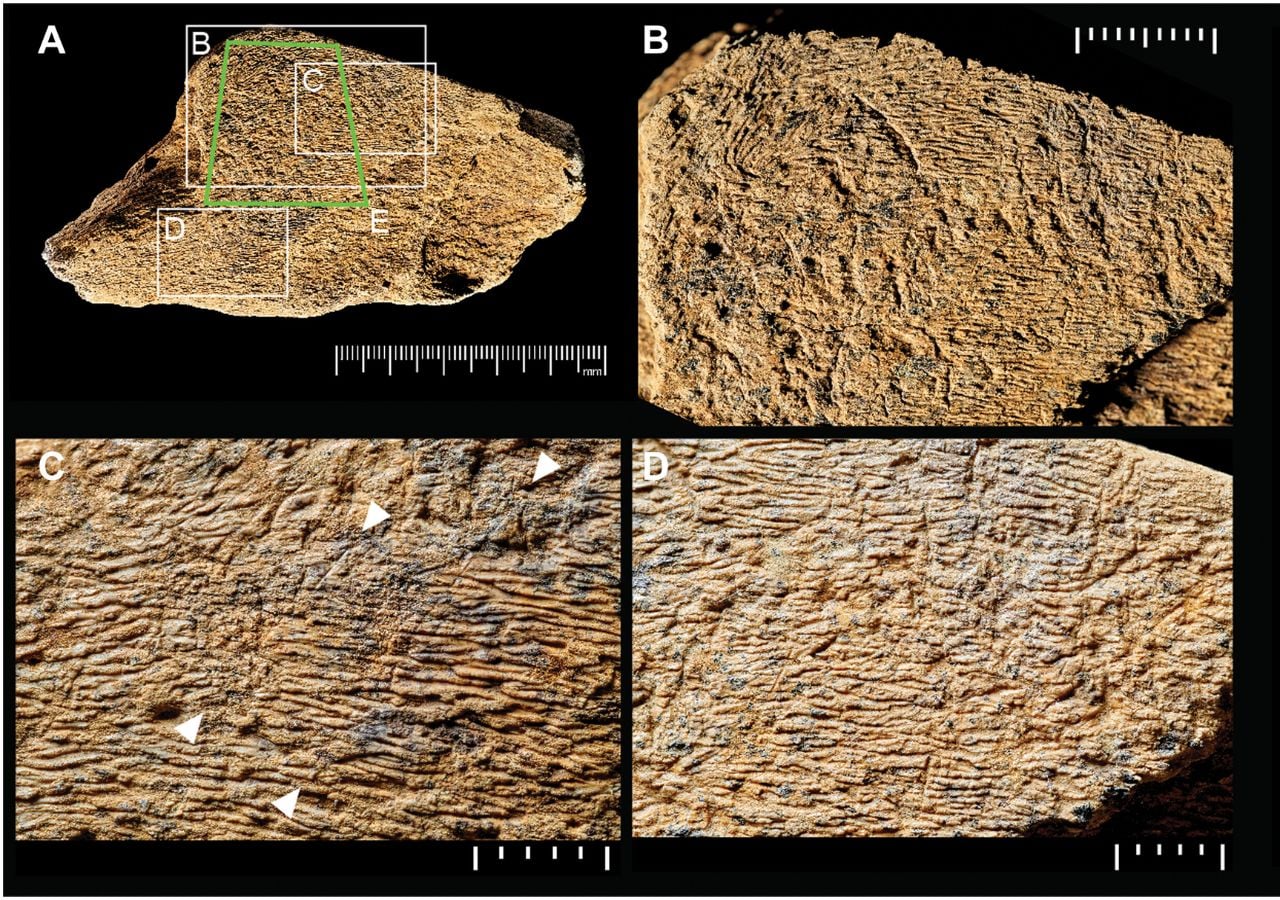
Photographs of battered areas of the elephant’s cortical bone. Credit: Simon A. Parfitt / CC BY 4.0
Archaeologists have identified a 500,000-year-old hammer made from elephant bone as the oldest tool of its kind ever found in Europe. The rare discovery sheds new light on the technological abilities of early human ancestors in prehistoric southern England.
The elephant bone tool, unearthed at the Boxgrove archaeological site near Chichester in West Sussex, offers a rare glimpse into the craftsmanship of species such as early Neanderthals or Homo heidelbergensis.
Researchers from University College London and the Natural History Museum analyzed the artifact, confirming that it had been intentionally shaped and repeatedly used to sharpen stone tools like handaxes.
Elephant bone tool offers new insight into prehistoric Europe
The team found the bone fragment in the early 1990s, but only recently identified it as a tool through detailed analysis. Using 3D scans and electron microscopes, they found notches and impact marks on its surface, along with small pieces of flint embedded in the grooves.
These marks revealed that the tool had been used as a hammer, likely to restore the edges of dulled stone tools through a process known as knapping.
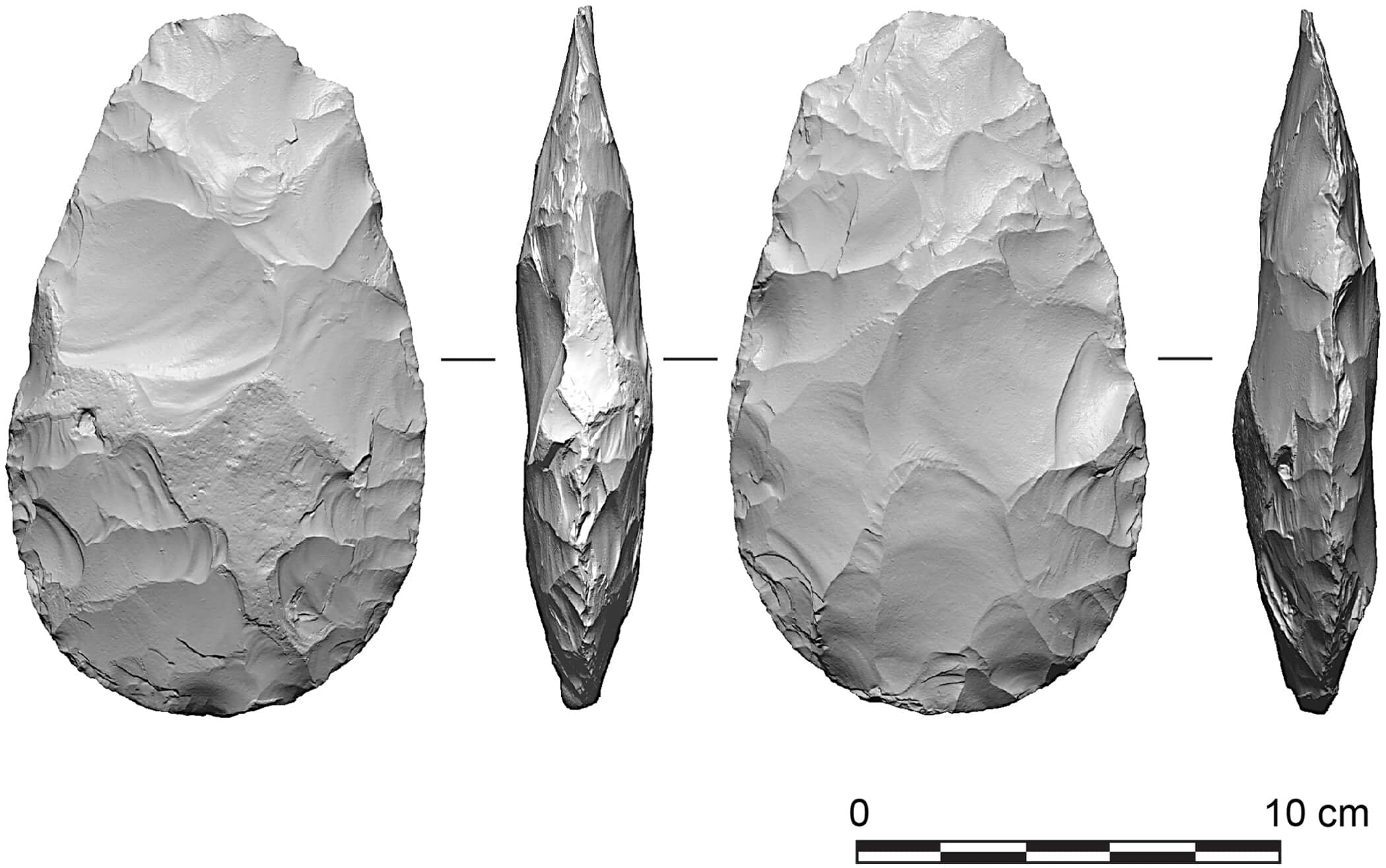
Handaxe from the Boxgrove paleosol horizon. Credit: Simon A. Parfitt / CC BY 4.0
Lead author Simon Parfitt of UCL and the Natural History Museum said the discovery highlights the early humans’ resourcefulness. He explained that these ancestors had a strong understanding of available materials and selected elephant bone, despite its rarity, for its strength and durability. Parfitt noted that such material was likely seen as valuable and worth preserving.
Measuring about 11 centimeters (4.3 inches) long, 6 centimeters (2.4 inches) wide, and 3 centimeters (1.2 inches) thick, the tool has a triangular shape and is made mostly from cortical bone, the dense outer layer of bone tissue.
Its size and strength suggest it came from a large animal, most likely an elephant or mammoth, although the fragment is too incomplete to confirm the exact species.
Oldest tool of its kind sheds light on early human ingenuity
Dr. Silvia Bello, a co-author and researcher at the Natural History Museum, said the use of this bone fragment as a tool reflects complex thinking and a deliberate approach to toolmaking. She emphasized that shaping and reusing such a rare material for delicate tasks like sharpening shows a high level of planning.
While tools made from elephant bones have been discovered at sites in Africa dating back 1.5 million years, similar finds in Europe are extremely rare and typically much younger.
Most are no older than 43,000 years and are usually linked to early modern humans in warmer regions. This makes the Boxgrove find especially significant for understanding early tool use in prehistoric Europe.