
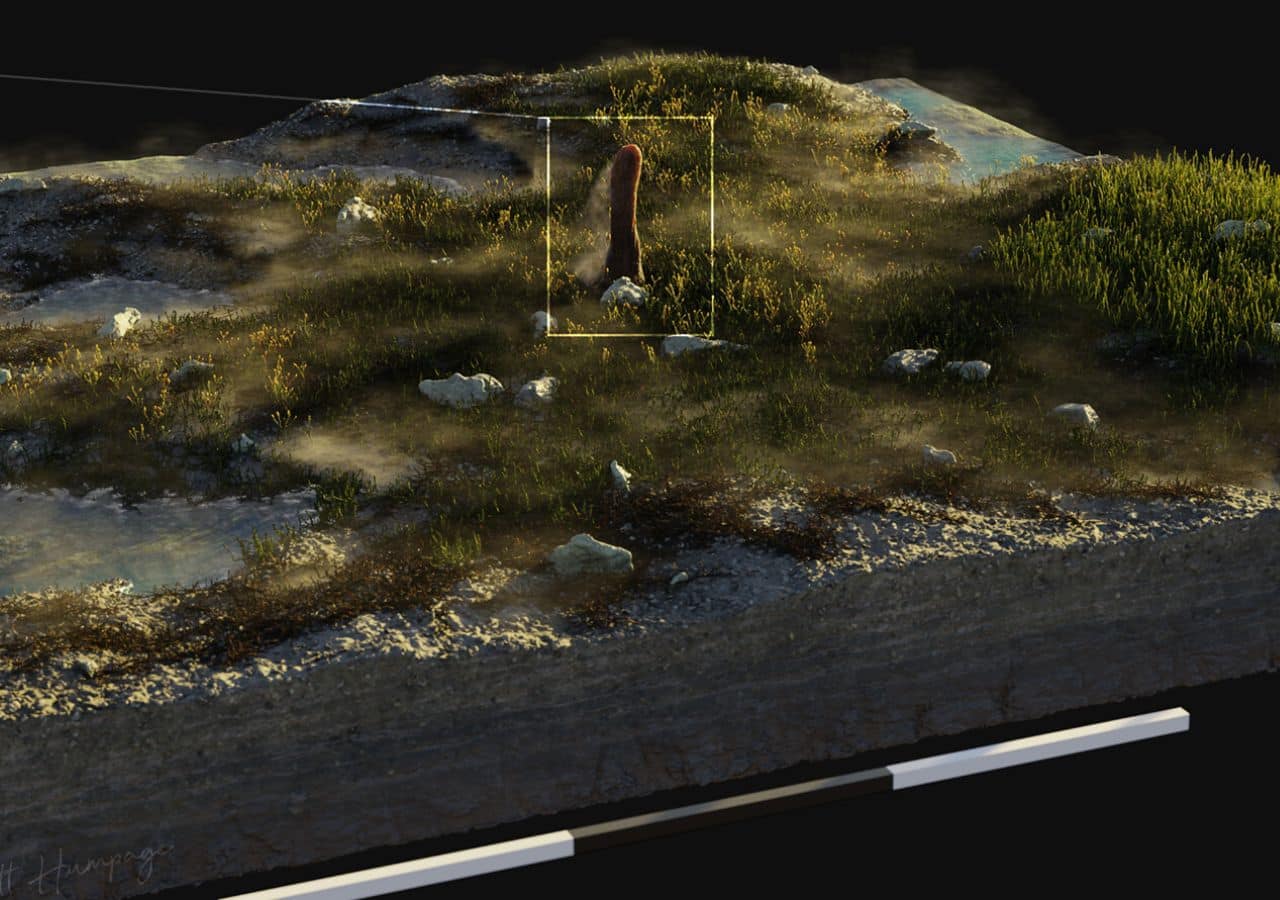
Artist reconstruction of P. taiti within the Rhynie ecosystem. Credit: M. Humpage, Northern Rogue Studios / CC BY 4.0
A group of scientists has uncovered what they believe to be a completely new form of life that once grew as tall as 26 feet and lived on Earth approximately 410 million years ago. The ancient organism, known as Prototaxites, was long believed to be a type of fungus, but recent research has revealed it does not fit into any known category of plant or fungal life.
The study, conducted by researchers at National Museums Scotland, points to Prototaxites as part of an entirely extinct evolutionary branch. By analyzing fossil evidence, the team determined that this towering organism belonged to a group of complex life forms that no longer exists on the planet. This new form of life, identified through detailed anatomical and chemical analysis, shows no clear ties to any existing biological group.
Ancient life that defies classification
Dr. Sandy Hetherington, co-lead author of the study, said the discovery marks a major step in resolving a scientific debate that has lasted over 160 years. He explained that Prototaxites displayed structures and molecular features that do not match those of fungi or plants, supporting the idea that it evolved along a separate and now-extinct path.
A Scottish fossil may have just unmasked one of Earth’s strangest giants, and it does not fit neatly into any category we use today.
Scottish fossil points to a 410 million year old giant from a lost branch of life
A newly studied fossil of Prototaxites, found in Aberdeenshire,… pic.twitter.com/dkMKOVGP5e
— Gandalv (@Microinteracti1) January 22, 2026
The fossil at the center of the research was recovered from the Rhynie chert, a sedimentary deposit located near Rhynie in Aberdeenshire. This site is internationally recognized for its rare and well-preserved early land-based ecosystems.
Dr. Corentin Loron, who also led the study, emphasized the significance of the Rhynie chert, calling it one of the oldest and most detailed fossil sites for terrestrial life. He noted that the site’s exceptional preservation allows scientists to apply modern techniques, such as machine learning, to study fossil chemistry and structure in ways not possible before.
Fossil study offers insight into new form of life
In their investigation, the team examined both the internal anatomy and chemical composition of the fossil. According to Laura Cooper, co-author of the study, earlier research had already ruled out connections to known groups of large, complex organisms.
She explained that the evidence supports Prototaxites as a unique evolutionary experiment, one that helped shape our understanding of how complex life may have evolved in different directions.
The fossil has been added to the national collection at National Museums Scotland in Edinburgh. Dr. Nick Fraser, keeper of natural sciences at the museum, said the specimen highlights Scotland’s role in revealing key chapters in Earth’s history.
He added that this research demonstrates how museum collections continue to play a central role in scientific discovery by offering material for comparison and modern analysis.