

Last weekend, a new international league kicked off.
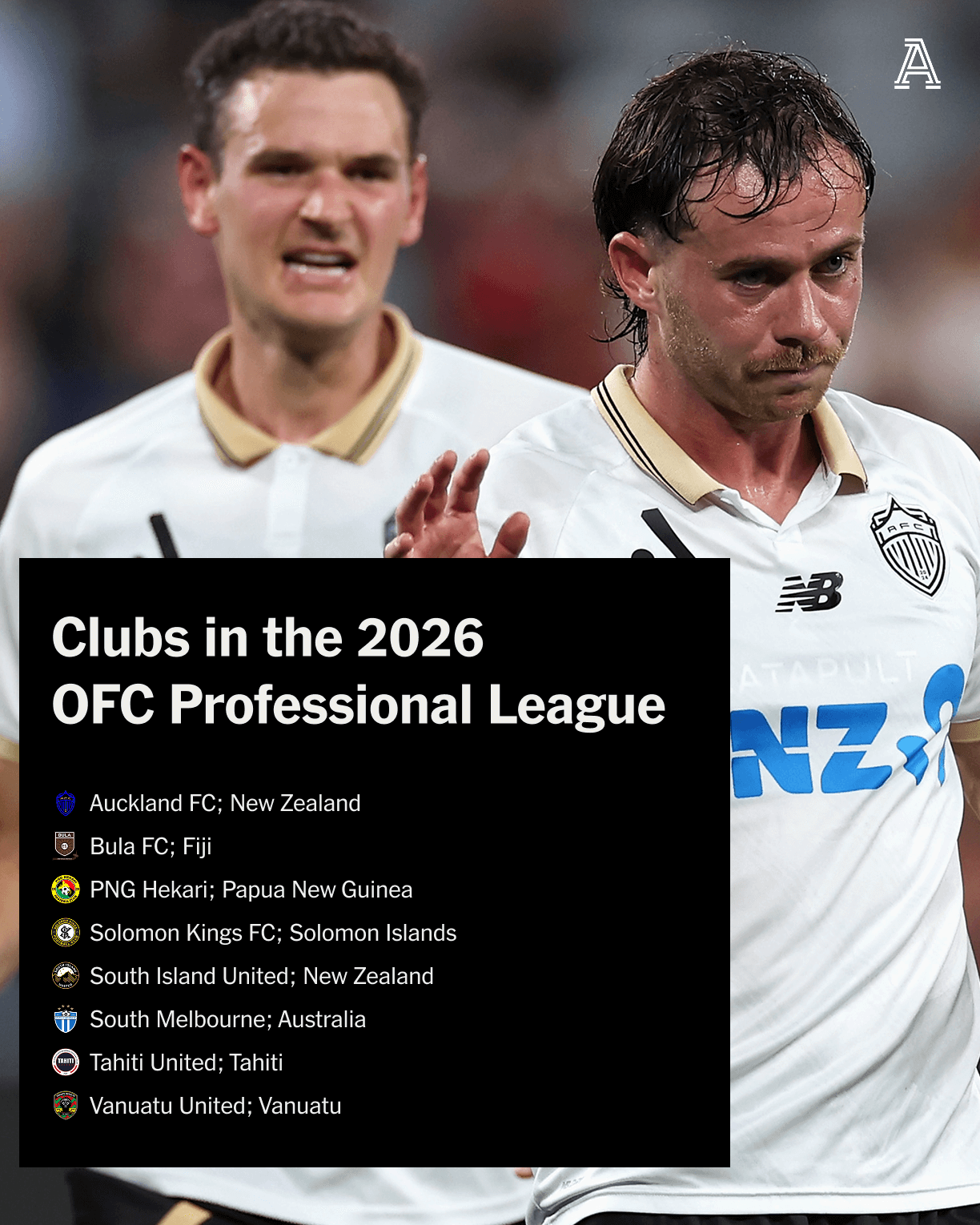
Eight clubs from seven nations across Oceania — the vast geographic region comprised of more than 10,000 islands and 14 countries, including Australia and New Zealand — are competing in the inaugural OFC Professional League.
The competition is the first properly cross-border league in the sport, designed to incorporate club sides from microstates into a professional competitive structure and provide them with a pathway to major tournaments. Its creation is a landmark moment in the game which may provide an insight into its future, with the possibility of further cross-border leagues and a potential foreshadowing of continent-wide league tournaments globally.
Lambert Maltock, the president of the Oceania Football Confederation (OFC), said the new league “will change the landscape of football in Oceania, forever”. But its impact may stretch beyond the part of the world it calls home.
What is the OFC Professional League?
The OFC Professional League contains two clubs from New Zealand and one each from Australia, Fiji, Papua New Guinea, the Solomon Islands, Tahiti and Vanuatu. The OFC wants to incorporate a team from Hawaii, which, as a U.S. state, falls under the remit of Concacaf (the federation for North and Central America and the Caribbean) and does not have a professional football structure.
The new venture is the only professional league structure in the OFC — the Australia-based A-League is also professional, but Australian sides at club and international level switched to the Asian Football Confederation (AFC) in 2006.
The first phase consists of each team playing its seven opponents twice over five ‘circuits’, the first of which is being hosted in New Zealand, before later ‘circuits’ in Papua New Guinea, Australia, the Solomon Islands and Fiji.
After 14 rounds of matches, the second phase will begin with the teams split into two groups: a leaders’ play-off section, consisting of the top four sides (they will compete for three semi-final berths), and a challengers’ play-off pool — the four remaining teams, with the final last-four spot up for grabs. Each side will play their three opponents once at this stage.
The semi-finals and final will be single-leg matches. All games in the second phase, including the semi-finals and final, will be played in New Zealand, and each team is guaranteed a minimum of 17 games per season.
Why has it started?
The winners of the league will represent Oceania at the FIFA Intercontinental Cup (the new name for the annual version of the Club World Cup) later this year, as well as at the next now four-yearly Club World Cup, set for 2029.
South Melbourne, who last month won the second-division Australian Championship title, cannot qualify for those FIFA tournaments because, as detailed above, Australia is now part of the AFC. Should they win the OFC Professional League, the competition’s spot would go to its runners-up.
Auckland FC, a New Zealand club founded in 2024 to play in the A-League, will field an age-restricted team as part of the conditions of their entry. They can qualify for those FIFA tournaments, due to New Zealand being part of the OFC.
Auckland City (not to be confused with Auckland FC), who represented Oceania in last year’s Club World Cup in the United States, are not fully professional. This led to concerns their participation in the tournament would create a competitive imbalance as they faced some of the giants of the global game. They were paid an entry fee of $3.58million (£2.67m at the current rate) by FIFA, world football’s governing body and the event’s organiser.
This was significantly lower than any of the other 31 clubs in the tournament, with each side’s fee calculated on “ranking based on sporting and commercial criteria”. This variation followed concerns that the huge amounts on offer would further widen financial inequalities across the sport and warp domestic leagues.
While Auckland’s part-timers lost 10-0 to Germany’s Bayern Munich and 6-0 to Benfica of Portugal, their 1-1 draw against Boca Juniors, one of Argentina’s biggest clubs and six-time champions of South America, earned them an additional $1million — the fee for drawing a match in the group stage. A victory would have been double that sum.
In March 2023, FIFA president Gianni Infantino pledged support from his organisation for the concept of an Oceania league.
“The proposals are a win-win for the development of all forms of the game across the region,” Infantino said, as per oceaniafootball.com. “I once again pledge FIFA’s full support to help our friends and colleagues in Oceania to make this proposal become a reality.”
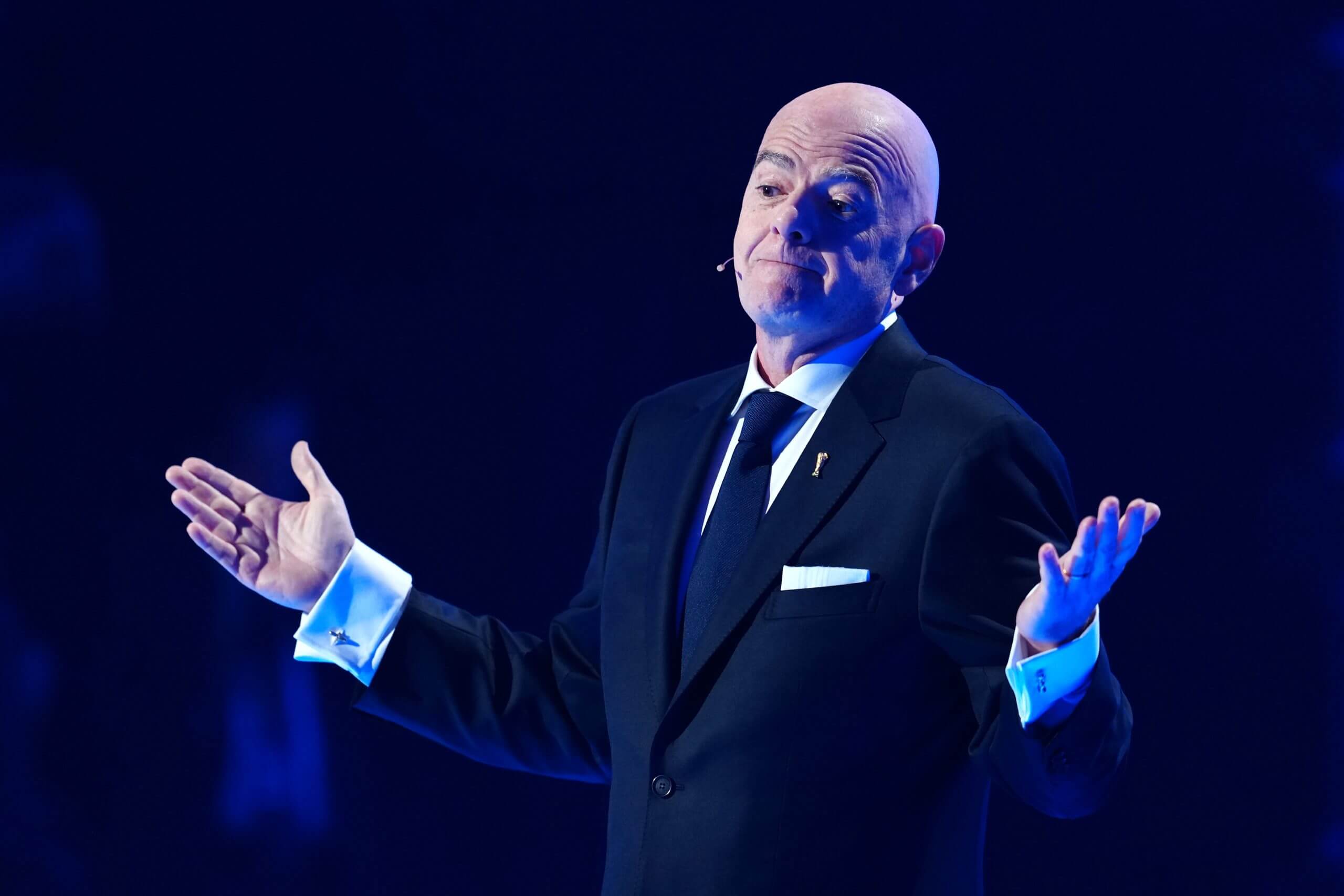
FIFA president Gianni Infantino has spoken in favour of the new league (Jia Haocheng – Pool/Getty Images)
The league’s matches will be broadcast on the FIFA+ platform,
This past October, the Fiji Football Association reported quotes from its president Rajesh Patel that the OFC Professional League would be funded by a four-year, $20million agreement with Saudi Arabia’s tourism authority. “We are thankful for this investment, which makes professional football a reality in our region,” Patel said at the launch of Bula FC, his country’s representatives in the league.
No official confirmation of this investment has been made by the OFC, though.
Its initial league presentation was made in Riyadh, Saudi Arabia’s capital, at the World Football Summit in December 2024.
Do other international leagues exist?
The OFC Professional League is the only truly cross-border soccer league, but there are multiple examples of clubs playing in leagues of nations other than their own.
Canadian sides Toronto FC, Vancouver Whitecaps and CF Montreal all play in Major League Soccer, which otherwise consists of teams from the United States. This arrangement allows greater growth potential, more income, stronger competition and a higher platform for these clubs than the Canadian Premier League (CPL). MLS is motivated by greater club diversity and exposure to the Canadian market.
Auckland FC and fellow New Zealanders Wellington Phoenix play in Australia’s A-League, with similar motivations for the clubs and league as in MLS.
In the United Kingdom, five Welsh clubs have remained in the English system throughout their existence: Cardiff City, Swansea City, Newport County, Wrexham and Merthyr Tydfil. Colwyn Bay decided in 2019 to join the Welsh system after dropping down the English pyramid. No Welsh football league system existed when those clubs were formed, hence their places in the English pyramid.
Similarly, all pro clubs in Liechtenstein play in the Swiss football system, as Liechtenstein has no professionally-organised league of its own. Other microstate clubs are incorporated into neighbouring leagues: Monaco are part of the French setup, FC Andorra play in the Spanish one and San Marino Calcio are in the Italian structure.
Derry City, from the Northern Irish city of Derry, play in the Republic of Ireland’s League of Ireland. The club moved away from the Northern Irish league due to security concerns related to The Troubles — an ethno-nationalist conflict in Northern Ireland that lasted for about 30 years from the late 1960s to 1998 — that saw police ask them to play their home matches in Coleraine, 30 miles away. Since 1985, Derry City have played in the League of Ireland.
Have new cross-border leagues been discussed?
A unification of the leagues in Northern Ireland and the Republic of Ireland has recently been promoted by Kieran Lucid, an Irish tech entrepreneur based in Belfast.
The arguments for all such league unifications are similar: smaller competitions are being left behind the game’s bigger nations because of less lucrative TV deals, smaller markets, less potential for growth, and a limited range of opponents.
These ideas all face similar challenges too: participating clubs would lose access to a top division, the number of available qualification spots for the three competitions run by UEFA, European football’s governing body (a key source of revenue for some of these leagues) would halve, travel costs would increase for clubs and away fans, and any novelty factor is likely to dissipate.
Other challenges are likely to emerge, too. The premise of the leagues is that a certain number of representative clubs from each nation would be present in the top tier, calculated on population size. Yet that balance may see teams avoid relegation, or being denied promotions earned on the pitch, so these ratios were maintained.
For Ireland, too, a political argument exists that may provide an additional challenge. The island was partitioned in 1921, with Northern Ireland remaining part of the United Kingdom and the Republic of Ireland becoming an independent nation.
But what about elsewhere?
In 2021, it was widely reported that Belgium’s Pro League clubs had voted unanimously to merge with their Dutch neighbours to form a “BeNeLiga”. The two European nations share close cultural and socio-economic ties, with league unification becoming a topic of discussion at several points but there have not yet been similar agreements in the Netherlands. For many of its smaller clubs, they are unlikely to volunteer to lose lucrative matches against Dutch football’s big three: Ajax, PSV and Feyenoord.
Elsewhere, Latvian league president Maksims Krivunecs has promoted the idea of a Baltic League which would combine teams from his country with Lithuanian and Estonian sides. The three nations have a combined population of around six million, with Latvia the highest ranked in UEFA’s league coefficients at 39th. Krivunecs is quoted by BBC Sport this month as saying that a combined league with Estonia and Lithuania is a “necessity”.
His proposal would maintain each of the three domestic leagues but would halve their number of games, with the leading teams from each nation then entering a combined competition for the second half of each season. Krivunecs believes this proposal would maintain the individual national champions, and thus continued entrance into UEFA competition for the clubs concerned, while creating additional prize money and sponsorship opportunities from a combined league.
The true gap in European football is between west and east, with each of the top eight domestic leagues all in the west. No Eastern European club has reached the European Cup/Champions League final since Crvena Zvezda’s victory in 1991. That preceded the Balkan Wars and the breakup of Yugoslavia into seven successor states: Slovenia, Croatia, Bosnia-Herzegovina, North Macedonia, Montenegro, Serbia and Kosovo.
Those nations continue to directly compete in basketball’s ABA League, with mooted reports of a possible merger in football, but without any official talks at league level. Any such move is unlikely, due to security concerns.
Swift Hesperange, a club from Luxembourg, claims that certain UEFA statutes and those of the Luxembourg Football Federation (FLF) are in breach of European Union law. They are legally challenging these regulations and essentially are presenting a case for cross-border leagues spanning multiple nations.
What about the United States?
In 2021, FIFA president Infantino suggested Mexico and the U.S. should team up for a league “that could quite well be the best in the world”. With teams from Canada already represented in MLS, this could be the basis of a Concacaf League, such as the one which has just commenced in Oceania.
What happened to the African Football League?
In November 2019, Infantino travelled to the Democratic Republic of Congo to celebrate the 80th birthday of Tout Puissant Mazembe, one of the biggest and most successful clubs in Africa.
“We have to take the 20 best African clubs and put them in an African league,” Infantino told reporters during that visit. “Such a league could make at least $200million (£164m at today’s rates) in revenue, which would put it among the top 10 in the world.”
In 2021, plans for the African Super League — which it was initially called — were approved by the Confederation of African Football (CAF), African football’s governing body.
In August of the next year, it was announced that the league would involve 24 teams from 16 countries (it was never clarified how the 24 would qualify/be selected). These would be split into three regional groups — north, central west and south east — of eight, who would play each other home and away, with a promotion-relegation system. There would be 197 matches overall, and the league was due to run from August 2023 through to the following May.
Infantino said the project would be a “world first” and a “game-changer”.
Before its launch, however, the competition’s name was changed to the African Football League and it was scaled back to an eight-team knockout format for its inaugural season. Mamelodi Sundowns of South Africa beat Morocco’s Wydad AC in the final, with clubs from DR Congo, Nigeria, Tunisia, Angola, Tanzania and Egypt also involved.
A statement from CAF in August 2023 read: “The inaugural AFL is a precursor to the fully-fledged AFL competition, which will feature the 24 highest-ranked football clubs on the African continent and will commence during the 2024-2025 football season.”
The competition did not return for 2024–25, however, and no longer appears on CAF’s competition list.
What about the European Super League?
In April 2021, a plan to create a 20-team, closed-shop European Super League (ESL) fell apart following a substantial backlash from supporters. Of the 12 founding members, nine pulled out swiftly following its launch. Another, Juventus, said in 2023 that they had withdrawn from the proposal, leaving just Barcelona and Real Madrid attached to the project.
In December 2023, A22 — the Madrid-based management company working on behalf of the ESL — announced a change of proposals, to 64 clubs competing in three divisions. Relegation and promotion would be possible between those tiers, with the potential for 20 teams to qualify for the league each season via their domestic results. TV coverage would also be free for fans. It did not, however, reveal how sides would access this revised competition.
The ESL’s plans had changed again by December 2024, with a proposed four-tier format, comprising 96 clubs, with teams qualifying via their domestic leagues. The project was repackaged as the Unify League, which would be divided into four sections — Star, Gold, Blue and Union — with 16 teams each in the first two, and 32 in both of the others.
Last November, A22 wrote to UEFA demanding pre-authorisation of its Unify League concept “within eight weeks”. The competition would, in theory, challenge UEFA’s Champions League, Europa League and Conference League system, rather than nations’ domestic leagues.
Yet the OFC Professional League has not only removed international borders for the concept of league competition but crosses the jurisdictions of multiple continental governing bodies.
It may provide the blueprint for the sport’s evolution in the coming decade.