
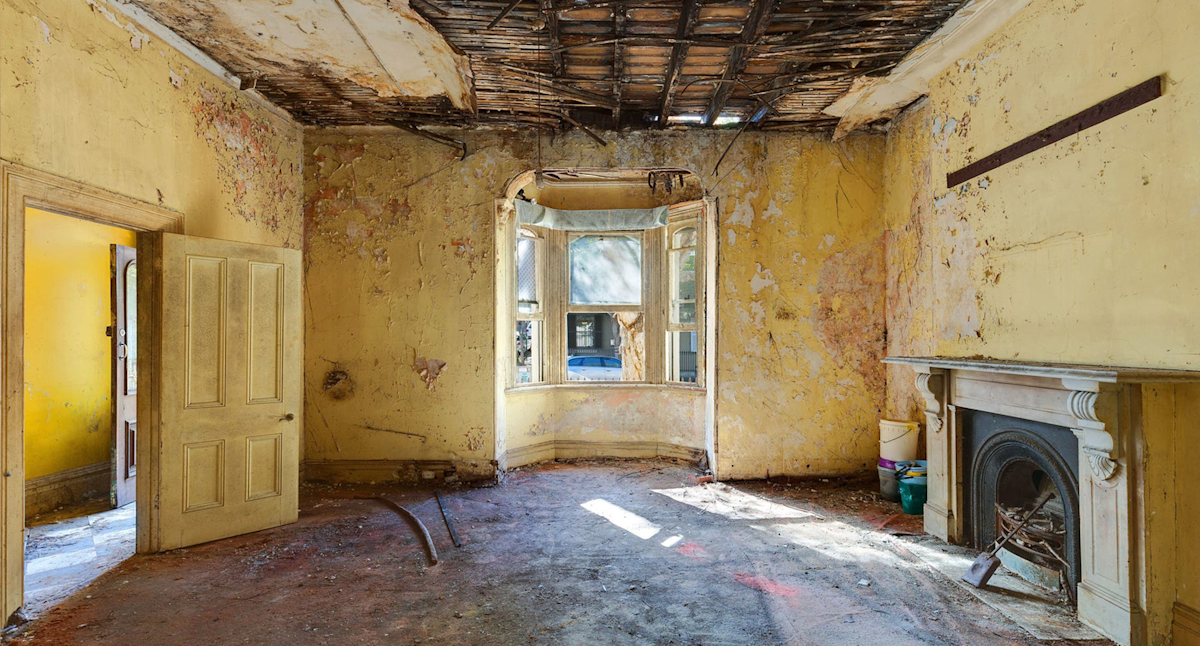
 This uninhabitable Sydney house in Darlinghurst highlights the ‘illusory’ nature of out high housing ‘wealth’. (Source: Domain)
Australians are rich. Just look at how much our houses are worth.
There’s no denying we’re a wealthy nation. But with much of that wealth tied up in housing, it’s fair to question how helpful that wealth actually is.
According to data from the Australian Bureau of Statistics, household wealth rose by 3.1 per cent over the September quarter, surging to a record high, underpinned by rising house prices. For good reason, there was no shortage of headlines about how good we’re going.
RELATED
That makes us look good on paper. Australia ranked fifth in last year’s UBS Global Wealth Report in terms of wealth per adult at US$516,640 (AUD$746,665) behind Switzerland, the US, Hong Kong and Luxembourg. Australia climbs even higher in terms of overall median wealth.
However Australian Economist Stephen Kirchner says there is an “illusory” element to our growing riches, arguing that “more expensive housing makes us poorer”.
He used a rather famous example to make his case, sharing a photo of a dilapidated and uninhabitable terrace house in Sydney’s Darlinghurst that sold well above its listing price, fetching $4.6 million at auction. And that was even in 2020, before house prices really took off.
Kirchner said red tape and excessive regulation has helped drive “a massive wedge between the marginal cost of new dwellings and their price”, particularly in highly sought after sections of the market.
“You pay not for the physical structure, but for the legal right for the house to exist in its location,” he wrote in Substack over the weekend in an article titled; “The housing wealth that isn’t”.
The construction industry is calling to reduce red tape to boost housing supply. (Source: Getty) · Getty Images
Much is made of the ‘wealth effect’ from rising house prices – the notion that Australians will spend more and feel richer when their housing value goes up (not to mention the ability to tap equity) – but economists do still quibble over its true nature.
“An increase in the general price level is usually considered to have a negative wealth effect and the consumer price index includes a significant housing component via rents and the price of new dwelling,” Kirchner wrote.
“But what is true for the general price level is probably true for housing as well. An increase in house prices is a reduction in purchasing power over housing services, even if you are an owner-occupier.”
Increasing supply and using land more efficiently for housing creates more tangible wealth for a population, rather than rising prices due to supply constraints.
The Sydney-based economist used himself as an example, saying he wants to put a staircase in his house to make use of his roof space, effectively adding an additional room to his property. However local laws don’t permit it.
“So my roof space is effectively off limits as useable space, unless I can convince the local council to give me a waiver from their planning controls,” he wrote.
Kirchner said he was quoted $35,000 as the cost of applying for the necessary approvals including the cost of engaging a historian for a heritage impact statement.
Half the cost of building a home in Sydney is taxes and red tape, according to analysis commissioned by the Housing Industry Association last year. It found that 49 per cent of the money for a house and land package in a Sydney suburban development goes toward regulatory costs, infrastructure charges and tax.
In order to tackle to housing crisis in his state, NSW premier Chris Minns recently moved to lessen the powers local councils have over planning rules and housing approvals.
The building industry is also now calling on the federal government to cut regulation in the construction sector.
The government’s Productivity Commission in a report last month estimated the cost of red tape inhibiting the housing industry at $47.5 billion.
Master Builders Australia is calling on the federal government to reduce red tape to the tune of $12 billion. The group, which represents the country’s biggest residential property developers, is advocating the change in a submission to the 2026-27 budget process, the Australian Financial Review reported last week. The industry body argues it is essential if Australia is going to meet its ambitious target for new residential dwellings under the National Housing Accord.
Get the latest Yahoo Finance news – follow us on Facebook, LinkedIn and Instagram.