
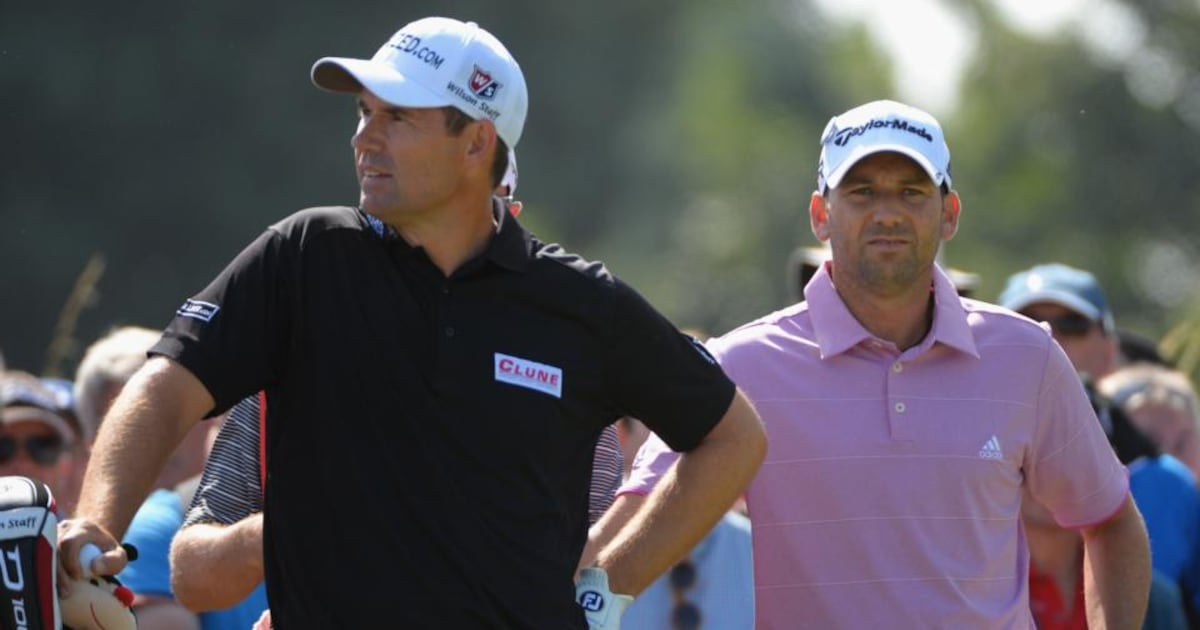
In an interview with Lawrence Donegan at the end of 2008 Pádraig Harrington was asked about his relationship with Sergio Garcia. Donegan would have known the lie of the land and where the bodies were buried, but it was the kind of question that many players would have deflected or smothered with diplomacy. Harrington dispensed with those guard rails.
“We have zero in common, bar the fact we both play golf,” said Harrington. “He is the antithesis of me, and I am the antithesis of him … We’re also competitors who for the last number of years have been vying over who is the number one golfer in Europe. I think in the hearts and minds of a lot of people Garcia would have been number one, while I have been ranked number one.”
Donegan described the “antipathy” between them as “obvious” and “the worst kept secret in golf”, even though, as Harrington pointed out, there had never been “a row or a run-in”.
Of the three Majors that Harrington had won over the previous 18 months, Garcia had been the underbidder in two of them. In his victory press conference after the 2008 US PGA Championship at Oakland Hills, Harrington was asked 12 questions, four of which made reference to Garcia, one of his playing partners in the final round. Reading the transcripts now it is hard to tell whether the reporters had caught the whiff of sulphur between them.
Golf is a game of manners, customs, self-regulation and outward decency. Even at the elite level, you will hear players compliment their playing partner’s shots. During rounds that often take more than five hours, the pros will exchange pleasantries and small talk and drop their game faces.
But unless it’s the final group on Sunday, they might not see their playing partners as their greatest opponent: a lot of the time, they’re fighting their swing, or their mentality, or the course, or the elements, or their place on the money list. Looking in from the outside, that endless battle is fascinating too.
But that’s not enough. Golf needs rivalries and needle and elements of bitterness. We need the sense that some players just hate each other’s guts, even if that is unspoken. There is too much general chumminess. Marquee groups – the made for television confections for the opening rounds of a tournament – are too often populated by players who like playing together.
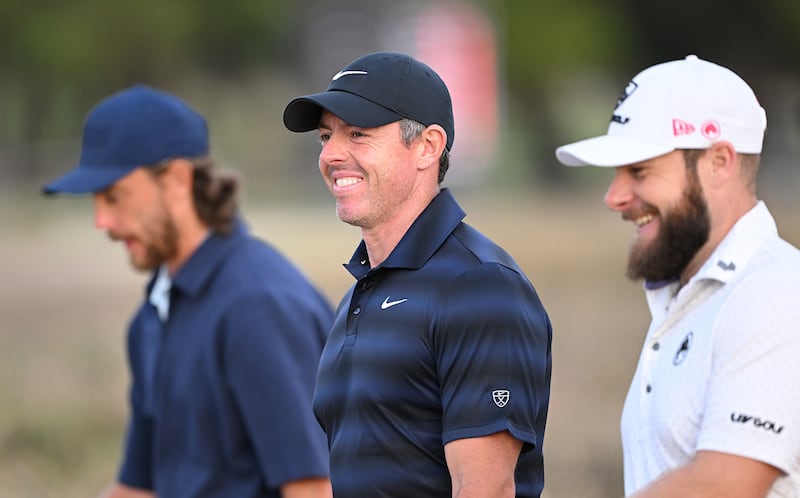 Chummy: Organisers appear hell-bent on buddy golf groupings, such as Ryder Cup team-mates Rory McIlroy, Tommy Fleetwood and Tyrrell Hatton (pictured during this weekend’s Dubai Desert Classic). Photograph: Ross Kinnaird/Getty Images
Away from tournaments, many of them live in little sun-kissed communities and practice together. TGL, the indoor golf league headlined by Tiger Woods and McIlroy, is a laboratory example of giggling collegiality among many of the best players in the world.
When Europe’s top Ryder Cup players turn up at a DP World Tour event the organisers seem to be only interested in buddy golf. Ideally some permutation of Rory McIlroy, Shane Lowry and Tommy Fleetwood, or maybe all three served in a timesheet sundae. It’s nice and its sweet, but we need a little bit of whatever was going on between Harrington and Garcia.
Outside of Ryder Cup week, there is no obvious needle between any of the top players. Who does Scottie Scheffler have beef with? There must be somebody, but nobody we know of.
McIlroy didn’t spare some of the LIV defectors as they were walking out the door, but he clearly has no problem with Jon Rahm, for example, or Tyrrell Hatton, who took the tainted Saudi shilling and still turned up in Bethpage, beating the crest on their European jumpers.
Last week in Dubai McIlroy said that Rahm and Hatton should pay their fines to the DP World Tour essentially so they can still be members and therefore eligible for Ryder Cup selection. A legal process on this matter may finally come to a head in February.
McIlroy made his remarks knowing that he would be playing with Hatton (and Fleetwood) for the opening two rounds. Would that be a problem? Waiting on the fourth tee on Friday there was nothing but bonhomie. “Only good vibes here among these good friends,” said Nick Dougherty in the Sky Sports commentary.
Through the decades, though, some tension between the best players in the world was par for the course. Nick Faldo and Seve Ballesteros didn’t get along and only buried the hatchet on Ryder Cup weeks. Woods and Phil Mickelson were incompatible too, even on Ryder Cup weeks.
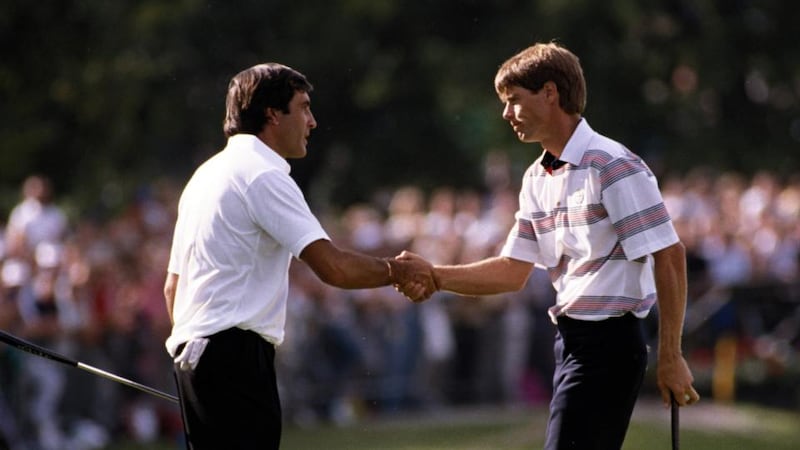 No love lost: Team Europe’s Seve Ballesteros (left) famously said the USA’s 1989 Ryder Cup team was made up of “11 nice guys and Paul Azinger”. Photograph: Getty Images
Ballesteros and Paul Azinger had a running spat towards the end of Ballesteros’s career. Faldo insulted Azinger in one of his books. Tom Watson accused Gary Player of cheating once after a televised skins match. Many years later, Watson and Mickelson fell out publicly after Watson’s ineffective captaincy of a US Ryder Cup team. Big-time golf was full of these undercurrents.
Players like Faldo and Woods didn’t court affection or necessarily care if it landed on them. They only cared about winning. They weren’t interested in small talk on the course or being friends with any of their biggest rivals.
Faldo fell out with Mark James, publicly and spectacularly, when James didn’t give him a captain’s pick for the 1999 Ryder Cup; James, for his part, was a polarising figure too. Faldo and Garcia didn’t get along either, the tension in their relationship stemming from Faldo’s disastrous Ryder Cup captaincy in Valhalla and Garcia’s performance that week.
When Garcia became Europe’s all-time leading points scorer in Paris, 10 years later, the Spaniard was asked for his reaction. “This means a lot to me,” Garcia said, disguising his punch. “I have passed some of my heroes today – and Nick Faldo.” That kind of stuff was a kick of chilli in the dish.
In the old westerns, the cowboys who wore white hats were the heroes and the cowboys who wore black hats were the villains. When LIV Golf was established, too many of the black hats left.
Brooks Koepka has negotiated his return, and even though he is not the player he used to be, his cold arrogance will bring something to the PGA Tour.
Bryson DeChambeau is making too much money to do a U-turn, and that is also true of Rahm. But Dubai Desert Classic winner Patrick Reed, the most disliked man on the PGA Tour before he left, is angling to come back. I never thought I would say this, but they should let him.
There is too much sugar. Not enough salt.