
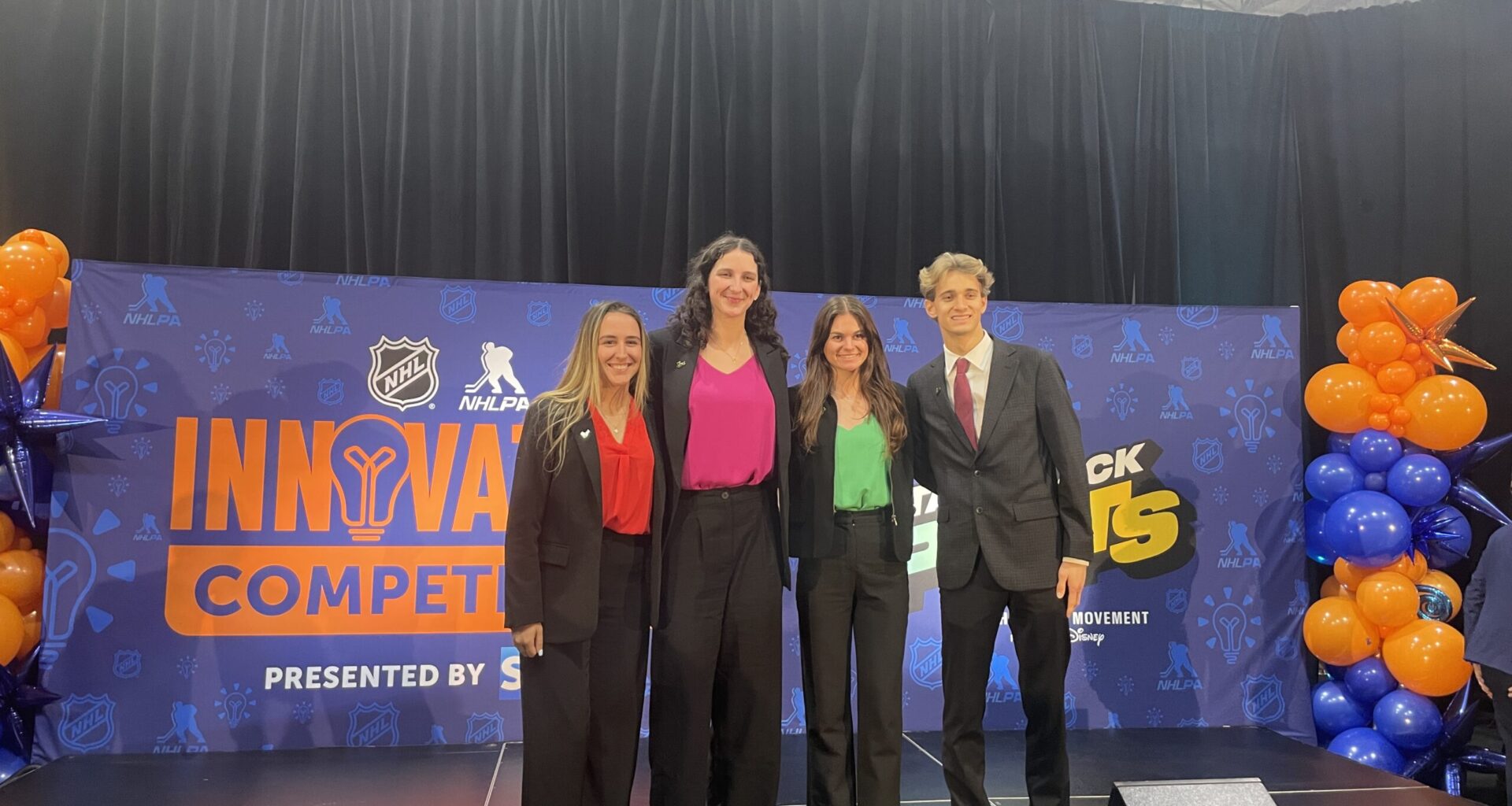
 USF students part of the Vinik Sport and Entertainment Management Program won the Change Maker award as a part of the NHL’s Hockey Innovation Competition at ESPN’s Wide World of Sports in Orlando. ORACLE PHOTO / MITHIL VYAS
Hockey’s future growth in Florida may not start on the ice, but in Hispanic and Latino community spaces built around food, music and connection.
Four USF graduate students believe those gatherings can serve as a welcoming first introduction to the sport through a new, community-first event proposal.
Claire Maloney, Emma Mussante, Kylie Haffner and Anthony Costanzo are all first-year students in the Vinik Sport and Entertainment Management Program at USF.
Together, they created Hockey Unidos — a grassroots proposal built around monthly, community-first ball hockey activations rooted in Hispanic and Latino culture.
Maloney, 21, said the idea came to life through the group’s research into untapped potential to grow the NHL’s fanbase.
Ice hockey accounts for just 4% of self-declared favorite sports among fans in the U.S., according to Fox Sports.
“We saw that 94% of Hispanic males reported being sports fans,” Maloney said. “But, less than 7% follow the NHL.”
Their idea earned the group the Change Maker Award at the NHL Hockey Innovation Competition on Thursday at ESPN’s Wide World of Sports in Orlando.
The NHL Hockey Innovation Competition, presented by SAP and supported by ESPN’s Take Back Sports initiative, is designed to bring in fresh ideas from college students to help grow the sport.
The award recognized the most practical and ready-to-launch concept among 28 submissions from 12 colleges and universities across Florida.
Six teams advanced to the final round to present their proposals to NHL and industry leaders.
But the win for the students came with more than recognition — as they received a $2,000 scholarship and tickets to the 2026 Navy Federal Credit Union Stadium Series.
Related: USF men’s basketball’s second-half surge fuels victory over FAU
Instead of arenas, the group’s concept centers on utilizing unused community spaces for gatherings, food and family events.
Each event would include ball hockey, Spanish-language NHL broadcasts, music, giveaways and Hispanic-owned food vendors.
Mussante, 23, said their research showed strong interest among Hispanic and Latino residents in local gatherings, which led them to focus on that population.
“We also found that 63% of Hispanic and Latino residents want community events in general,” Mussante said. “So why not hockey? Since it’s such a growing sport in Florida.”
So, Miami emerged as a natural pilot market, as 44% of the designated market area identifies as Hispanic or Latino — the region’s largest demographic group.
Related: Derrick Brooks brings ‘Game of Life’ philosophy to USF
The intent, Maloney said, was to elevate Hispanic and Latino voices in a way that felt genuine rather than promotional.
“Hispanic culture and heritage is such an important part of Florida culture and heritage,” she said.
Haffner, 23, said Florida’s cultural diversity made the concept feel necessary.
“Especially down by Miami, like Hispanic culture is such, like a center to all the culture down there,” she said. “And we just felt like we could represent them a little more and make sure they had a voice in the conversation of the future of NHL.”
Haffner said the idea was reinforced by personal experience, recalling a friend from Mexico who attended his first hockey game in Orlando.
“We brought him to a hockey game, and he was like ‘I never knew that this was so fun,’” Haffner said. “We want to do that for anybody who might be interested in the sport… everyone’s welcome in hockey.”
On the finance side, Costanzo, 23, focused on making sure the concept could work if adopted.
Each monthly gathering would cost about $12,000 — with roughly $3,000 for staffing, operations and equipment, $2,000 for giveaways, and around $1,000 each for marketing, food, entertainment, permits and insurance.
Still, the team highlighted the design as sponsor offset, allowing the events to be held in corporate parking lots and driving foot traffic to and from them.
Related: USF’s Brian Hartline becomes highest paid coach in program history over Golesh
That balance of creativity and practicality is what appealed to NHL officials in Orlando.
Mandi Duhamel, the NHL’s vice president of industry growth and community development, called the team’s proposal practical and ready to implement.
Duhamel said the students presented a complete business plan with all the operational details, making it a concept the league could seriously consider.
The competition itself, she explained, was designed to gather fresh ideas from outside the NHL’s usual circles.
“We thought the next generation was the best place to go,” she said.
NHL Commissioner Gary Bettman praised the creativity of participants, calling the event an exciting showcase of innovation with the potential to make a real impact on the sport.
“I’m thrilled with the level of engagement to creativity, how smart the participants are,” Bettman said.
And with the NHL continuing to explore how its fan base can grow, Bettman said innovation like that showcased at the event reflects an encouraging direction for the league.
“The game has never been better,” he said. “Everything starts with the game, and our fans are the most avid, the most loyal, the most passionate.”
Related: USF’s new president could earn nearly $2 million in first year
Haffner said she felt acclaimed after the team was announced as the award winners.
“Honestly, just extremely honored,” Haffner said. “We were in such good company.”
For Mussante, the recognition signaled that the NHL had truly taken their idea to heart. She said the league’s support showed the importance of making hockey more inclusive.
“I think it means a lot to see this idea come to fruition and to know the league recognizes this as an important initiative,” she said.