
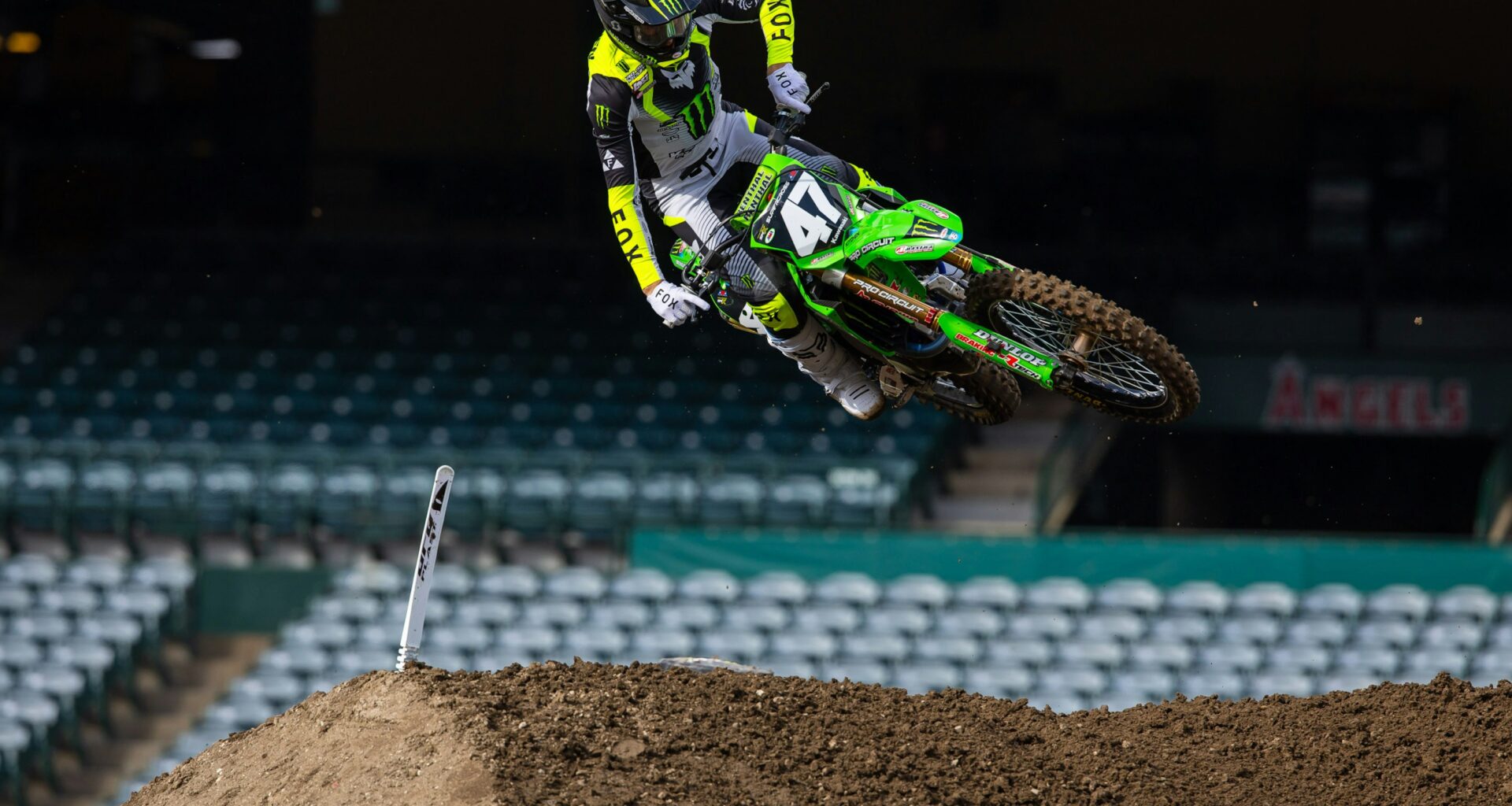
For the sand, this changed significantly from day to night. The inside was a little better in the qualifying sessions and most stuck to it. When the track crew reworked the track in the evening, though, they built a nice berm that encircled the outside of the track. Riders could then hammer the berm and carry a ton of momentum. Watch Hunter Lawrence in the early laps of the main event. He didn’t realize that line had formed and got passed a few times there.
Levi Kitchen had a seriously wild crash in his heat race, literally doing a front flip and somehow coming out unscathed, and still qualifying. Have you ever seen anything like that?
This was about as fortunate as one can get in a big crash. The face of that jump had softer dirt in it from the rebuild and when riders sat into the face, they went much deeper into the stroke and then rebounded violently. This type of thing is always a risk with the first heat. Subtle changes to the jump face, whether dirt or angle, can have disastrous consequences. Orlando 2006 and Daytona’s whoop changes come to mind with this type of scenario. Kitchen caught a huge break to escape uninjured.
Speaking of Kitchen, he exited the race after his starting device didn’t come loose. What could have caused that to happen?
The starting devices are pushed to extremes nowadays. The metal grates provide excessive traction so the bike wants to wheelie more than dirt. To counteract that, riders are pulling their front end down to ranges that have never been seen. To unlock that, a hard compression needs to be enacted (lower than the locking point). If a rider has a mellow first corner or if there is any hitch in the mechanical side, it can stay locked. It doesn’t happen often but it can. The fix is to hit a jump or braking bump to get that compression needed (assuming there isn’t a mechanical issue).