
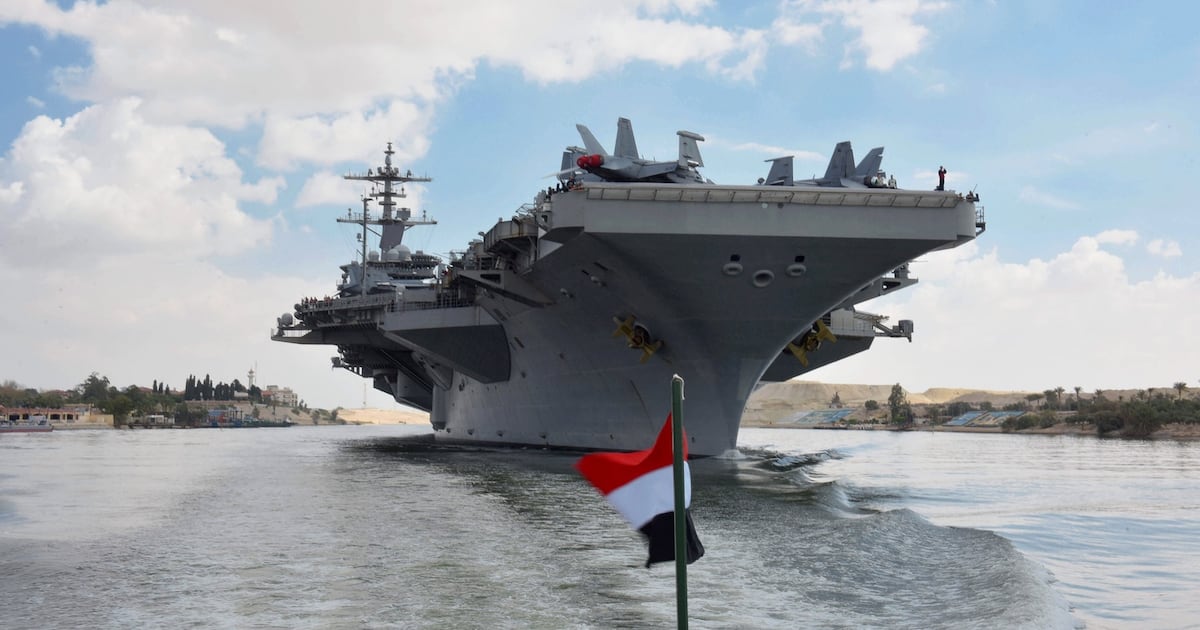
A US aircraft carrier and its supporting strike group arrived in the Middle East on Monday in response to tensions over the recent clampdown on protests in Iran.
The deployment of the USS Abraham Lincoln in the Gulf has prompted Tehran to warn of attacks against Washington’s regional allies and assets if it is targeted.
A senior Iranian official told reporters: “This military build-up – we hope that it is not something for real confrontation – but we are ready for a worst-case scenario.”
He said Iranian retaliation would be far more destructive than strikes launched against Israel during last June’s 12-day conflict, which Iran did not consider a threat to the regime.
Speaking about the earlier conflict, the official said: “Iran tried to be very restrained, predictable and measured in its responses to both Israelis and Americans. This time, we take any attack – limited, unlimited, surgical, kinetic … whatever they call it – as an all-out war against us. And we will respond in the hardest way possible.”
[ Women against Iran’s regime: ‘Freedom is fragile… do not take it for granted’Opens in new window ]
US president Donald Trump assembled the armada after threatening military action if Iran executed citizens detained during recent mass protests against Tehran’s regime.
The executions did not happen, and Trump subsequently suggested that he wants to “make a deal”.
The US president previously used an escalation in tensions to secure his objectives in negotiations. Both sides appear to be engaging in shadow-boxing, and neither wants war.
Trump believes himself to be in a strong position. Iran’s defences were breached and the government was weakened by US and Israeli bombing in June, while its “axis of resistance” – Lebanon’s Hizbullah, Shia militias in Syria and Iraq and Yemen’s Houthis – has been contained.
The US is demanding that Iran end uranium enrichment under its nuclear programme, curb support for allies, and limit its arsenal of ballistic missiles.
The first two demands have been met. Uranium enrichment ceased in June after US-Israeli strikes on major nuclear facilities, while Iran’s allies have been crippled by US and Israeli action. However, Iran insists on maintaining its arsenal of ballistic missiles as a deterrent.
Iran’s options are limited to striking US bases and oil sector targets in the Gulf and disrupting the flow of oil through the Gulf of Hormuz. The country is unlikely to attack Israel, as this would draw joint Israeli-US retaliation and could result in the strategic targeting of Iran’s Revolutionary Guards Corps, the mainstay of the regime, as well as government facilities and leading political figures.
Oman, Qatar and Saudi Arabia have been lobbying behind the scenes to promote contacts between Washington and Tehran, while the United Arab Emirates foreign ministry said the federation would not allow its airspace, territory, or territorial waters to be used for attacks on Iran.
The US-based Human Rights Activists News Agency reported 5,848 deaths and 41,283 arrests during the recent protests in Iran. The Iranian authorities have said 3,117 people were killed, and have not given details of numbers of arrests.