
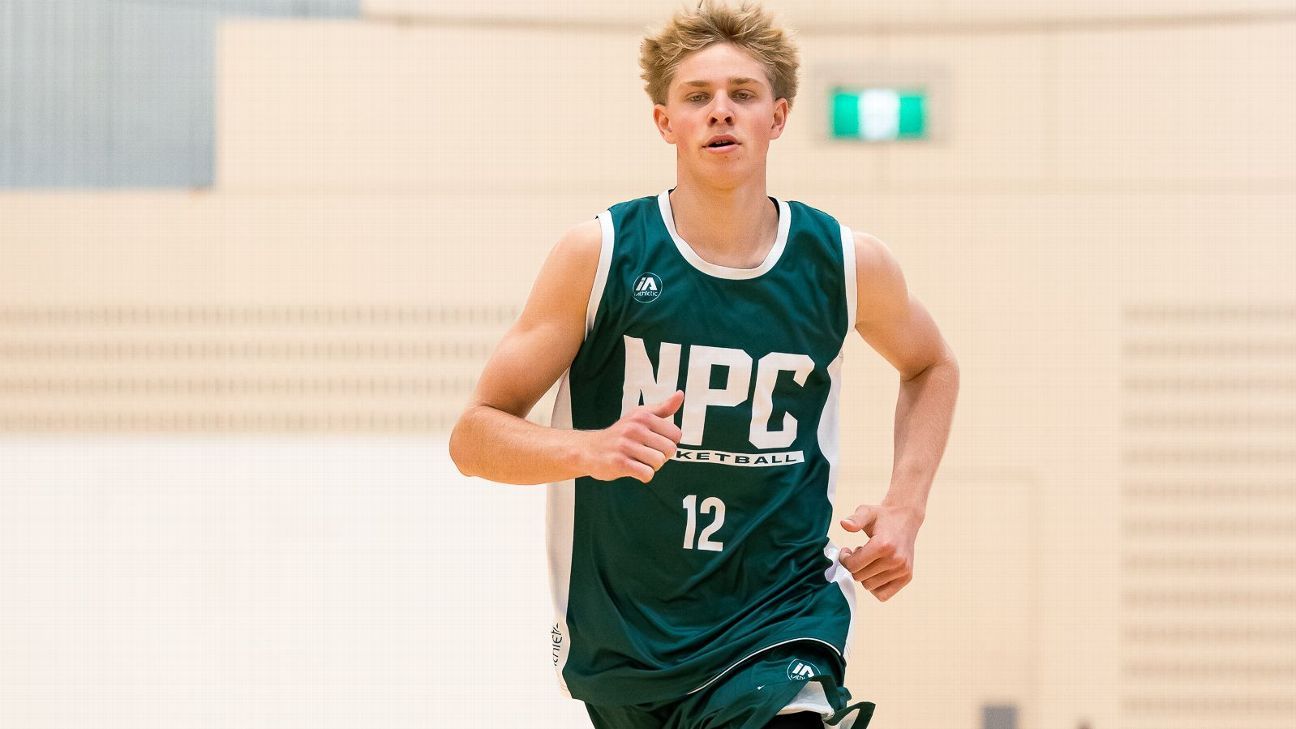
If the 2026 edition of the annual National Performance Camp is anything to go by, there’s good reason to be optimistic about the future of Australian basketball.
Around 50 of the country’s best boys and girls basketball prospects descended onto Canberra in the end of January to participate in the annual, invite-only camp — which is a gateway into the Australian national program — with an eye toward identifying Boomers and Opals of the future.
Naturally, the talent level was high – featuring the country’s best 2009-born and 2010-born prospects – and there was an intensity level to match. Once again, the boys’ side of the camp was run by the Centre of Excellence’s Robbie McKinlay and Braden Cotter, both of whom offered an admirable balance of guiding skill development while also instilling a strict value structure among the 23 athletes involved. Australian basketball great Dave Andersen was among the coaches who would help guide the players; the four-time Olympian playing a key role with the young big-men at camp.
A big takeaway from the lead coaches involved was the performance of the bottom-age talent – there’s a high level of excitement at the depth coming through – as well as the understanding and use of the big-men over the duration of the camp.
A handful of NBA teams sent representatives to the camp, while the NBL’s General Manager of Next Stars Recruitment, Liam Santamaria, was also in attendance. Surprisingly – and disappointingly – no NBL teams sent representatives; a contrast to last year, where multiple made the trip to the nation’s capital.
The event was useful in multiple ways. There’s value in seeing the development of the 2009-born athletes relative to their performance in last year’s camp, while this was our first opportunity to get eyes on the 2010-born players within the national setup. This was also an opportunity for Greg Vanderjagt – head coach of the Australian under-17 team – to get an early eye on the athletes ahead of selections for the 2026 FIBA U17 World Cup in late June.
ESPN was in attendance for all four days of the camp; here’s a breakdown of the prospects who impressed.
Luke Paul – 6’6 point guard (2009-born)
Fresh off signing a multi-year deal with the NBL’s Next Stars program, Paul entered this camp with lofty expectations; and, throughout the week, he managed to fulfil, and arguably even exceed them.
Paul confirmed some of the evaluations that had been made about his game and capacity: here’s this 6’6 – and still growing – point guard with an elite feel and high-level floor game, who met the expectation of being the country’s top 2009-born NBA prospect. He’s in a league of his own among this cohort as a passer and playmaker, where he uses his size to see over defences and find passing windows. He excels in the open floor – playing downhill is where he’s at his most threatening – and is an underrated crasher on the offensive glass.
Luke Paul at the National Performance Camp. ESPN
Unlike some of the jumbo Australian point guards who came before him, Paul’s jump-shot is a legitimate part of his game, with his mechanics looking extremely functional; put simply, with his size and ability to shoot the ball, he could play on the wing with no issue.
On the final day of action – during the Green vs Gold game – Paul took over the contest in the second quarter, playing the passing lanes well and getting easy scores in transition, to give his team the lead going into the half. The coaches then decided to put Paul on the other team; his new team proceeded to win the second half of the game.
Paul will now embark on a very busy remainder of 2026, where he’ll play for WA Metro at the U18s Nationals in April, then likely be the primary player for the Australian national team at the U17 World Cup in Türkiye at the end of June. Of course, in the midst of all of that, he’ll also have to pick which NBL team he’ll be suiting up for as a Next Star ahead of the 2026-27 season.
Yahya Basaran – 7’0 centre (2009-born)
There was a fascinating collection of big-men at the camp, but Yahya Basaran did an impressive job separating himself from the rest of the pack.
There had been a lot of chatter around Basaran over the last eight months, that he would eventually emerge as the premier big out of this age group, and the glimpses he showed in Canberra confirmed that suspicion.
The 7’0 centre out of Türkiye – who, along with his family, is now based in Victoria – has very real size and length and showed off his good hands and impressive touch throughout the camp. Basaran has an effective post package for this level, including a few counters down low; the footwork surprising some of the NBA personnel in attendance. Basaran had some impressive finishes at the rim and around the paint, which should come as no surprise, of course, considering he had spent time over the last 12 months working out with one of Australia’s most accomplished big-men in Dave Andersen.
The big surprise with Basaran came during the third day of action, when there was a focus on shooting. We’ll have to see how it translates to real games, but he hit catch-and-shoot threes with an impressive level of consistency, with a good-looking stroke that also appeared quite functional.
There’s a sense Basaran – like every big at the camp – is still figuring out how to use his body, so there’s an expected rawness to his game at times; a trait that’s not uncommon among young centres. Basaran has a Lachlan-Olbrich like hyper-flexibility, so it’ll be fascinating to see how he grows athletically, and if he assumes a similar mobility over the course of his career.
Will Hamilton – 6’5 forward (2009-born)
There’s a lot to like about Will Hamilton, who continued to show why he’s one of the premier players among this age group.
Where Hamilton has primarily excelled from the instances we’ve seen him over the last 12 months is with his size and athleticism; he’s been able to physically impose himself on smaller opponents. Now, there’s still a lot of that power aspect to his game – he plays the role of the typical Australian four-man to perfection – but the coaches at this camp did a great job at making sure we saw him in scenarios that are more conducive to how he’ll progress as a player.
Will Hamilton proved he’s a leader of the group and certainly going to be his role heading into the U17 World Cup. ESPN
Hamilton did drills with the wings and, for the most part, didn’t look out of place. The 6’5 forward is a great finisher at the rim, and the shot-making is better than most would expect for someone most see as a ‘bully ball’ type of player; of course, we’ve seen him demonstrate a high-level postgame over the past year as well. Hamilton is not a crazily impressive vertical leaper but has really functional athleticism across the board, and runs the floor exceptionally well.
On top of him being an impressive basketball talent, it was clear he was among the main leaders of this group, with the coaches leaning on him throughout the camp; a trait one would assume he’ll continue to carry over as the U17 World Cup approaches.
Oluwakorede Olutayo – 6’2 guard (2010-born)
One of the players who drew a lot of eyes over the week was Oluwakorede Olutayo, with the guard looking really impressive as an advantage creator off the dribble and finisher at the rim.
Olutayo got to the rim with ease, where he’d lean a lot into his two-foot jump, finishing over and through defences. The combo guard out of Sydney has impressive hang-time, and showed to be a high-level finisher with both hands once he got two feet in the paint.
In the short-term, an athletic guard like Olutayo seems like a really useful addition to a potential Australian team for the U17 World Cup, where his ball-carrying – while also having the ability to play off the ball – could prove important.
Longer term, though, it’ll be fascinating to see if he breaks out of the ‘combo guard’ mould he’s clearly in. If Olutayo refines some of that point guard skillset – tightening his handle and developing his playmaking even more – it would dramatically raise his ceiling as he progresses through his career.
Samson Nathan – 6’5 guard/wing (2010-born)
Here’s one athlete that was tough to ignore.
Samson Nathan is a psycho in the best possible way. The 6’5 off-guard was among the hardest workers all week, culminating in a Green vs Gold game where he was seemingly everywhere. Nathan would’ve had at least six or seven deflections in the game, ran the floor harder than everyone, made countless hustle plays, and was clearly playing through multiple injuries that came as a result of those hustle plays.
Samson Nathan stood out for both his work rate and skillset. ESPN
The work rate was what stood out, but there’s a skillset there too. Nathan is a really solid athlete and, while he’s not an absolute knockdown shooter, he seemed to have enough functional shooting to his game; and he made enough on the final day of action to trust it’ll continue developing.
The size for his position is what initially draws the eye, but the work-rate is the thing that makes it difficult to look away, so the hope is that part of his competitive nature is appreciated as he progresses through his junior career.
Riley Saville – 6’4 guard/wing (2010-born)
There’s something very simple about Riley Saville’s game that makes him an intriguing player to track going forward.
Out of every player at the camp, Saville’s jumper seemed the most natural; there was a consistency to the mechanics, whether it was a quick catch-and-shoot or during drills where he’d come off turnouts. He has solid size for his position and, during the Green vs Gold game, played the role of ancillary shooter and secondary playmaker extremely well.
STAY IN THE KNOW WITH ESPN
Stay across all the big sports news — sign up to our weekly newsletters here!
SUBSCRIBE
If there was one player from this camp who projects as a potential shooting specialist as he progresses through his career, it’s Saville, and there seems to be an admirable maturity to accept that sort of role within this national team environment.
He’s, of course, the son of former Boomers wing Glen Saville.
Isaiah Jorgenson – 6’7 forward (2009-born)
Isaiah Jorgenson has been one to watch since last year’s National Performance Camp, so it was good to see him show some impressive flashes of growth over the course of the week.
What makes Jorgenson an interesting prospect is that, when he’s amid his Queensland program, he hovers more within the frontcourt, as a paint presence on the offensive end. It makes sense, because he does have great touch around the basket and a unique ability to finish around and over traffic.
Isaiah Jorgenson showed some impressive flashes of growth. ESPN
Of course, as he rises up the ranks and plays a higher level of basketball, he projects more as a wing – it’s also worth noting that he’d be quite lean for a frontcourt player – and, to his credit, he showed more than enough of a perimeter skillset in Canberra to trust that he can excel in that position.
Jorgenson has shown enough spot-up shooting chops to think he can continue to emerge as one of the country’s best wings, especially because he has great size for his position at 6’7. During the game on the final day of action, Jorgenson also showed some glimpses of ball-carrying and creation; a part of his game that, if it develops, could elevate his ceiling in a substantial way.
Who else stood out?
There were some players who deserve an honourable mention for how they performed throughout the camp, showing off some moments that caught the eye.
Riak Akhuar is a 6’8 wing who appeared to show some real promise as a wing who can really catch-and-shoot. It’s rare that players with that physical profile show shooting potential this early, so he’s one worth tracking going forward.
Tom Dammers has been a regular fixture in these camps and on junior national teams for the past year, and the 6’3 guard was among the more mature competitors over the week. He’s a good ball-carrier, reliable as a catch-and-shoot option – particularly out of the corners – and has a high work-rate, really effectively picking up full-court.
Outside of Basaran, Will Dooley was the big-man who looked like he could make an impact at the state – and potentially national – level in the near future. He’s around 6’11 and showed solid touch finishing at and around the rim, while demonstrating a level of maturity with his spacing and positioning over the week.
Antonio Browne dealt with some minor injuries throughout the week – he had an elbow concern coming in, then suffered a head knock during the game – so he wasn’t able to show off the extent of his capabilities, but he’s a known quantity so he’s worth highlighting. Over the week, the 6’4 guard continued to show that he’s a solid ball-carrier, with impressive footwork and finishing around the paint.
It’s also worth noting that Tasmania’s Johnty Dynan suffered an injury on the first day of action and didn’t participate for the remainder of the camp. Victoria’s Josh McCann sat out the majority of the week with an injury, then got re-injured – both minor – in the middle of the Green vs Gold game, so there wasn’t enough sample size to evaluate him either.