
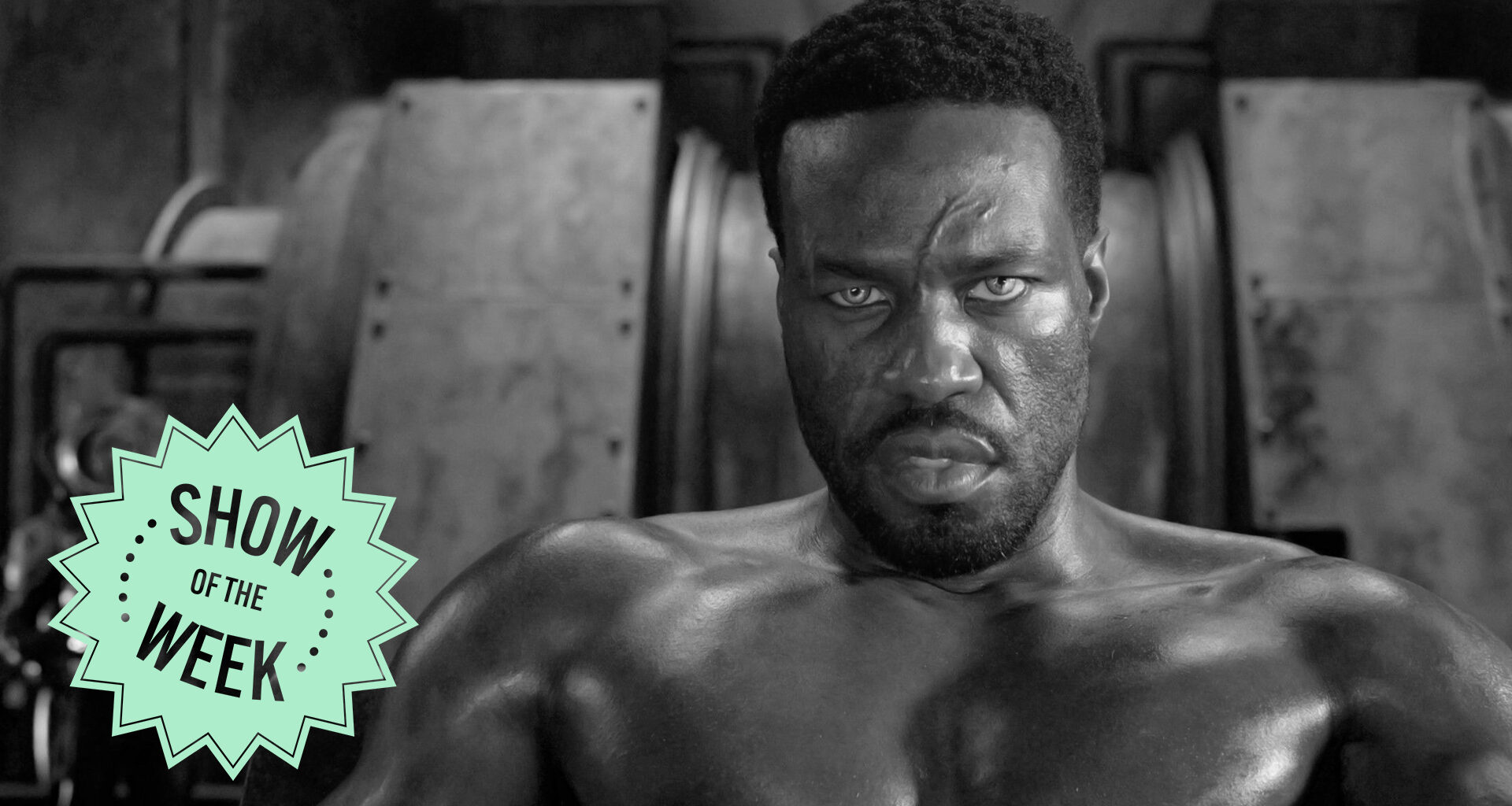
In Wonder Man, the Marvel Cinematic Universe attempts to justify itself. Its meta-narrative about the casting and shooting of an intergalactic superhero remake sees its Oscar-winning director Von Kovak (Zlatko Burić) argue that even the schlockiest of origins are no barrier to creative achievement—David Cronenberg, after all, turned a 1958 B-movie into his genre-defining body horror The Fly.
That scene, and quite a few others in creators Destin Daniel Cretton and Andrew Guest’s eight-part series, expose the tension at the heart of the modern superhero film like flesh peeled back to reveal muscle. It’s all come down to this, now, for the MCU: moving forward requires innovation, while paddling in place only requires nostalgia. And yet: the longer the latter prevents the former, the more likely the whole thing finally implodes.
Wonder Man itself is a charming standalone story that feels already abandoned by the powers that be. Actor Simon Williams (Yahya Abdul-Mateen II) is desperate to land the lead in Kovak’s film. The original was his dearly departed dad’s favourite, and his own career is in total stagnation.
During the audition process, he develops an unlikely friendship with Trevor Slattery (Ben Kingsley), the man who once took the guise of the Mandarin in Iron Man 3. He’s back in Hollywood now, returning to his old career ambitions. But Simon’s hiding a big secret: he can control ionic energy, which, for someone who’s never enrolled in the Avengers or pursued herodom in any form, has mostly entailed accidental property damage.
Wonder Man is a tale of two parts. One is a lo-fi buddy comedy about two thespians self-obsessed in entirely different ways. Simon is the overthinker, happy to derail a shooting schedule in order to fixate on subtext and character backstories; Trevor, meanwhile, is all wild instinct.
The other is the MCU puzzle piece. Its look tries to blend both—sparse prestige television grit (think The Bear) and high-Marvel sheen—and ends up a little odd in the process. But, mostly, Wonder Man works because Abdul-Mateen and Kingsley make such a wonderful pair. The latter makes a feast of both Shakespearean verse, and lines like: “I feel like Stevie Nicks having coke blown up her bunghole.”

Tension in this series bubbles up every once in a while, in sometimes curious ways. It’s meant to be standalone, yet feels distinctly like foundational work for the franchise’s planned X-Men-centric future. It’s never specified whether Simon is a mutant or not, but the series does introduce “the Doorman Clause”, a ban on superpowered individuals working in Hollywood, for fear they’d present a financial liability.
It’s interesting timing to see Wonder Man toy with the kind of quotidian discrimination typically directed towards mutants, and all the marginalised communities they represent. And it’s interesting, too, that Simon is largely defined by the way he clings to the past. He’s a true-blue cinephile with the Dr. Strangelove poster to prove it (he’s definitely paying for a patron account on Letterboxd!), who struggles to be present and authentic because he’s so fixated on reliving these old classics rather than pursuing his own imagination.
He finds a way to break past that barrier, and yet, at the very same time, the series buys fully into the obsession with replicating iconic costumes stitch-by-stitch – something that appears to be 90% of the selling point when it comes to bringing back the Fox X-Men cast for this year’s Avengers: Doomsday. Wonder Man betrays how deep in an identity crisis Marvel currently is. But that, funnily enough, is also what makes the show as good as it is.