
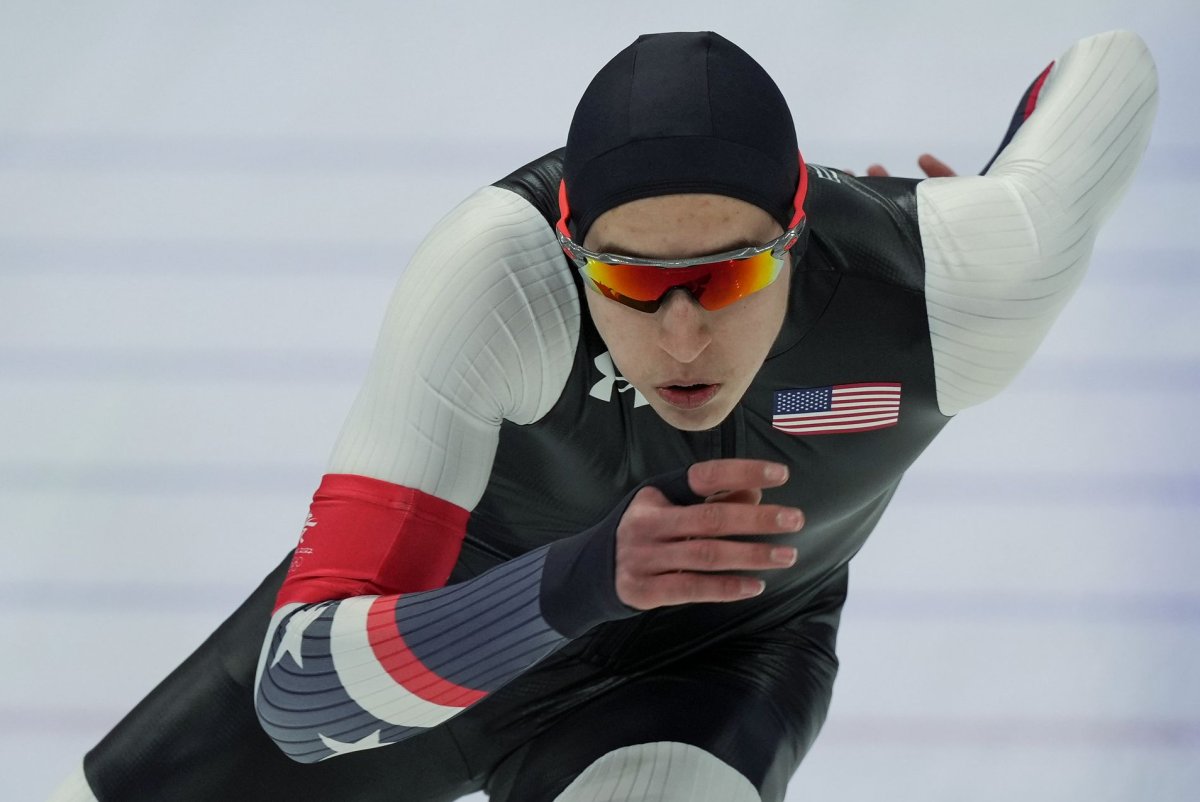
MIAMI, Jan. 28 (UPI) — Speed skaters mostly frolic on frozen floors, but when they aren’t slicing ice during the Winter Olympics, they can be found biking hundreds of miles, using power unmatched by some professional cyclists.
And that regimen is key to building a base and sculpting gold medal contenders, Team USA’s Jordan Stolz and Erin Jackson told UPI.
They swaps boots and blades for road bikes for what they deem “intense” summer training. Stolz’s training menu sometimes features weekly totals of more than 425 miles, with 5-hour rides that cover 85 miles.
“What makes it worse is you are tired from doing a lot in the weight room,” Stolz said. “There are a lot of squats and stuff. Your legs are already dead and you’ve got to hit a 5-hour ride. It’s not that enjoyable.”
Stolz, 21, is to compete in the 500-, 1,000- and 1,500-meter sprints, as well as the mass start at the Winter Games. The Kewaskum, Wis. native, who grew up idolizing six-time Olympic medalist Apolo Anton Ohno, is aiming to make his own mark — as the favorite in all four events — next month at Milan Cortina 2026.
Stolz, the world record holder in the 1,000 and American record-holder in 500 and 1,500, ranks No. 1 in the world in all three distances. He powered his massive legs with not just intense weight lifting, but also by pedaling up to a maximum wattage of 2,100 to 2,300, power akin to a professional track cyclist and even beyond some riding in the Tour de France.
Stolz, who dominated the latest World Cup with 16 victories in 23 races, does some of that work alongside fellow speed skaters from his Dutch team on treks through mountains in Tenerife, Spain, when he isn’t cruising the Wisconsin streets.
“The summer is way harder than the winter, but you have to do it to be able to build a huge base,” Stolz said. “The winter is more like you climb to the top and your 100-meter time starts going down, your 500-meter time starts getting in the range you want it to be. Summer is more like a build up for the entire winner.”
Stolz, who crashed while traveling 40 mph in June, cycles on a daily basis, with some shorter workouts mixed in. He said that he couldn’t quite match long distance speeds of four-time Tour de France winner Tadej Pogacar, but “sprinting would be a different story.”
Jackson, who became the first Black woman to win a Winter Olympic gold medal in an individual sport in 2022, will look to defend her 500-meter title and plans to compete in the 1,000-meter finale.
The 33-year-old Ocala, Fla. native, known for her transition from an inline skating sensation to speed skating champion, called cycling her “main form of cardio.”
Jackson and Stolz, who are part of the Hershey’s It’s Your Happy Place campaign, are doing solo workouts at this time of the year. Jackson said she met with teammates for rides three or four days each week during the summer.
The speed skaters also mix in dry land, which consists of simulating skating movements and positions in your shoes. Jackson and her teammates are on the ice five days each week and weightlifting at least twice each week.
Pressure is inherent for these Olympic athletes, but physical demand often tips the scale. When they aren’t building endurance through cycling, they are attempting to find ways to avoid injury.
Costly tolls are paid due to the stress they put on their bodies and nature of the sport, which requires unnatural bending and weight baring movement.
“Back injuries are really big,” Jackson said. “I’ve heard of hip and knee injuries, but they are not as common as the back. I think if you scanned the spines of all speed skaters, at least 80% to 85% would have some sort of disc herniation. It’s a pretty big thing in our sport and something we are all trying to be really proactive about.”
Jackson said she needed to alter her training during the Olympic cycle due to three disc herniations in her lower back. She also tore her hamstring this fall.
She increased elliptical machine work and uses aqua jogging to compensate for the issues, but mostly does training similar to her eight teammates.
“I would say the main differences would be in our preparation in our warm-ups and cooldowns and things like that,” Jackson said. “I do more of a customized thing in that regard to the injuries I’ve had and trying to maintain everything.”
Athletic injuries often trigger mental battles. Jackson said she remains motivated by competition and self improvement, even if the progress is slow. She said the simple act of skating in circles all day is how she finds happiness.
“My goal is to try to be better than yesterday’s Erin,” Jackson said. “Trying to keep that motivation going, that’s kinda what drives me. … My go-to inspirational piece is to take things one day at a time.
“If you think about a big goal, like wanting to be an Olympic champion, something like that can seem really big and overwhelming to tackle all at once. But if you break things down and think, ‘What’s one thing I can do to take me one step closer to that goal?’ Then take one step after another. That’s a less intimidating way of tackling your big goals.”
The 2026 Winter Olympics speed skating schedule will start with the women’s 3,000-meter final Feb. 7 at Milano Speed Skating Stadium.
The men’s 1,000-meter, 500-meter and 1,500-meter finals will be held Feb. 8, 14 and 19th, respectively. The women’s 1,000-meter finale will be Feb. 9. Jackson will look to defend her title in the women’s 500-meter final Feb. 15.
The men’s and women’s mass start finals will be Feb. 21, the final day of competition.

Los Angeles Dodgers pitcher Yoshinobu Yamamoto (C) celebrates with teammates after the Dodgers defeat the Toronto Blue Jays 5-4 in 11 innings in Game 7 to win the World Series in Toronto on November 1, 2025. Photo by Aaron Josefczyk/UPI | License Photo