
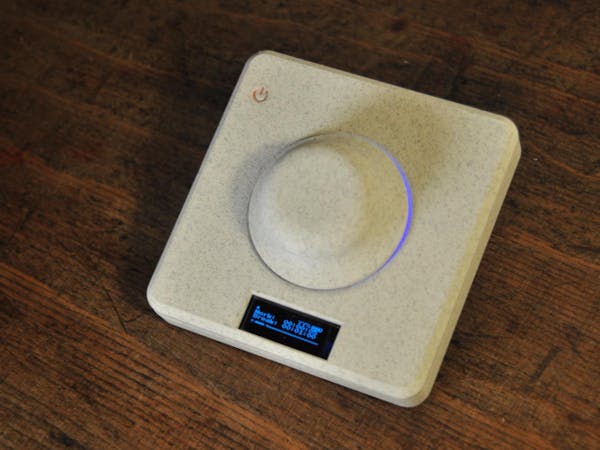
Maker Konrad Wohlfahrt, also known as “Donut Studio,” has gone back to the drawing board to design and release a slicker — though, he admits, somewhat trickier-to-build — version of his Focus Wheel study assistant: the Focus Wheel 2.0.
“I was always happy with how the Focus Wheel looked and felt, but there was one issue I didn’t see coming: the power supply. I tried to keep things simple by powering it through a USB-A port,” Wohlfahrt explains. “That meant using a power bank, which worked… but wasn’t ideal. It took up extra space on my desk, felt a bit clunky, and made the whole setup less portable when studying away from home. After a while, I started asking myself: wouldn’t it be nicer if the Focus Wheel could just sit on the desk all by itself? That thought eventually led me to rebuild the Focus Wheel, this time with my newly acquired hotplate and a fresh mindset. The goal was simple: make it battery powered.”
The Focus Timer has a new look, with its creator overhauling the design for fully standalone use. (📹: Conrad Wohlfahrt)
The idea behind the original Focus Wheel was simple: create a dedicated gadget for Pomodoro-style focus-and-break timing — an hour of focused work followed by a 15-minute break, though this can be easily customized. “The timers were [originally] set up on my phone,” Wohlfahrt explains, “and keeping your phone nearby can be a major distraction. I think the best solution is to just ditch the phone altogether.” The result was a device that uses an Espressif ESP32-C3 microcontroller to drive a WS2821b RGB LED ring, a buzzer, and a rotary encoder with tactile switch, which together with a tiny 0.91″ OLED display serve as a user interface.
The redesigned version increases the component count to support an integrated battery, primarily handled by the Texas Instruments BQ24075 linear battery charger chip. At the same time, Wohlfahrt dropped the potentiometer-based slide at the side of the original Focus Wheel, and its physical push-button switches, for TT Electronics TTP223-powered capacitive touch. “The Focus Wheel is controlled using a rotary encoder and two [of the] touch modules,” the maker explains. “The same OLED display as before is used for visual feedback, and a passive buzzer with a flyback diode handles sound output. Unlike the first version, which could only produce an annoying beep, this one can generate different frequencies and even play simple melodies.”
The redesigned Focus Wheel 2.0 is detailed in Wohlfahrt’s Instructables post, while design files and source code for the original and its successor can be found on GitHub under an unspecified open source license.