
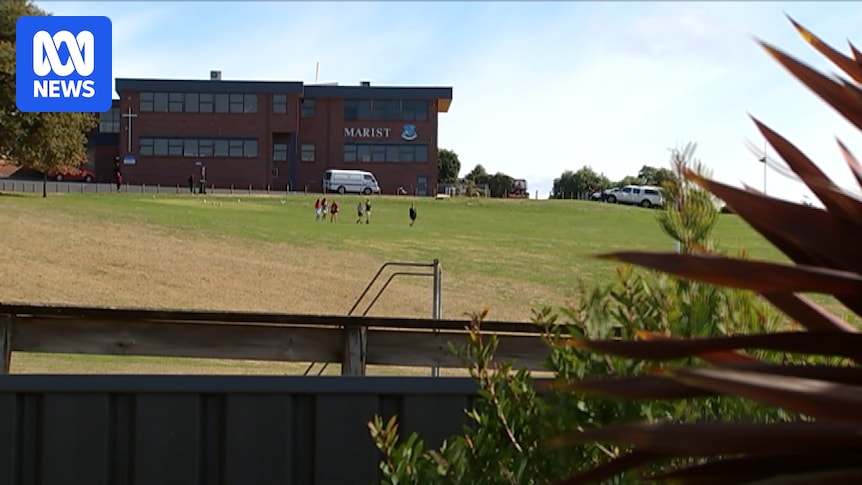
A former deputy principal at a Tasmanian Catholic School has told a parliamentary inquiry he was “treated as though morally compromised” and stood down after revealing he was in a de facto relationship.
Sam Johnstone was one of three people who gave evidence yesterday to a parliamentary inquiry into school bullying. The other two were students. All relate to different Catholic schools.
Mr Johnstone is a practising Catholic and was the deputy principal of Marist Regional College in Burnie from 2021, until he was stood down in late 2024. It was a school he also attended.
He told the parliamentary inquiry he was going through a marriage break-up, and became very close to a female colleague whose “support became critical” to his wellbeing.
The inquiry heard Mr Johnstone disclosed this relationship to the school — and that’s when things changed.
Sam Johnstone was stood down from his role of the deputy principal of Marist Regional College. (ABC News)
“From that point on, the focus shifted. It was no longer about my professional conduct, my leadership or my years of service,” he said.
“It became about my personal life or how it was perceived.
“I was judged not on behaviour, but on the relationship and marital status. Not on evidence, but on assumption. Not with care, but with process and power.”
Mr Johnstone told the commission that despite the fact there was no finding of professional wrongdoing or “evidence-based assessment of misconduct”, he was stood down from his position.
“I was treated as though I was morally compromised and had been involved in criminal-type behaviour at a time when I was already deeply vulnerable and needed support and care,” he told the inquiry.
“At that point, the discrimination became explicit.
“I was told I could not continue as a leader, and even a teacher in my school, nor could I teach in any other Catholic education Tasmania school.”
The inquiry heard the “blanket exclusion” was not based on any substantiated finding of wrongdoing, and when he attempted to negotiate, he was offered “diminished” non-teaching roles.
Mr Johnstone eventually resigned and signed a non-disclosure agreement.
He told the inquiry that agreement explicitly stated that no professional criminal wrongdoing occurred.
“I lost my role. I lost my vocation. I lost my community, when I needed all of them the most,” he said.
“And despite the severity of what occurred, there has been no accountability for those who made these decisions, while I continue to carry the consequences.”
Mr Johnstone said he had chosen to share his story in the hope it would affect change.
“People shouldn’t live in fear … whether it be young male or females, that are either heterosexual, homosexual, gender-fluid, or whatever it is they’re dealing with, or their marital status,” he said.
“People need to be able to feel safe … and they feel that there’s an arm-around approach as opposed to a punitive, out the door [one].”
Trans student placed alone in tent on school camp
St Patrick’s College student Amilie Courtney, 17, also shared her experience with the inquiry.
The transgender girl described having to navigate an education system that treated her as a “problem to be managed rather than a person to be supported”.
“The impact of this is not abstract. It is daily, practical, and exhausting,” she told the inquiry.
Ms Courtney said when she started in Year 7, her ‘dead name’ — or former birth name — appeared on the roll.
After she raised it, it was changed so that her preferred name was then shown in brackets.
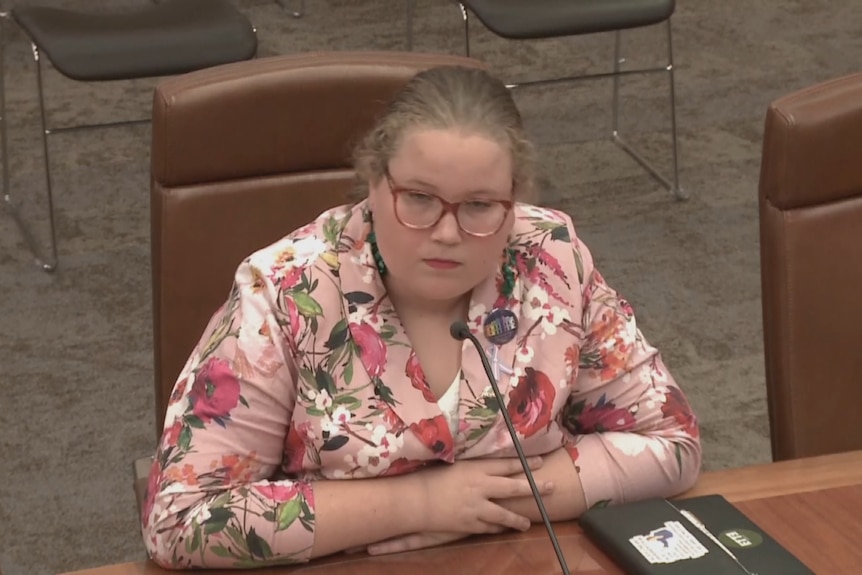
Amilie Courtney described having to navigate an education system that treated her as a “problem to be managed”. (Supplied: Parliament of Tasmania)
It was eventually fixed, but Ms Courtney told the inquiry that reports and documents were still sent home under her dead name.
“This might sound small, but being forced to repeatedly see and explain a name that does not represent you is deeply distressing,” she said.
She said bullying had been serious, sharing a story of her experience in Year 9 when one of the boys mocked her using her dead name.
“[He] told the other students in the class, ‘Call him Oliver. That’s his real name’,” she said.
“They kept yelling, ‘Oliver, Oliver, Oliver’ at me until I left the area in tears.
“I reported it and I was told the boys were given the punishment of a stern talk.
“That was it. No meaningful consequences. A few days later, I was required to spend two hours on a bus trip with these same students.
“No-one checked if I was safe. No safety plan was put in place.”
Ms Courtney also said she was placed in a tent on her own on school camps, isolated from the rest of the students.
A student detailed the experiences of being bullied at St Patrick’s College. (Supplied: St Patrick’s College)
“Normally, students are placed into small groups of the same gender and shared tents and responsibilities,” she said.
“Because I’m transgender — and therefore considered a risk — I’m not allowed to be in any group.
“I’m placed alone in my own tent and expected to manage everything by myself.
“At the campsite, the boys would have one side of the paddock. The girls would have the other. And I would be in a tent around about 100 metres away.
“So while everyone was forming friendships and memories, I was physically and socially separated.”
Ms Courtney told the inquiry all she wanted was equal treatment.
“I’m asking to be allowed to go to the bathroom to get changed, to go on camps, to be able to be called my name in a way that I feel proud of, and that the same way that other students are,” she said.
“No child should have to trade their dignity for an education.”
Staff ignored loud and explicit homophobia
Leon Pecl is a transgender man, but for a long time he identified and presented as a gay woman, including throughout his entire schooling at Mount Carmel College from 2009 to 2019.
Mr Pecl told the inquiry that throughout school he faced bullying, ostracism and harassment because of his sexuality.
“I clearly recall an incident in maths class where I was being loudly interrogated by a fellow student about my sexual orientation,” he said.
“She repeated invasive, vulgar and sexually explicit questions, that no 14-year-old should be expected to answer at all, let alone in front of their entire class.
“This happened a metre and half from our teacher who continued grading work at her desk as though nothing had occurred.”
He said incidents like this were commonplace.
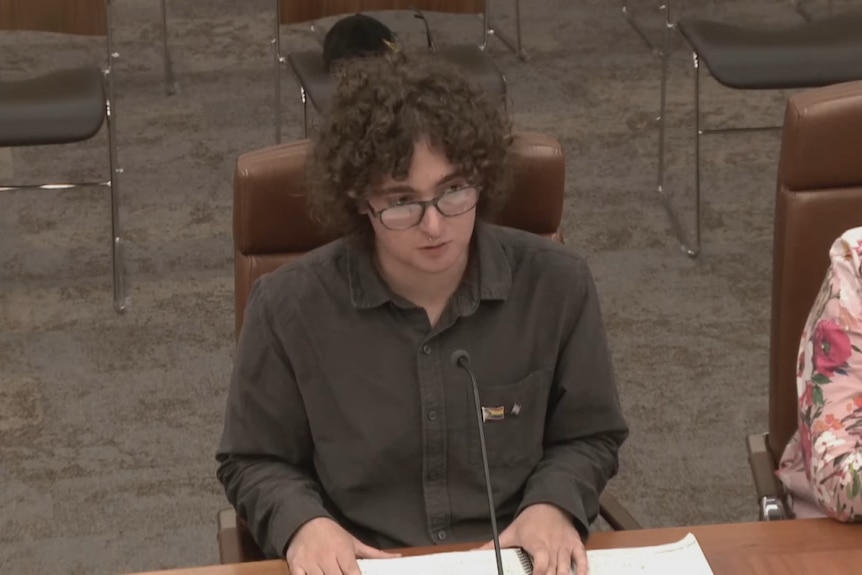
Leon Pecl said that throughout school he faced bullying, ostracism and harassment because of his sexuality. (Supplied: Parliament of Tasmania)
“The majority of staff ignored loud and explicit homophobia and transphobia,” he said.
“Reporting homophobic bullying did more harm than help as a lot of the staff did not care, and all it ever did was, in their mind, confirmed you were gay.
“My childhood friends and I were banned from physical contact such as hugging or holding hands — all at an age where I think that is quite developmentally normal for young girls to do.
“Other girls were, of course, allowed to engage in these friendly behaviours and were allowed to form and keep close friendships without suspicion because they were heterosexual.”
He said in the classroom “anything LGBT-related was considered a taboo topic” and many teachers refused to engage with it.
Asked what he wanted to come out of the inquiry, Mr Pecl said he wanted to see real action taken against bullying.
“No queer Tasmanian that I have ever spoken to … ever reports having had a good experience at a Catholic school,” he said.
“It is an environment that enables, and sometimes even encourages, hostility toward queerness.
“You are not able to go to school, learn, make friends like any other student.”
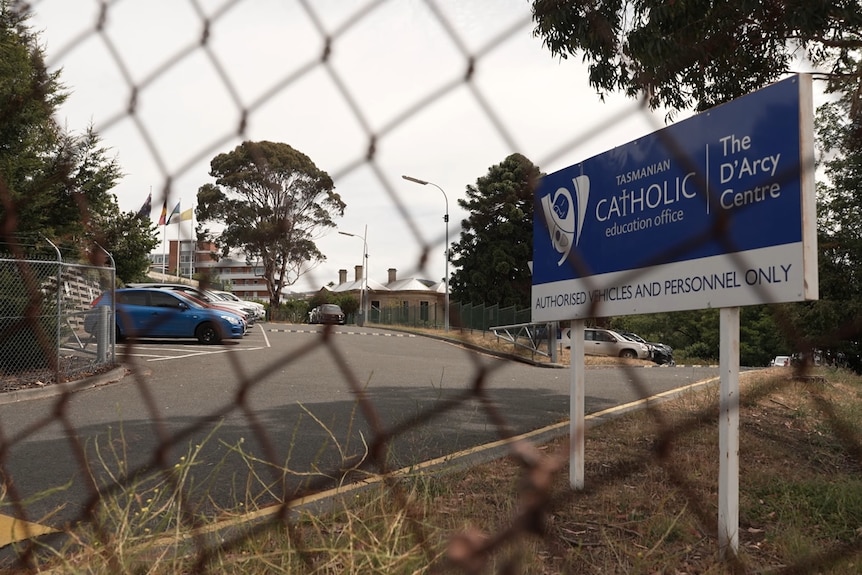
Catholic Education Tasmania said it took bullying and discrimination seriously. (ABC News)
The ABC contacted Catholic Education Tasmania and detailed some of the allegations made by the three witnesses.
In response, the Archdiocese and Catholic Education Tasmania said they “take bullying and discrimination extremely seriously and we aim to provide a safe environment for all who are involved in Catholic education”.
“It would be inappropriate to publicly respond to individual statements made under privilege to a parliamentary committee,” they said.