
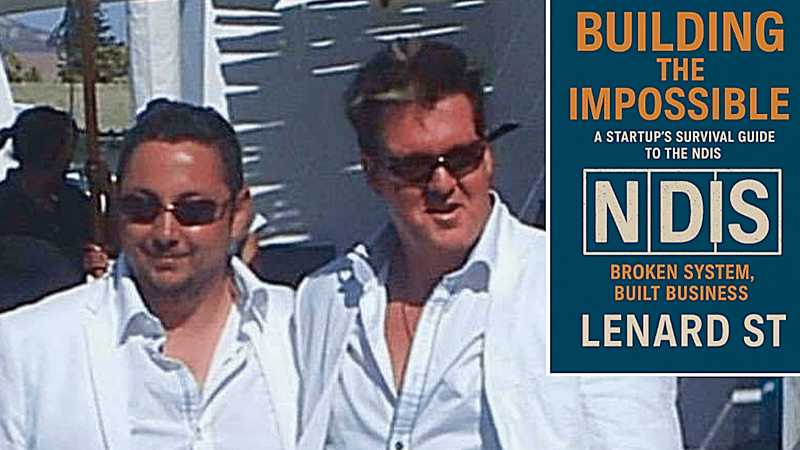
ASouth African couple who left behind a collapsed real estate business after client trust money was allegedly moved into other accounts, are now operating a network of NDIS-approved companies and a charity in Australia.
Two disability businesses linked to husbands Lenard Barend Swanepoel-Trollip, 44, and Christiaan Frederick Beyers Swanepoel-Trollip, 57, have since collapsed, allegedly owing staff, the tax office and creditors hundreds of thousands of dollars.
Staff caring for two high-needs NDIS participants allege wages went unpaid for several weeks late last year during a business collapse, leaving them unable to contact their employer, forcing carers to organise rosters themselves.
 Lenard and Christiaan.
Separately, a connected entity is locked in a Supreme Court dispute in Western Australia, after a writ filed in December alleged misuse of confidential client information.
The court action and care concerns has prompted closer scrutiny of the pair’s business dealings. Christiaan has trained as a counsellor, while Lenard has re-established himself in Australia as a self-described NDIS expert, writing a book promoting the scheme’s “incredible opportunities”.
Lenard strongly rejected any allegations of wrongdoing on behalf of the pair. There are no recorded court outcomes, convictions or adverse findings of credit in relation to either individual.
South African insolvency
The story begins in Cape Town, where the couple incorporated Beyers Realty Group in 2013.
“(Beyers Realty Group) was, so it appeared, a successful estate agency which was built around the personality of the respondents,” liquidator Thomas Van Zyl wrote in an affidavit.
The success did not last.
A claim made to the real estate regulator in September 2016 was investigated, and the business entered liquidation. The liquidator’s report identified the alleged movement of client trust money into other bank accounts.
Lenard said it was an innocent mistake, stating in an affidavit: “I accept I made a mistake in my conduct utilising the trust account funds to support the growth of the business.”
“When Christiaan and I arrived in Australia, we did so with virtually no assets”.
Lenard Swanepoel-Trolip
By November 2016, Van Zyl alleged 13.9 million rand – about $1.2 million – had been removed from the business accounts. As the investigation intensified, he sought urgent court orders which he claimed was to prevent further asset sales.
Separately, a court-appointed curator alleged R961,000 (about $725,000) was removed from the trust accounts over nine months, between December 2015 and September 2016.
Court-appointed curator Thomas Makupo told this masthead recovery of trust money was “not possible” because company accounts were empty and “the directors had also left the country”.
Court records show both Lenard and Christiaan were declared bankrupt by the High Court of South Africa in early 2017.
Lenard said neither he nor Christiaan had ever been convicted of fraud or misappropriation, denied claims he left South Africa to avoid creditors or authorities and said the business entered liquidation “in the usual sense”.
“When Christiaan and I arrived in Australia, we did so with virtually no assets,” he said.
Rebuilding in Western Australia
With South Africa behind them, the couple sought a fresh start in Perth where Lenard has family. They began steadily building a portfolio of disability and NDIS-related businesses.
From March 2019, ASIC records show Lenard has held current or former roles across more than a dozen entities spanning disability services, community housing, NDIS compliance and charitable organisations.
Lenard is currently a director of registered charity Bila Foundation, and is both a director and shareholder of Bila Community Group Australia, Bila Counselling and Support Services and six related entities.
He was previously a director of Sunshine Counselling Western Australia (December 2020-March 2024), Sunshine Auditing (August 2021-June 2024) and two other entities.
Likewise, he was previously a shareholder of Bila Support Services (February 2022-August 2022) and Sunshine Counselling (December 2020- April 2022).
Christiaan has also appeared as a director or shareholder across many of these companies. He is currently a director and shareholder of Stemineer Pty Ltd, incorporated in October 2025, and holds shares in Bila Community Housing.
He is a previous director of Bila Counselling and Support Services (March 2022-August 2023), Sunshine Counselling Western Australia (June 2020-August 2021) and Bila Support Services (February 2022-August 2022) and was a shareholder of Sunshine Counselling Western Australia (June 2020-June 2021).
 Boarding a seaplane to Rottnest Island.Sunshine Counselling: Claims of no assets, unpaid staff
The first Australian business to fail was Sunshine Counselling Western Australia, an NDIS-funded counselling provider that began in June 2020 and entered creditors’ voluntary liquidation, in May 2022.
A statutory report prepared by liquidator Clifford John Sanderson alleged the company had no assets, and owed an estimated $238,000 to creditors, including $85,000 in employee entitlements and $120,000 to the tax office.
The liquidator raised concerns about the company’s financial records in the report, including $24,000 worth of office equipment listed as “disposed” and left behind at a former office.
Sanderson noted Lenard had established new entity Bila Counselling and Support Services two months before his appointment as liquidator, and said it was “unclear” whether Sunshine’s assets had been transferred to the new business.
The liquidator reported possible insolvent trading concerns to ASIC, but noted the regulator chose not to commence an investigation.
Lenard said Sunshine Counselling was wound up due to a dispute between himself and another director, denied transferring assets between companies, and said he had no reason to suspect any insolvent trading.
An investigation by this masthead has found another entity, Bila Support Services, was established by Christiaan three months before Sunshine’s liquidation.
Another collapse, claims of more unpaid workers
Bila Support Services entered liquidation on December 5 last year.
A preliminary creditor report shows $224,000 was owed, including $140,000 to staff for unpaid wages and superannuation, and $80,000 to the tax office.
ASIC records show Christiaan registered the business in February 2022, with Lenard holding all shares.
Six months later, Christiaan removed himself as director and Lenard removed his shareholdings, and Lenard’s younger sister, Jennifer McAlpine, 37, was appointed director and sole shareholder.
Christiaan continued as secretary until May 2024.
This masthead understands McAlpine had been managing the business until the pair had a falling out.
Payslips seen by this masthead show some staff were paid through Bila Counselling and Support Services, where Lenard is director and secretary. McAlpine was removed as co-director in November last year, but retains a 50 per cent shareholding.
“The records we have examined suggest [Bila Support Services] was placed into liquidation after it became reliant on a related company controlled by a relative of the director for payment for its services, and all payments ceased,” liquidator Greg Quin told this masthead.
Investigations are ongoing, with a detailed report to creditors due in February.
Lenard did not accept that there had been a collapse of multiple NDIS-related entities and said he was not a director or shareholder of Bila Support Services at the time it entered liquidation.
Care continuing despite unpaid wages claims
Current and former staff at a group home operated by Bila Counselling and Support Services in Gosnells, in Perth’s south-east, said the alleged unpaid period coincided with a breakdown in contact from management, leaving carers to organise rosters among themselves to maintain round-the-clock care.
The workers said the home supported two NDIS participants with autism who required 24-hour care, so they were unable to simply stop working when they claimed they were not paid.
Most staff were on international working visas sponsored by the network.
Some staff members told this masthead they worked extended shifts, including 80 hours one week, to cover gaps while waiting for clarity about their payment.
This masthead has seen messages from a WhatsApp group created by staff to manage rosters during the transient period, when they say management was difficult to reach.
City of Gosnells acting chief executive officer Grant Bradbrook said the city had not granted any approvals for a business to operate from the Verna St address.
“As such, no business is currently permitted to operate at this site,” he said.
One of the landlords said rent was not up-to-date and said the NDIS Quality and Safeguards Commission and Fair Work had been contacted.
Lenard said staff caring for NDIS participants at the Gosnells property were employed by Bila Support Services, and McAlpine retained control of payroll systems at the time wages went unpaid.
But McAlpine said she was locked out of all her accounts when she was removed as director and therefore unable to pay staff.
Lenard said employees were paid from when he stepped in as “acting director” in December, and he had taken steps to ensure continuity of care.
A business in dispute
The strain has reached the Perth courts.
In December, Lenard, under Bila Counselling and Support Services, filed Supreme Court proceedings against McAlpine, along with a former employee and a newly formed disability provider, alleging the misuse of client information.
Interim orders agreed before Supreme Court Justice Michael Howard on December 23 restrict contact with certain clients while allowing existing services to continue.
McAlpine said she denied the claims and would defend the proceedings, arguing Lenard was an undischarged bankrupt and therefore ineligible to manage Australian companies.
ASIC registered liquidator Stephen Hathway said a person could not act as a company director in Australia if they were bankrupt.
“Based on the evidence that these debtors are undischarged bankrupt in South Africa, they would be prohibited from acting as directors of Australian companies,” Hathway said.
Lenard said he and Christiaan were not undischarged bankrupt under Australian law and were legally entitled to act as company directors.
 Lenard’s book on the NDIS.Literary Highways‘Incredible opportunities’ in the NDIS
Despite the apparent collapses, Lenard has positioned himself publicly as an authority on navigating the NDIS.
In his book Building the Impossible: A Startup’s Survival Guide to the NDIS, he writes the sector is “filled with incredible opportunities for those who understand how to navigate it properly”.
ASIC records show he established Provider Compliance Group two and a half weeks after Bila Support Services entered liquidation.
He is also listed as the director of a software platform marketed to NDIS providers as a tool to manage compliance and describes himself online as an NDIS-approved quality auditor.
Lenard stood by his comments about the “incredible opportunities” in the NDIS, noting Bila Counselling and Support Services had passed its most recent audit.
“Our track record speaks for itself regarding the opportunities within the NDIS. We support over 100 participants who depend on our services,” he said.
A charity on fragile footing
Alongside the for-profit businesses sits Bila Foundation, a registered charity established in 2023 and entitled to income tax exemptions.
ASIC records list Lenard as a director alongside his sister and his mother.
Its latest annual report shows revenue surged to $3.3 million in revenue (up from $505,000 the year prior) from NDIS plan management and labour hire, but it ended the year with just $2244 in cash, relying heavily on related-party transactions including loans of more than $480,000.
Auditor Michael Cooper said the charity would continue operating but required ongoing financial support from directors and related parties.
Lenard said Bila Foundation had its own board, bank accounts and independent annual audit, and related-party transactions were on “normal commercial terms at market rates” and disclosed.
Regulators respond
A spokesperson for the NDIS Quality and Safeguards Commission said it took the suitability of NDIS providers “extremely seriously” and while it would not comment in relation to any specific individuals, confirmed it is examining the matter at the Gosnells group home.
An ASIC spokesperson said the regulator did not comment on whether it is investigating specific individuals or entities.
“Where we identify misconduct, ASIC can take a range of regulatory actions, including civil or criminal proceedings through the courts and seeking director disqualification,” the spokesperson said.
An ATO spokesperson, speaking generally and not commenting on this specific case, said directors can in some circumstances be held liable for unpaid company tax debts, including through director penalty notices, even after a company enters liquidation.
South African authorities, including the South Africa Department of Home Affairs, have been contacted for comment.
Start the day with a summary of the most important stories. Sign up for our Morning Edition newsletter.