
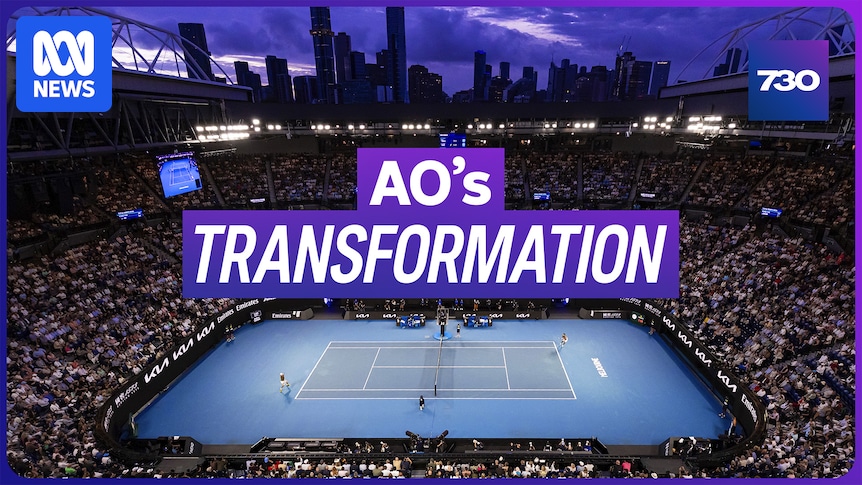
MIKE LORIGAN, REPORTER: The Australian Open extravaganza is now a three-week festival of tennis.
BEN ROTHENBERG, TENNIS JOURNALIST: There’s definitely been a more is more is more kind of ethos from Tennis Australia in recent years.
MIKE LORIGAN: The lines have been longer than ever.
DEBBIE MILLS, TENNIS FAN: I think they’re just overwhelmed, they didn’t realise there was going to be that many people.
MIKE LORIGAN: This year there are the big names. The eye-catching looks.
TENNIS COMMENTATOR: Naomi does things, how Naomi wants to do it.
MIKE LORIGAN: And some new faces for Australian fans
DARIA KASATKINA, AUSTRALIAN TENNIS PLAY: Okay, take a coffee and just relax. I’m like, okay, take a coffee and I’ll relax. Okay guys.
MIKE LORIGAN: On the court, the big four have made way for just two according to tennis scribe Ben Rothenberg
Back-to-back champion, Italy’s Jannick Sinner, who’s looking to make it three in a row and the world number one, Spaniard Carlos Alcaraz whose never won here.
BEN ROTHENBERG: The two of them between them have divided the last eight grand slam titles between them and no one else is really coming close.
MIKE LORIGAN: Novak Djokovic has won 10 times here and after Italian Lorenzo Mussetti retired hurt in their quarter final at 39 he’s been gifted a chance to make it 11.
BEN ROTHENBERG: Up until he finally lost to Sinner in 2024, he’d been on an incredible run of undefeated play here except for the one time he got deported. Obviously, it didn’t help his cause competitively that year, but other than that he’s really, really been strong and this has been his place.
MIKE LORIGAN: Australia’s brightest hope, Alex De Minaur, the sixth seed, again made it the round of eight. And again, has fallen short to the very best.
ALEX DE MINAUR, AUSTRALIAN TENNIS PLAYER: I’ve lost to Rafa, Novak, Jannik, twice, and now Carlos. As tough as it is when you get results like this, you get back up, you get back on the horse.
MIKE LORIGAN: Does he have the game yet to really contest for a grand slam? What’s he missing?
BEN ROTHENBERG: He’s missing not being Sinner and Alcaraz at this point. Those are the two guys who have what it takes and everyone else is in a pretty distant third at best.
MIKE LORIGAN: For the first time in the Open era, in both the men’s and women’s draw, the top six seeds made it to the quarter finals.
None look sharper than the world number one Belarussian Aryna Sabalenka, the US Open champion.
BEN ROTHENBERG: Sabalenka has been an incredibly reliable threat at the majors. She’s still the player to beat here.
MIKE LORIGAN: Prize money and pressure to perform mean the stakes are high for players. American Coco Gauff was hoping her frustrations would go unnoticed.
COCO GAUFF, AMERICAN TENNIS PLAYER: Maybe some conversations can be had because I feel like at this tournament, the only private place we have is the locker room.
MIKE LORIGAN: At times, tennis talk has taken a backseat to geopolitics.
REPORTER: I’ve been asking a lot of the American players just how it feels to play under the American flag right now and I’m just curious how you feel?
AMANDA ANISIMOVA, AMERICAN TENNIS PLAYER: Yeah, I mean I was born in America and I’m always proud to represent my country
REPORTER: Just to clarify a little, sort of in the context of the last year of everything that’s been happening in the US, does that complicate that feeling at all?
AMANDA ANISIMOVA: I don’t think that’s relevant.
MIKE LORIGAN: For some Ukrainian players, the tournament was another opportunity to draw attention to the war at home.
OLEKSANDRA OLIYNYKOVA, UKRAINIAN TENNIS PLAYER: We need your help and I would like to share the way people can help Ukrainians.
MIKE LORIGAN: Ukrainian player, Oleksandra Oliynykova, since her first-round loss, has targeted Aryna Sablenka over Instagram.
ARYNA SABALENKA, BELARUSSIAN TENNIS PLAYER: I have spoken a lot about that before, obviously, I want peace. If I could change anything I would definitely do that.
MIKE LORIGAN: Russian born, now Australian citizen, Daria Kasatkina, switched allegiances to Australia last year.
DARIA KASATKINA: In the past few years I’ve been through things which were out of my control, and unfortunately, they were very, very emotionally exhausting.
MIKE LORIGAN: I’m hoping you can give us some insight. What does it mean to you to be an Australian?
DARIA KASATKINA: Honestly, I cannot even describe how much that means because it’s not just about the passport, it’s about the acceptance, let’s say.
MIKE LORIGAN: Kasatkina is openly gay and has been outspoken in her criticism of Russia’s war in Ukraine.
BEN ROTHENBERG: This was not something that will go over well in Vladamir Putin’s Russia at all and all the sort of anti-gay laws they have there.
MIKE LORIGAN: Kasatkina made an early exit in this year’s Open, going down in the first round but is looking forward to more years ahead at her now, ‘home slam’.
MIKE LORIGAN: What parts of Australian life have you embraced?
DARIA KASATKINA: Honestly, just the way they take things. The way they’re just, not just chill, but they’re like, don’t worry about it. Just don’t worry about it. And I’m like, no, I’m worrying about it, what are you talking about.
MIKE LORIGAN: Off the court, tournament directors are keen to spruik the improvements to the fan experience.
BEN ROTHENBERG: There definitely has been a sort of push pull at this tournament generally between sort of the Happy Slam, everything’s relaxed, everything’s light and breezy; things they project and also this deeply corporate, deeply commercial side of the tournament, which is very real.
This tournament I think has gotten more openly and crassly commercial than any of the other majors by a great distance.
MIKE LORIGAN: Ben Rothenberg has been coming here for almost 15 years and has seen the ‘Happy Slam’ transform.
BEN ROTHENBERG: They just added a third stadium this year named after a corporate sponsor. No other Grand Slam has any arena or court named after a corporate sponsor.
MIKE LORIGAN: 7.30’s requests for an interview with Tennis Australia were declined. In a statement it said about the criticisms: “Our fan response and customer satisfaction would suggest the contrary.”
The man at the helm of the Australian Open’s commercial transformation is long serving CEO Craig Tiley.
BEN ROTHENBERG: He’s really become the most front facing, most ubiquitous, best known tournament director in a lot of ways.
MIKE LORIGAN: Tiley has answered questions on rumours he is being lined up to take a job with the US Open.
REPORTER: Is this our last chat previewing a tournament Craig?
CRAIG TILEY: There’s been a lot of speculation, and I’m not going to continue to fuel that speculation.
MIKE LORIGAN: For now, all eyes are on Rod Laver Arena.
Tonight the women’s semi-finals will be decided. On Friday, it’ll be the men’s turn to duke it out.