
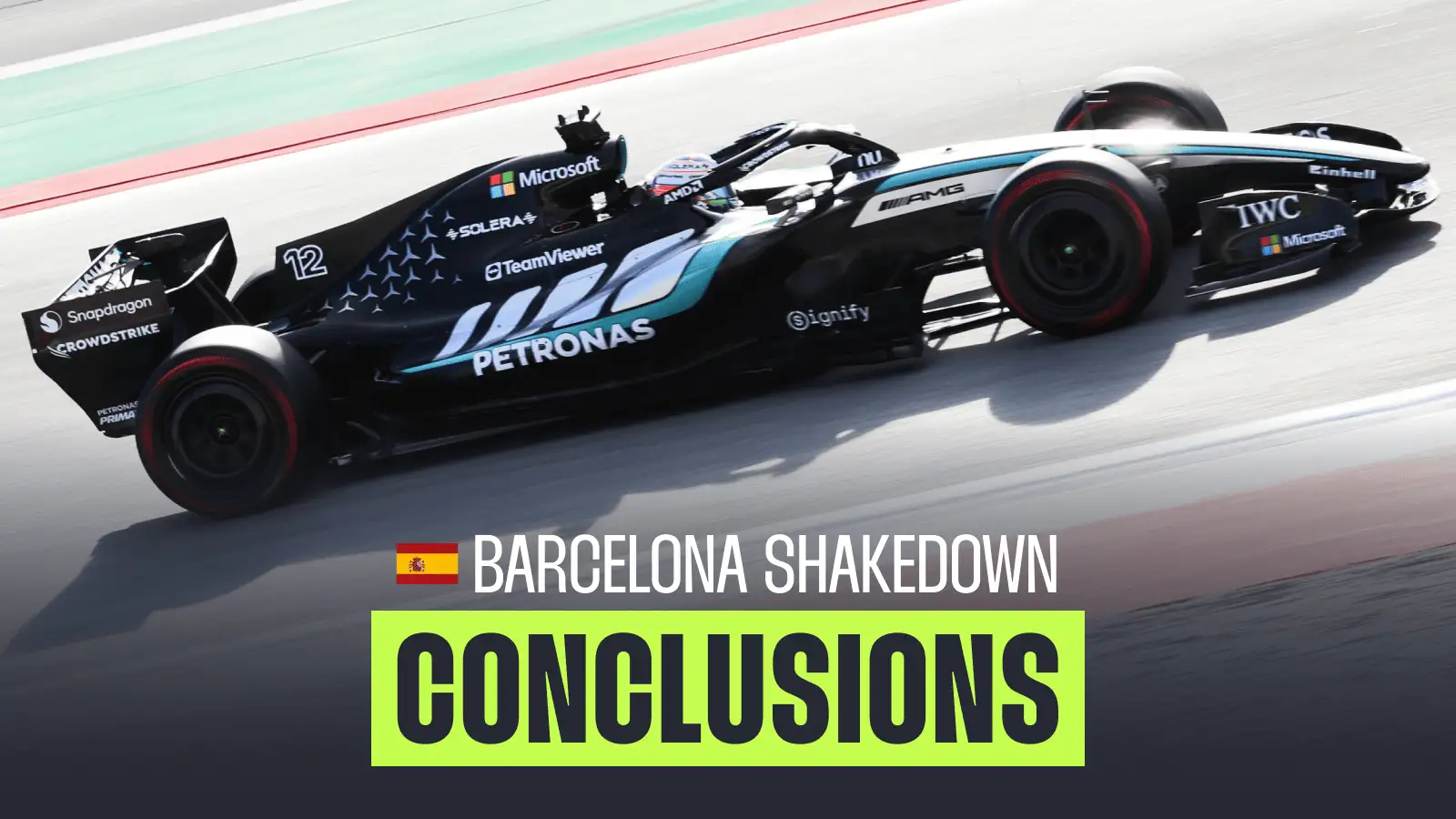
Ferrari driver Lewis Hamilton set the fastest time of all in Barcelona, but it is his former team Mercedes sitting pretty after the first pre-season test of F1 2026.
With the new-look Red Bull in action, Adrian Newey’s first Aston Martin F1 car arriving and debuts for Cadillac and Audi, here are our conclusions from ‘Shakedown Week’ in Spain…
Mercedes is stepping out of the darkness and back into the light
Want more PlanetF1.com coverage? Add us as a preferred source on Google to your favourites list for news you can trust
Nobody can say that there were no warning signs here.
For more than two years there had been whispers – the type of whispers too substantial and persistent to dismiss – that Mercedes’ preparations for the 2026 rule changes were more advanced than its rivals.
Then came the comments of the likes of Carlos Sainz, who admitted last year that the promise of getting his hands on a 2026 Mercedes engine was one of “the main reasons” behind his decision to join Williams in the summer of 2024.
Then last month came the first tangible hint of the source of that advantage as it emerged that Mercedes is among two 2026 manufacturers believed to have exploited a loophole in the new engine regulations related to compression ratio.
Red Bull Powertrains, for what it’s worth, was the other manufacturer named in the media – a function, almost certainly, of Red Bull’s engine division signing a large number of Mercedes High Performance Powertrains staff over recent years.
Yet it is reportedly Mercedes itself with the firmest grip on, and the fullest understanding of, the new technology at play this season.
All this is why Mercedes was regarded as the overwhelming favourite for 2026 (and, indeed, the place to be for Max Verstappen to instantly return to his dominant ways) long before a wheel had even been turned this year.
Nothing has happened this week – a first little glimpse of what this year might hold – to suggest the theory of a Merc-a-thon season will not become the reality over the coming months.
To watch George Russell and Kimi Antonelli effortlessly rack up the laps in Barcelona was to see an F1 team finally stepping out of the darkness and back into the light.
The misery that stalked Mercedes throughout the ground-effect era (just seven race victories between 2022 and 2025) was washed away over the course of five restorative days of testing that, even at this early stage, is likely to tee the team up for its most successful season in years.
Barcelona could not have gone much better for Mercedes, which topped the charts for laps completed among the teams (500) and the engine manufacturers (1,137).
Such was the rock-solid reliability of the W17 that the team is already planning to get straight down to some setup work when the second test begins in Bahrain next month, a luxury few – if any – of the other teams have bought themselves.
There is an energy and optimism about Mercedes in these early weeks of 2026 that has not been present since the end of 2021.
Much like its former driver Lewis Hamilton, Mercedes has been a team diminished for the last four years, scarred by the circumstances of its 2021 defeat and driven to frustration by the repeated failure to recapture its former glories.
Now, though, Mercedes is slowly regaining its strength and its self-confidence.
All those rumours, it seems, were true: the three-pointed star is rising again.
Isack Hadjar will benefit from the peace and quiet at Red Bull in F1 2026
Following the departures of Christian Horner and Helmut Marko last year, there has been much talk of a new, more corporate Red Bull going forward.
A Red Bull that operates more like a modern race team with an umbilical cord to a major corporation, one more in the style of Mercedes than an oversized, semi-detached Formula 3 team that may as well have been called ‘Christian & Co. sponsored by Red Bull’.
For better or worse, you say? That is to be decided.
But a little glimpse of the new way of doing things arrived with Isack Hadjar’s accident late on the second afternoon in Barcelona.
In previous years, the sight of Hadjar in the barriers would have been the signal for Marko to toddle off in the direction of the German and Austrian media to tell everyone, live and uncut, what he really thought.
A promising start marred by one big mistake, Marko might have said. Less than ideal with the replacement parts thin on the ground at the start of testing.
And anyway, he might have added, none of us realised what the new car was capable of until Max climbed in and showed what it could really do…
There is no question that Marko’s running commentary on all matters Red Bull often made a bad situation worse for the team, and especially its underperforming second drivers from Pierre Gasly to Yuki Tsunoda, over recent years.
This week, though?
There was nobody breaking ranks. Nobody deviating from the message.
Nobody daring to publicly undermine Hadjar or apply pressure after one little error before he even started to get comfortable in the cockpit of the RB22.
Amid reports that the team was waiting on the arrival of replacement parts, Red Bull simply announced that it wouldn’t be taking to the track on Wednesday, missing Thursday’s running too before finally returning to the track with little fanfare on the last morning.
Hear that? That’s the comforting sound of peace and quiet.
Welcome, then, to the new Red Bull Racing.
More corporate, yes, but also more professional. More low key. More dignified. More united.
It’s a quite different place, you’ll find, to the organised chaos of old.
Audi and Cadillac have a long road ahead
A good indication of just how well Audi and Cadillac have done to get to this point came on the penultimate day of running.
As most of the other teams were collecting the laps in Barcelona, Williams posted an update on its own 2026 preparations from deep inside the factory at Grove.
“Another piece of the puzzle complete,” the team captioned an image on social media of Carlos Sainz finally carrying out his seat fit in the 2026 car.
That’s the same Williams, you’ll recall, which ended car development early last season as part of its masterplan to make the best possible start to 2026.
Despite being the first brand-new team to arrive in F1 in a decade, Cadillac managed to hit that particular milestone an age ago, posting footage of Valtteri Bottas’s seat fit on December 8 – 24 hours after the final race of last season in Abu Dhabi.
Audi, meanwhile, seemed to consider it a badge of honour when it became the first team to take to the track with its 2026 car for a shakedown on January 9, more than two weeks before the start of this test.
For all the sense of achievement of making it this far and meeting these early deadlines, however, the Barcelona test was a reminder that both these teams still have a long road ahead.
No team to carry out three days of running this week completed fewer laps than Cadillac (164) with the team managing no more than 66 on a single day.
Audi fared only marginally better, managing a combined 95 laps on its first two days of running before salvaging the situation with 144 laps on the board on Friday.
The team’s suspect reliability – Gabriel Bortoleto did not reappear on Day 1 after suffering what was confirmed as a “technical issue” before the lunch break – also did nothing to eradicate long-held fears over the Audi engine.
It took no shortage of hard work for these teams to make the start of testing.
Yet Audi and Cadillac are finding out that the real hard work is only just beginning.
The great unanswered question facing Adrian Newey and Aston Martin
Fernando Alonso had waited all his life to drive a Formula 1 car designed by Adrian Newey, so a few extra days would not hurt.
After PlanetF1.com revealed last week that Aston Martin would miss the start of testing, the AMR26 did not take to the track until the final hour of Thursday’s running in Barcelona.
When it finally did break cover, it made for one of those great and all-too-rare Formula 1 moments when the sport’s collective jaw drops to the floor.
So different to any other car out there, such a range of ideas thrown at a single canvas, so many little details catching the eye the deeper it is examined.
It has become a cliché in this business to describe a racing car as a work of art.
Only with Newey, the patron saint of the pencil and drawing board, does it still ring true.
In his in-depth technical analysis of the Aston Martin on Friday, PlanetF1.com technical editor Matt Somerfield likened the “shock factor” of the Aston Martin sidepods to the first sighting of Mercedes’ zero-pod concept in 2022.
Matt Somerfield tech analysis: Aston Martin AMR26 steals the show
Adrian Newey masterclass revealed as Aston Martin AMR26 dissected
McLaren MCL40 reveals next-level aero design in Barcelona
So unique is the AMR26 compared to the rest of the field that it offers hope that Newey – who spoke last year of the new rules containing more scope for interpretation and innovation than first thought – has once again found something the rest have missed.
Still there is hope that this car might finally be the one to bring Alonso’s 33rd F1 win and – who knows? – potentially a third world championship too.
Yet the great unanswered question surrounding this car and its prospects for the new season – one impossible to answer after barely 24 hours of running, none of it meaningful or representative – concerns the Honda engine.
Despite its recent success with Red Bull and Max Verstappen, is is important to remember that Honda is effectively returning to F1 this year after withdrawing from the sport at the end of 2021.
Honda’s U-turn – announcing its partnership with Aston Martin in May 2023 – almost certainly came at a cost to its preparations for 2026 in terms of development, resource and manpower.
Koji Watanabe, the president of the Honda Racing Corporation, recently downplayed expectations for the 2026 engine, telling Japanese outlet Sportiva that “there are many areas where we are struggling.”
The good news at least? “Nothing fatal has happened that we cannot overcome.”
Perhaps the biggest question hanging over Aston Martin in 2026, then, is whether Newey’s latest masterpiece will be enough to mask the seemingly inevitable shortcomings on the Honda side.
And whether Honda – with the possible assistance of the FIA’s Assisted Development and Upgrade Opportunities (ADUO) scheme, a safety net set up last year to help struggling manufacturers catch up in 2026 – can sufficiently close the gap to give Alonso a fighting chance.
No doubt the warmer temperatures of Bahrain will paint a clearer picture of what exactly Aston Martin has to work with.
It was a mistake to hold this test behind closed doors
Formula 1 cannot have it both ways.
It cannot pour such enormous resource into making itself appeal to the masses, only then to lock the masses out when the first test of the new season rolls around.
There were two main reasons why this test, officially branded Shakedown Week, was held behind closed doors.
The first is that Bahrain pays handsomely for the rights to hold official testing each season, hence the request – ignored by some teams – to use only testing liveries in Barcelona.
The second was that teams were concerned that their first steps in this new era would not cast them in a particularly flattering light.
Clearly the memories of the early days of the V6-hybrid era, when some high-profile teams were plunged into disasters from which they would not quickly recover, were not far from some minds.
Yet what was there to really fear about this test? Did any team really disgrace itself?
Some covered more mileage than others, yes, but were the lows so low that they had to be shielded from public view? The technical bloodbath of January 2014 this was not.
It is as clear now as it was three months ago that it was a mistake to hold this test behind closed doors.
More than that, though, it was an opportunity missed.
Formula 1 teams are never more impressive, after all, when they are forced to confront problems, troubleshooting issues and finding the solutions to them.
There was a chance here to tell a tale of progress and how the teams – especially the stragglers of this test – work to overcome the many hurdles they encounter between Day 1 in Barcelona and the opening race in Australia.
By failing to face the world at their weakest, in other words, the teams also lost the opportunity to show Formula 1 at its strongest.
Want to be the first to know exclusive information from the F1 paddock? Join our broadcast channel on WhatsApp to get the scoop on the latest developments from our team of accredited journalists.
You can also subscribe to the PlanetF1 YouTube channel for exclusive features, hear from our paddock journalists with stories from the heart of Formula 1 and much more!
Read next: Barcelona Day 5: Lewis Hamilton puts Ferrari fastest on final day of first F1 2026 test