
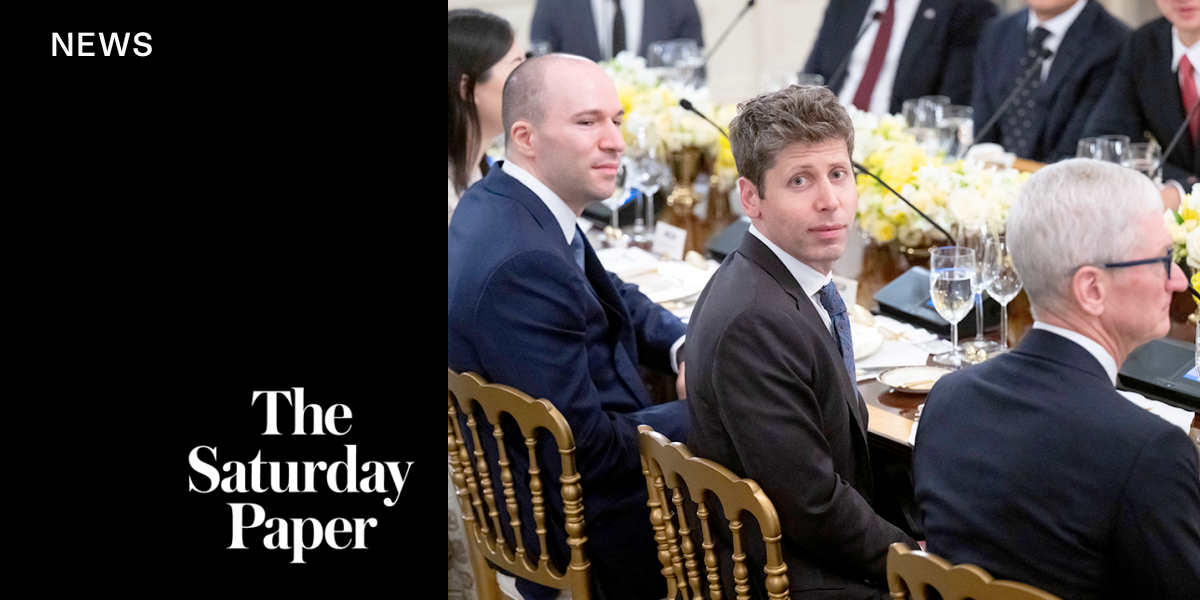
He’s a geeky university dropout, a doomsday prepper, an advocate of the benefits of psychedelic drugs. A gay vegetarian who has cosied up to Donald Trump, despite the knowledge that the conservative Christian, agrarian and fascist elements that dominate Trump’s political base really don’t care for people like him.
Most importantly, he is perhaps the greatest salesman in history.
Sam Altman, the Silicon Valley entrepreneur whose private company, OpenAI, launched ChatGPT about three years ago, sells a vision of a utopian future built on artificial intelligence so persuasive that investors ante up tens of billions of dollars. Even as his company continues to burn tens of billions of dollars.
The numbers are head-spinning. According to those extrapolated from the financial disclosures of Microsoft – which holds a 27 per cent stake in OpenAI, and as a public company is more transparent – Altman’s company lost as much as US$12 billion in just the September quarter of last year.
According to reporting that cites internal OpenAI documents, the company will lose a further $14 billion this year and incur total losses of some $44 billion out to 2029. Other reports say it will burn $115 billion. Altman himself has said the company will not generate a positive cash flow until 2029 or 2030. A lot of other people doubt it ever will.
Yet Altman’s promises that AI will be a panacea for all manner of human troubles, from cancer to climate change, continue to suck in more investment.
As Sebastian Mallaby, a senior fellow at the Council on Foreign Relations, noted in a piece for The New York Times a couple of weeks ago, just last March Altman raised $40 billion, which was “far more than any other company has raised in any private funding round, ever” – more even than has been raised by any company going public. All while OpenAI is “hemorrhaging cash”.
This, he wrote, made Altman “the best pitchman in tech history.
“The more capital he raised, the more the buzz around him grew. The buzzier he became, the more money he could raise.”
He will need a lot more money yet.
“… what Sam has been able to do, in broad daylight, is steal the intellectual property of the world. He has colonised the sum total of human knowledge in order to own it for himself.”
Altman has committed to spending some $1.4 trillion over the next eight years. He has done deals with many of the world’s biggest tech companies, including Oracle, Nvidia, Microsoft and Amazon. In each case, as Forbes pointed out in a piece in November, the companies’ stock prices all sharply increased following the deals.
It is all predicated on OpenAI’s optimistic projections of huge revenues.
Some have suggested it looks a lot like a Ponzi scheme. What if the projections don’t eventuate?
Mallaby, who reckons OpenAI will run out of money in about 18 months, thinks it would most likely be “absorbed by Microsoft, Amazon or another cash-rich behemoth. OpenAI’s investors would take a hit. Chipmakers and data center builders that signed deals with Mr. Altman would scramble for new customers.”
Other analysts suggest the companies that have done deals with OpenAI would renegotiate – as often happens in the complex field of tech finance – because, as one told Forbes, that would “ensure they get at least some amount of business from OpenAI, especially if the alternative is getting none at all.
“They don’t want OpenAI to go bankrupt…”
Even so, Mallaby worried that if OpenAI went pear-shaped, “frazzled investors may dump the whole A.I. sector”. Given that big tech has driven virtually all growth in American markets over the past year or so, that could precipitate a global financial crisis.
One thing the various experts seem to agree on is that even if worst came to worst, Sam Altman would not be on the hook for anything, because he has no direct financial stake in OpenAI.
He is playing with other people’s money. Just as his business and others like it are playing with other people’s data and intellectual property.
Saul Griffith, the Australian–American inventor, serial Silicon Valley entrepreneur and renewable energy apostle, who has had personal dealings with Altman, compares him to the 17th century philosopher John Locke, who is considered one of the most influential Enlightenment thinkers.
Griffith does not mean it as a compliment. Locke’s theory of property, laid out in his “Second Treatise of Government”, provided the intellectual basis for settler colonialism by arguing that indigenous occupation of land did not equate to ownership.
“Locke invented a moral philosophy that enabled the theft of lands from the world’s people through colonisation,” says Griffith.
“Colonialism stole the physical property of the world, and what Sam has been able to do, in broad daylight, is steal the intellectual property of the world. He has colonised the sum total of human knowledge in order to own it for himself.”
Philosophy aside, Griffith argues that there are practical constraints on the growth of AI and data centres, related to their huge energy consumption.
He has a good point. According to the International Energy Agency, electricity consumption from data centres was about 1.5 per cent of global electricity consumption in 2024. It is growing more than four times faster than the growth of total electricity consumption from all other sectors. For obvious reasons, this demand is not evenly spread.
If OpenAI were to hit its ambitious growth targets, it would consume something like 10 per cent of total US electricity generating capacity – maybe more. Some projections suggest data centres will require 12 per cent as soon as 2029.
Far from solving the existential problem of climate change, they are adding to it.
The proliferation of data centres poses a big challenge for Australia too. According to the Climate Council, there already are more than 250 of them scattered across the nation, with many more in the pipeline.
Among them is a $7 billion proposal by OpenAI, in partnership with the established data centre operator NEXTDC to develop a “next-generation” data centre in Sydney’s Eastern Creek.
“This initiative, part of the ‘OpenAI for Countries’ program, includes opening their first Australian office and supporting local AI adoption with partners like Coles and Commonwealth Bank,” the company said in a media release from December 4.
The release quoted Altman: “Australia is well placed to be a global leader in AI, with deep technical talent, strong institutions and a clear ambition to use new technology to lift productivity. Through OpenAI for Australia, we are focused on accelerating the infrastructure, workforce skills and local ecosystem needed to turn that opportunity into long-term economic growth.”
There were also enthusiastic quotes from Commonwealth Bank of Australia’s chief executive, Matt Comyn, lauding the potential benefits to small business.
Australian governments, state and federal, also are enthusiastic boosters of data centres, placing this country, according to the Climate Council, among the top five locations for data centres in the world. Most are located near major cities, Sydney in particular.
A report in The Sydney Morning Herald this week provided a sobering picture of the potential energy demand, citing the work of Dr Amr Omar, a research associate at UNSW Sydney’s School of Mechanical Engineering.
If every proposed development went ahead, it said, within 10 years, their demand for electricity would be “equivalent to the average electricity load of more than 10 million households” and, at their peak, “almost four times as much power as the rest of the city”.
Their operation also generates a great deal of heat, which typically requires a great deal of water – a “huge problem”, according to Omar. The proposed data centres located in Western Sydney would collectively use as much water as 330,000 homes.
The “critical question”, says Joel Gilmore, climate councillor and associate professor at Griffith University’s Centre for Applied Energy Economics and Policy Research, is how that electricity and water is sourced. The centres’ demand for electricity, currently about 2 per cent of the capacity of the national demand, is projected to rise to 9 per cent over the next decade, and maybe 12 per cent in the longer term.
“In many cases they are bringing renewables with them, but there’s no actual obligation for them to do that,” he tells The Saturday Paper.
“But if we build these data centres and don’t bring on new renewables, then we will have to rely more on coal than we otherwise would have. That means our emissions go up, but it also means that we’re relying even more on these ancient power stations that are 40-plus years, 50-plus years [old], in some cases.
“There’s big risks if we don’t have enough renewables and we get this new load, and then a coal power station falls over at a critical time.”
Likewise, water supply “is something that we absolutely have to manage. It’s a limited resource.”
On the upside, there are means by which the strain on drinking water might be mitigated, through “closed-loop cooling, like the radiator in your car … or the use of non-potable water – seawater or recycled water – or desalination plants”.
“And there are major users of water today that won’t be here in the future. Coal power stations and coalmining use about 380 billion litres of water every year. Those power stations won’t be here in 10 to 15 years.”
But it will take careful planning, and there is some reason to doubt that governments, in their rush to join the AI boom, are up to the task.
The announcement came just this month that the closure of Australia’s largest coal-fired power station, Eraring, near Newcastle, had been deferred to 2029 because of concerns about electricity supply. The federal government’s target of supplying 82 per cent of energy from renewable sources is looking increasingly unlikely to be met.
The extra power demand from the proliferation of data centres, says Richie Merzian, chief executive of Clean Energy Investor Group, “exacerbates the problems we have”.
“And every coal-fired power station we extend is just going to make it harder to make the investment case over the medium-term, because it changes the return rates, and it just complicates things further.
“It is still possible to do it all, but it does require a level of coordination and investment and priority that we haven’t seen.”
The rise of artificial intelligence poses many serious problems, from energy to its impact on jobs and, of course, the big one – that sentient artificial intelligence could decide it doesn’t need humanity.
Sam Altman is not going to solve them.
As he said in an interview a decade ago: if things go seriously bad, “I have guns, gold, potassium iodide, antibiotics, batteries, water, gas masks from the Israeli Defense Force, and a big patch of land in Big Sur I can fly to.”
This article was first published in the print edition of The Saturday Paper on
January 31, 2026 as “World’s most dangerous man?”.
For almost a decade, The Saturday Paper has published Australia’s leading writers and thinkers.
We have pursued stories that are ignored elsewhere, covering them with sensitivity and depth.
We have done this on refugee policy, on government integrity, on robo-debt, on aged care,
on climate change, on the pandemic.
All our journalism is fiercely independent. It relies on the support of readers.
By subscribing to The Saturday Paper, you are ensuring that we can continue to produce essential,
issue-defining coverage, to dig out stories that take time, to doggedly hold to account
politicians and the political class.
There are very few titles that have the freedom and the space to produce journalism like this.
In a country with a concentration of media ownership unlike anything else in the world,
it is vitally important. Your subscription helps make it possible.
Send this article to a friend for free.
Share this subscriber exclusive article with a friend or family member using share credits.

Used 1 of … credits
use share credits to share this article with friend or family.
You’ve shared all of your credits for this month. They will refresh on March 1. If you would like to share more, you can buy a gift subscription for a friend.
SHARE WITH A FRIEND
? CREDITS REMAIN
SHARE WITH A SUBSCRIBER
UNLIMITED
Loading…