
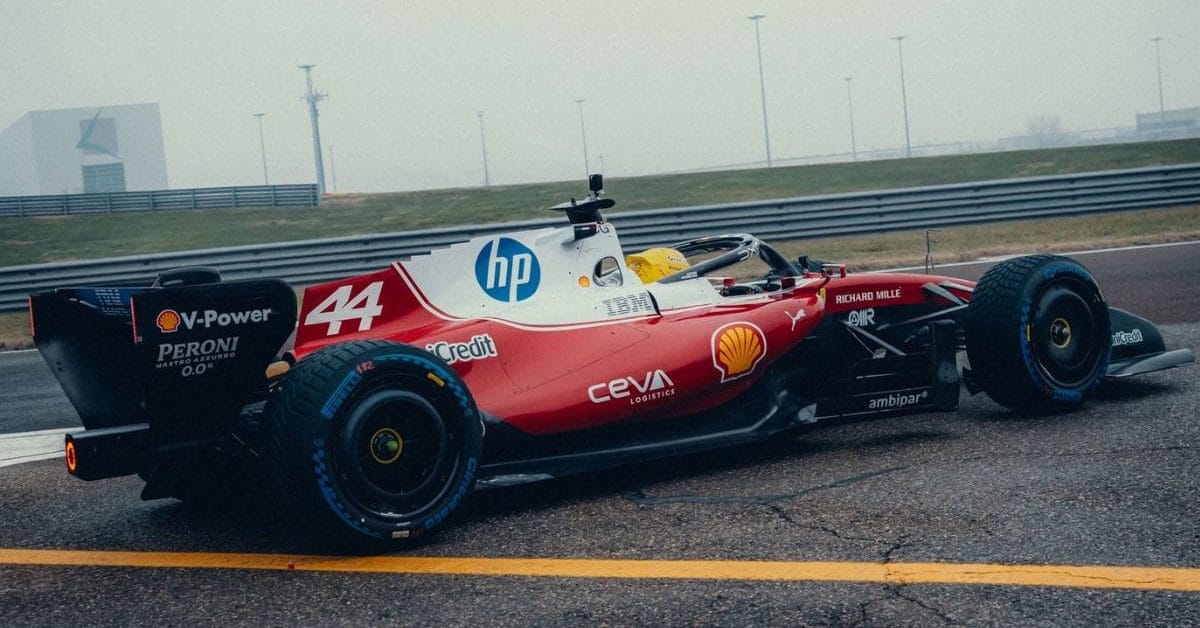
The first tests of the new Formula 1 2026 era were held under maximum secrecy at the Circuit de Barcelona-Catalunya: no TV coverage, data reduced to a minimum and a tightly controlled paddock. On track, the first signs emerged regarding reliability and technical direction, with Ferrari and Mercedes proving convincing, while Williams remained in the garage and Adrian Newey’s Aston Martin began its programme playing catch-up.
Five days, but not for everyone. The F1 2026 shakedown in Barcelona took place behind closed doors, and each team was allowed to choose only three days out of five to run its new car on track. The rest was handled by the “curtain”: no television coverage, limited live timing and a strictly controlled flow of information, with the circuit effectively sealed off among the surrounding hills.
In this context, lap times must be read for what they are: partial indications, because fuel loads, programmes, tyre compounds and daily objectives are not known with certainty. However, one thing became very clear: at this stage, the real priority is accumulating mileage without issues, checking that all systems function correctly, avoiding early reliability problems and gathering useful data ahead of the next tests.
Ferrari SF-26 and Mercedes W17: solidity, mileage and first flashes of pace
Among the most anticipated teams, Ferrari and Mercedes are the ones that come out of Barcelona in the strongest position. Their approaches were very similar: a lot of work, consistent running and, above all, very few serious problems. The Ferrari SF-26 closed the shakedown with the fastest overall reference time thanks to Lewis Hamilton, who set a 1:16.348 on the final day, ahead of George Russell with a 1:16.445 and reigning world champion Lando Norris with a 1:16.594.
The most important figure, however, remains consistency. Ferrari completed its programme without major disruptions, despite a debut affected by rain. Charles Leclerc explained this immediately after his first laps: “For now it is just about understanding whether everything works correctly, and I would say that it did.” At the end of the test, his confidence grew further: “We did everything we wanted to do.”
Mercedes also sent out a strong message with the W17, combining high mileage with performance levels that, while inevitably influenced by unknown fuel loads, were the most consistent across the week, both with George Russell and with Kimi Antonelli. In practical terms, two teams that, in the middle of a regulatory revolution, have already put down the first crucial building block: reliability and a solid technical base.
McLaren and Red Bull between question marks and optimism
McLaren and Red Bull encountered a few more issues. The reigning champions were forced on two occasions to miss the afternoon session due to problems with the car. In the latest case, a fuel system malfunction prevented the MCL40 from running in the afternoon of day four. Their programme was therefore less smooth than that of their rivals, although the car showed good underlying potential, which offers encouragement for the future, especially considering the strong performance of the Mercedes power unit.

The debut of Red Bull equipped with the first in-house power unit built by Red Bull Powertrains in partnership with Ford was also uneven but promising. At times the car appeared competitive, initially with Isack Hadjar on day one and later with Max Verstappen. However, the team paid the price for the accident involving the French driver at the end of day two, which forced the four-time world champion to wait for replacement parts to arrive from Milton Keynes. As a result, Verstappen only returned to the track on the final day of the test with the repaired car.
Red Bull’s decision to use only soft tyres throughout the test further complicated any attempt to draw even a partial early assessment of its performance.
Who struggled the most: Williams out, Aston Martin AMR26 behind schedule
The most severe case was Williams, which did not take part at all. Design delays and structural issues deprived the team of precious days precisely when every lap counts double. It is the classic catch-up scenario: while others are collecting data, you are starting from zero.
If Williams represents the biggest black hole, the Aston Martin AMR26 remains the big unknown. The car designed by Adrian Newey arrived late, appeared only towards the end of day four and completed very few laps before an abrupt stop. The following day it returned to the track with Fernando Alonso, but with an inevitably compressed preparation programme.
It was a debut that made headlines more for its potential than for the numbers. The car showed aggressive solutions, but the verdict is postponed because the sample size is still too small to draw meaningful conclusions.
What remains after Barcelona
Barcelona did not award titles and did not establish definitive hierarchies. It was, however, a first real-world check of the new Formula 1 2026 on track. One indication did emerge clearly: Ferrari and Mercedes started on their feet, with a solid base and an already high level of reliability.
Behind them, those who arrived late, namely Williams and to some extent Aston Martin, have already placed themselves in the worst possible position: chasing while others learn. The next tests will reveal whether these signals were merely shakedown smoke or the beginning of something more serious.
F1 2026 Barcelona test lap time classification
Lewis Hamilton (Ferrari): 1:16.348
George Russell (Mercedes): 1:16.445
Lando Norris (McLaren): 1:16.594
Charles Leclerc (Ferrari): 1:16.653
Kimi Antonelli (Mercedes): 1:17.081
Oscar Piastri (McLaren): 1:17.446
Max Verstappen (Red Bull): 1:17.586
Pierre Gasly (Alpine): 1:17.707
Isack Hadjar (Red Bull): 1:18.159
Esteban Ocon (Haas): 1:18.393
Laps completed by teams during the F1 2026 Barcelona tests
Mercedes: 502 laps
Ferrari: 431 laps
Haas: 387 laps
Alpine: 341 laps
Racing Bulls: 318 laps
Red Bull: 303 laps
McLaren: 285 laps
Audi: 240 laps
Cadillac: 164 laps
Aston Martin: 66 laps
Williams: 0 laps
Power unit mileage during the F1 2026 Barcelona tests
Mercedes: 5,253 km
Ferrari: 4,573 km
Red Bull Powertrains – Ford: 2,892 km
Audi: 1,118 km
Honda: 307 km
Feb 1, 2026Luca Marini
Let other Scuderia Fans know about us


