
This year’s Super Rugby Pacific competition will feature five new law innovations to reduce stoppages and simplify the game’s officiating.
The competition’s organisers today revealed the innovations that they said had the “emphatic support” of clubs and match officials:
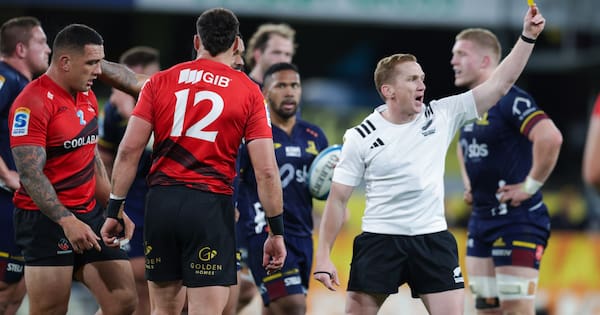
– It will no longer be mandatory for the referee to issue a yellow or red card to a player on the defending team when awarding a penalty try. Any sanction will be at the discretion of the referee (Law 8.3)
– Accidental offsides and teams delaying playing the ball away from a ruck will result in free kicks rather than scrums (Law 10.5 and Law 15.17)
– After the referee has called “use it” at the ruck, no additional players from the team in possession may join the ruck (Law 15.17)
– Teams will be permitted to pass the ball back into their half before kicking a 50:22 (Law 18.8a)
– Players will be allowed to take quick taps within one metre either side of the of the mark, or anywhere behind the mark, if they are within that two-metre channel running parallel to the touchlines. (Law 20.2).
The competition has also moved to limit the influence of the television match official (TMO).
This year in Super Rugby, the TMO will only intervene unprompted if the referee has overlooked an act of serious foul play (yellow card level or above), or a clear and obvious infringement leading to a try.
The assistance of the TMO at any other time can only be instigated by the referee – a move, the organisers say – “which both empowers the on-field match officials and improves the flow of the game”.
A statement released with the changes said more than four minutes of “dead time” had been eradicated over the last four years from Super Rugby Pacific games – a result of previous law innovations, including time limits when setting lineouts and scrums.
“These innovations for 2026 reflect the ongoing commitment of Super Rugby Pacific to deliver the most entertaining and engaging rugby competition in the world,” Super Rugby Pacific chief executive Jack Mesley said.
‘Quick taps and faster restarts’
“From the members and fans, to the players and coaches, and the referees themselves, we continue to experience resounding support for the measured steps that we’re taking to refine the game.
“We want to be a competition that encourages quick taps and faster restarts, that cuts down on unnecessary stoppages, and that embraces positive, attacking rugby.
“Super Rugby Pacific will continue to work closely with World Rugby and our stakeholders to evolve the game and produce the best version of rugby, and to strongly advocate that the innovations that are clearly working in Super Rugby Pacific be adopted more widely.”
Games that are level at the final whistle will again have an extra-time period of up to 10 minutes.
The first team to score during “super point” wins the match, with the match declared a draw if neither team scores during the period of extra time.
The six-team finals series format adopted last season will continue, but with a tweak to the “lucky loser” mechanic.
In 2025, the “lucky loser” was penalised one seeding, with the top-ranked Chiefs defeated in a qualifying final but still hosting a semifinal fixture the following weekend.
However, in 2026 the highest ranked losing team from the qualifying finals will progress as fourth seed, ensuring they play away from home in the semifinals and the grand final, should they qualify.
The new season kicks off on Friday, February 13 with the Highlanders hosting the Crusaders, who won last year’s final against the Chiefs.