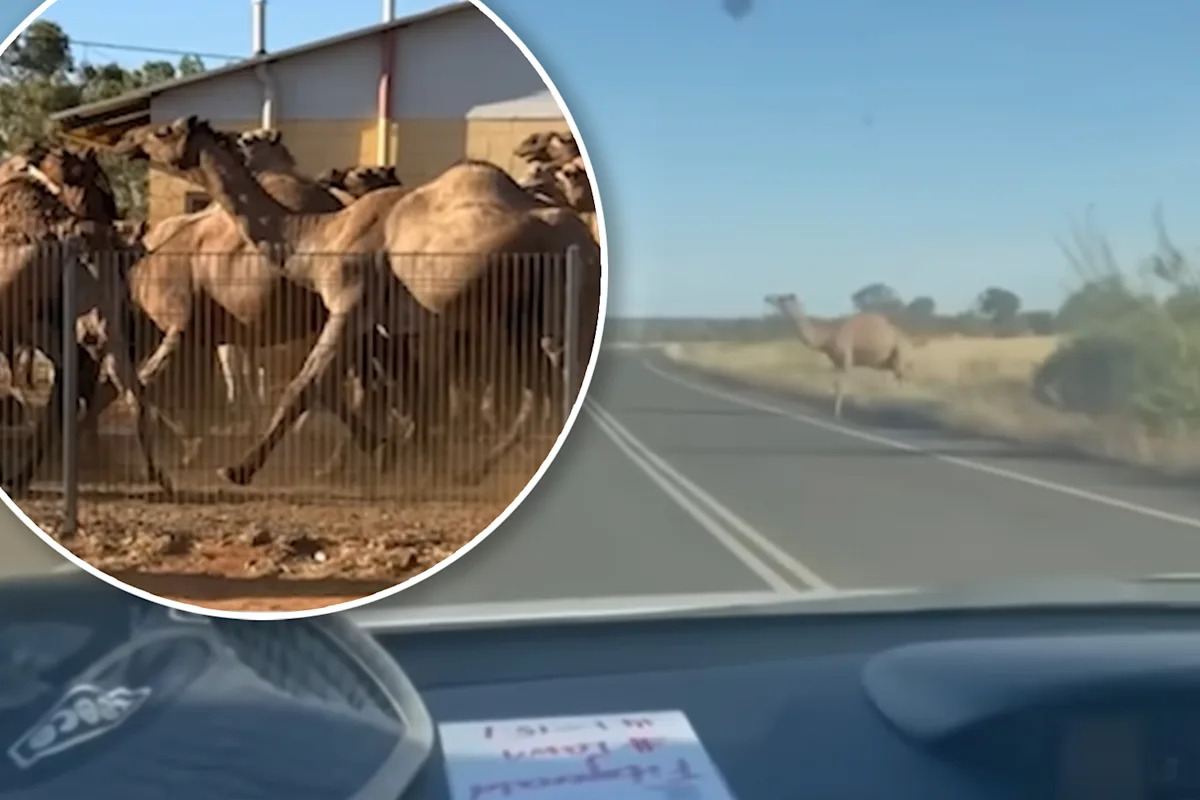
About 600 feral camels have been culled just weeks after rural residents claimed they had been forced to hide inside their homes as the invasive pests wreaked havoc. A lack of rain has prompted large herds of camels to storm outback communities in search of water.
The desperate camels have caused extensive damage to properties and businesses as they try to reach taps and knock air conditioning units off exterior walls with the hope of slight relief from the extreme heat.
People living in Mount Liebig, about 320km west of Alice Springs, said they had to barricade themselves inside this month after a ‘camel train’ spanning 5km in length was spotted nearby.
A dozen homes were left without a water supply as temperatures soared over 40 degrees, SBS reports.
Damien Ryan, area manager for the MacDonnell Regional Council, saw the chaos firsthand last week when 80 camels “clambered” to reach a small building leak.
“They just walk through six-foot-high security fences, and they knock the taps off the outside walls…they will break water mains a metre underground just to get to water,” he told SBS.
The Northern Territory’s Environment Minister Josh Burgoyne said the animals, which can smell moisture, are some of the biggest he’s ever seen.
“We’re talking about large bull camels weighing hundreds of kilos that just want water, and they’re willing to do anything,” he told SBS.
According to the Queensland Department of Agriculture and Fisheries, camels get most of their water requirements from desert vegetation, but can drink “brackish”, or salty water, to survive.
Remarkably, a dehydrated camel can drink 200 litres of water in just three minutes.
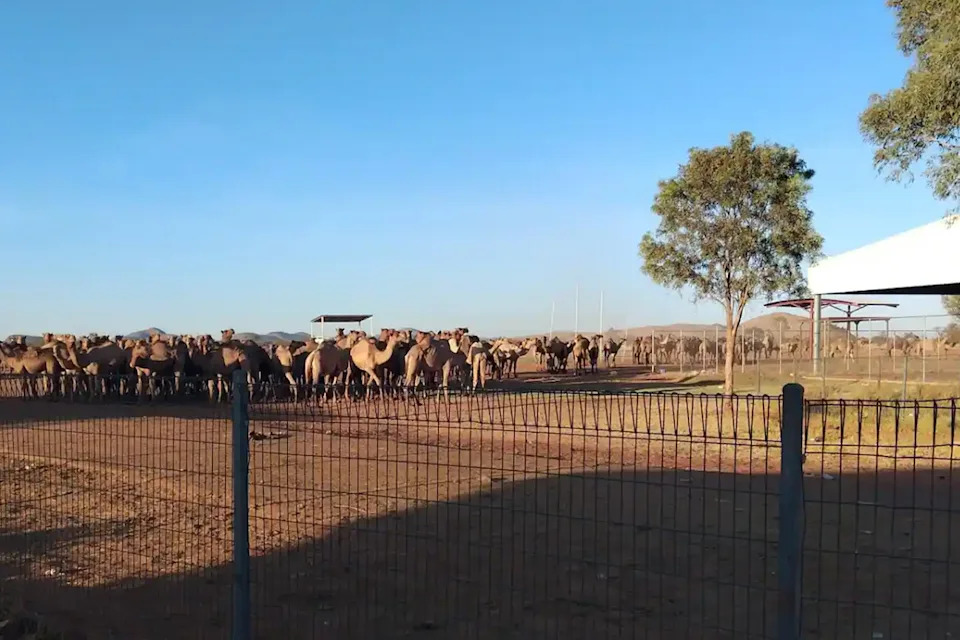
The huge herds of camels have damaged properties and fencing in Mount Liebig. Source: NT Government/SBS
Do you have a story about invasive animals? Contact newsroomau@yahoonews.com
Authorities call for more funding after three-day aerial camel cull
In response to the destruction, a joint taskforce comprising the NT Government, the Central Land Council and MacDonnell Regional Council approved a three-day aerial cull last week.
However, additional funding is needed to undertake larger culls, authorities argued.
“Local councils are quite literally having to hunt these camels out in the morning so that the communities can be safe,” Minister Burgoyne said.
“You imagine in Sydney or Melbourne, if a mob of feral camels came in, dug up the local water supply and residents were left without water for a week or two, I think we would see absolute outrage.”
Eradication out of the question despite $11 million economic hit
There have been national programs to control camel populations in the past, the last one ended in 2013.
The responsibility now falls on “individual landholders and communities”, Dr Carol Booth, the Invasive Species Council’s policy director, previously told Yahoo News Australia.
While some states and territories do have coordinated programs across the country, she said it’s “not consistent”.
“Eradication is not the goal,” she explained, adding it’s just not possible because there are just too many.
“It’s about bringing the numbers down so they are not causing massive damage.”
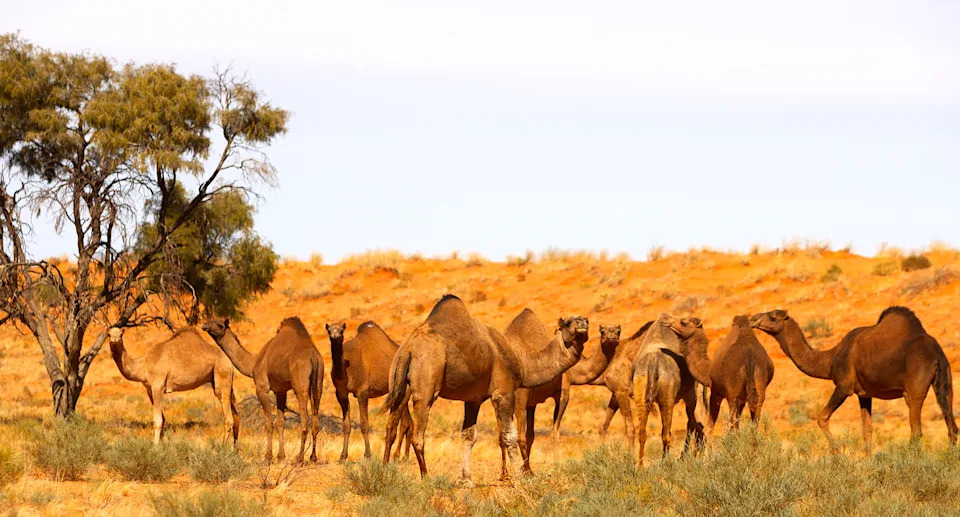
Camels spotted in the Simpson Desert in South Australia. Source: Getty
Aerial shooting and supplemented ground shooting are the most effective methods of population control, Dr Booth explained.
In 2009, it was estimated the annual economic cost of camels was about $11 million a year, according to CSIRO researchers.
Dr Booth said that camel populations double every eight to 10 years, so arguably the cost is even higher now.
Camels were first brought to Australia in the 1800s to help explore central Australia.
In the desert, their populations have exploded as a result, making Australia home to the largest wild population of Arabian camels in the world, according to Pest Smart.
Do you have a story tip? Email: newsroomau@yahoonews.com.
You can also follow us on Facebook, Instagram, TikTok, Twitter and YouTube.