
The fallout to last week’s horrific crash at the AlUla Tour rolled on into the weekend, numerous riders involved giving accounts of just how terrifying the 100km/h+ descent was. Organisers of the early-season race have also come in for criticism over the decision to route the stage down a 20 per cent descent, especially in the finale when speeds, stress and the scrum for positioning were always likely to be high.
Laurenz Rex, Fabian Grellier and Davide Stella were the three riders who came down, it perhaps something of a miracle that three fractured vertebrae was the worst injury, considering the speed and fact the incident spilt onto the rock-strewn roadside.
This has GOT to hurt 🤕
A blistering 106km/h descent inside the final 15km of Stage 3 caused a three-rider pile up of Laurenz Rex, Davide Stella and Fabien Grellier.
We hope all riders involved are ok 🙏#AlUlaTour | January 27-31 | SBS On Demand 📺 pic.twitter.com/tN2HVDbyyu
— SBS Sport (@SBSSportau) January 29, 2026
The TV coverage had just displayed a graphic explaining the camera motorbike was travelling at 106km/h when the crash occurred, reports suggesting Stella hit a cat’s eye, punctured and lost control. Rex’s Strava activity suggests his top speed was 99km/h, however, the accounts of others in the peloton suggest the stage’s top speeds may have been even faster.
Team Picnic-PostNL rider Frits Biesterbos told Belgian newspaper Het Nieuwsblad his top speed was 116km/h.
“That’s scary, yes,” he said. “I saw those three guys crash, and that really gets to you. In moments like that, you just hope it isn’t too serious. You keep going. Is that difficult? You just do it, because crashing unfortunately [it] is sometimes part of racing. I was super focused on my bike, because one small mistake can be fatal. We’ve seen that.”
A rider who knows the life-changing impact a high-speed crash can have is Fabio Jakobsen, who was left in a coma and suffered extensive injuries in a sprint crash at the Tour de Pologne in 2020, which saw Dylan Groenewegen banned from racing for nine months.
“In a descent like that, I avoid all risks,” Jakobsen said of last week’s AlUla Tour crash. “These speeds are insane. I honestly think our bikes and thin tyres aren’t made for this.
“I braked in pulses, that’s what I think you should do in these kinds of steep and ultra-fast descents, although I had the impression that some riders don’t know that. My computer already showed 106km/h. The guys in front of me were going even faster. Above all, I’m incredibly happy and grateful that nobody slammed into that rock wall on the side, because it could have ended much worse.”
Picnic-PostNL are trialling use of Aerobag’s innovative rider airbag this season, although the team’s riders were not using the tech last week. Team boss Roy Curvers sees the potential in rider airbags for racing but stressed they won’t suddenly remove all danger from crashes.
“An airbag can help prevent serious injuries, but it doesn’t stop riders from crashing,” he told Het Nieuwsblad. “A descent like that should never be a matter of life or death, but sometimes it becomes one because of the racing behaviour of some riders. As team management, we have to keep stressing that you shouldn’t take every risk in the world.”
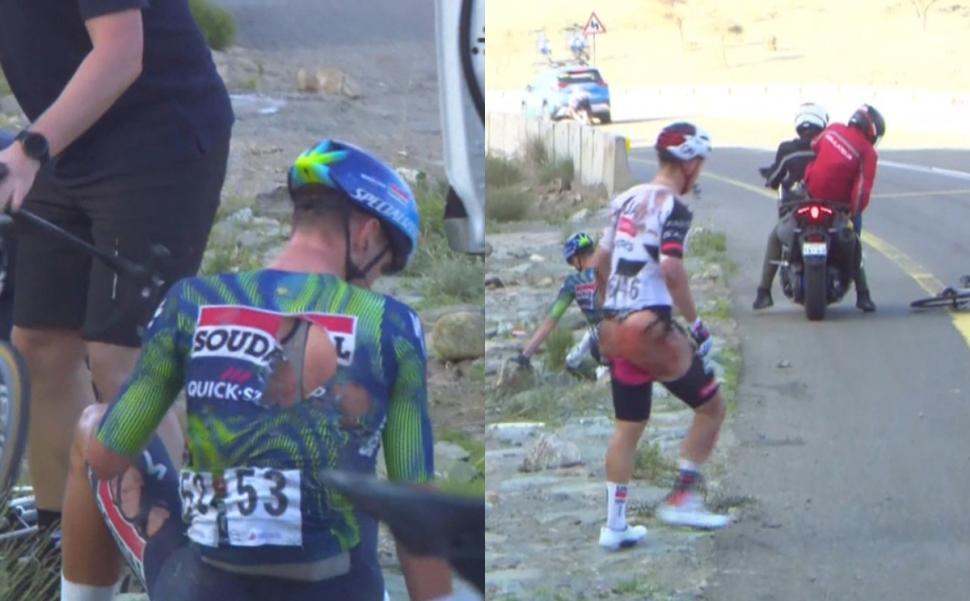
While Rex was remarkably the only rider of the trio to fracture a bone, Grellier and Stella’s teams confirmed the severity of their road rash, even if the TV pictures left little doubt about that.
Stella required “surgical cleaning” and would “remain in hospital under observation”, while Dutch newspaper De Telegraaf reported Grellier underwent emergency surgery on tears (apologies if you’re still eating breakfast) to his anus. The Frenchman’s team TotalEnergies said only that the injuries included “bruises and several deep cuts, requiring several weeks of rest”.