
Days remain until Thursday’s NBA’s trade deadline, and things continue to move fairly slow.
But things began heating up this weekend, and the Chicago Bulls, of all teams, helped get the ball rolling.
The Bulls filled the void when they joined the framework of a three-team deal, which also included Sacramento and Cleveland, on Saturday night. The trade, which became official Sunday afternoon, sent De’Andre Hunter to the Kings; Keon Ellis, Dennis Schröder and Bulls two-way forward Emanuel Miller to the Cavaliers; and veteran center/forward Dario Šarić and two future second-round picks to the Bulls.
Chicago approached the trade deadline with eight expiring contracts, including veteran guard Jevon Carter, who was waived to make room for Šarić. Roughly $2.8 million of Carter’s $6.8 million salary this season remained. The Bulls used their trade exception from last year’s Zach LaVine deal to accommodate the deal and got two future seconds for their trouble: a 2027 second-round from the Cavaliers via the Denver Nuggets, and a 2029 second-rounder from Sacramento that would be the worst from a prior deal with the Detroit Pistons, Milwaukee Bucks and New York Knicks.
Šarić, in the final season of his two-year deal, brings Chicago back to eight expiring contracts.
Dating back to the offseason, Bulls vice president of basketball operations Artūras Karnišovas emphasized the flexibility that the heap of expiring salary gave the team. Chicago, aiming to sneak past the Play-In in recent seasons, hasn’t been known to value such assets to this degree. While the Bulls’ involvement in the deal felt uncharacteristic, multiple league sources indicated to The Athletic that the Bulls have signaled to teams that they’re available as a hub to facilitate money for apron and tax-paying teams, which they helped Cleveland do in this deal.
All signs point to the Bulls leaning toward developing their young core. Chicago doesn’t seem likely to lean as far back as a tank/rebuild — a) ownership still dictates direction, and b) history shows head coach Billy Donovan is far too competitive to stomach anything resembling a rebuild — but it has emerged as a team much more focused on acquiring young players and assets than in prior seasons.
As opposed to the past, these Bulls seem focused on operating around a youthful framework centered on three core players in Josh Giddey, Matas Buzelis and Noa Essengue — all age 23 or younger. The Bulls have consistently expressed confidence in Essengue, one of the youngest players in the NBA, though the runway for him as a meaningful contributor proved lengthy even before his season-ending shoulder surgery.
The realized idea of Essengue is as a multi-positional defender, transition threat and, ultimately, a player complementary of both Giddey and Buzelis. That vision also includes Essengue finding a fit at power forward, accompanied by the idea that Buzelis will naturally move to the wing. In spurts, when the Bulls had the health to deploy double-big lineups, Buzelis demonstrated encouraging flashes in that role.
And while Chicago is focused on developing its young core, it also sounds open to adding youthful talent that fits that timeline. With Nikola Vučević, a grounded 35-year-old who hardly fits the bill for the Bulls’ high-octane offense and defensive aspirations (and whose trade value appears limited, though he is on an expiring contract), the most obvious void for Chicago’s timeline comes at center.
The Bulls seem to recognize the need for a rim-running, two-way big; Giddey still hasn’t played with a true lob threat or rolling big. While it’s unclear if Chicago has the most complete package to trade for second-year New Orleans Pelicans center Yves Missi, his name has been connected to the Bulls.
Missi’s playing time has been shaved down to 19.3 minutes per game from 26.8 as a rookie last season. In 43 appearances this year, Missi is averaging 5.7 points and 5.8 rebounds. Synergy grades Missi as a “very good” defender across 431 total possessions.
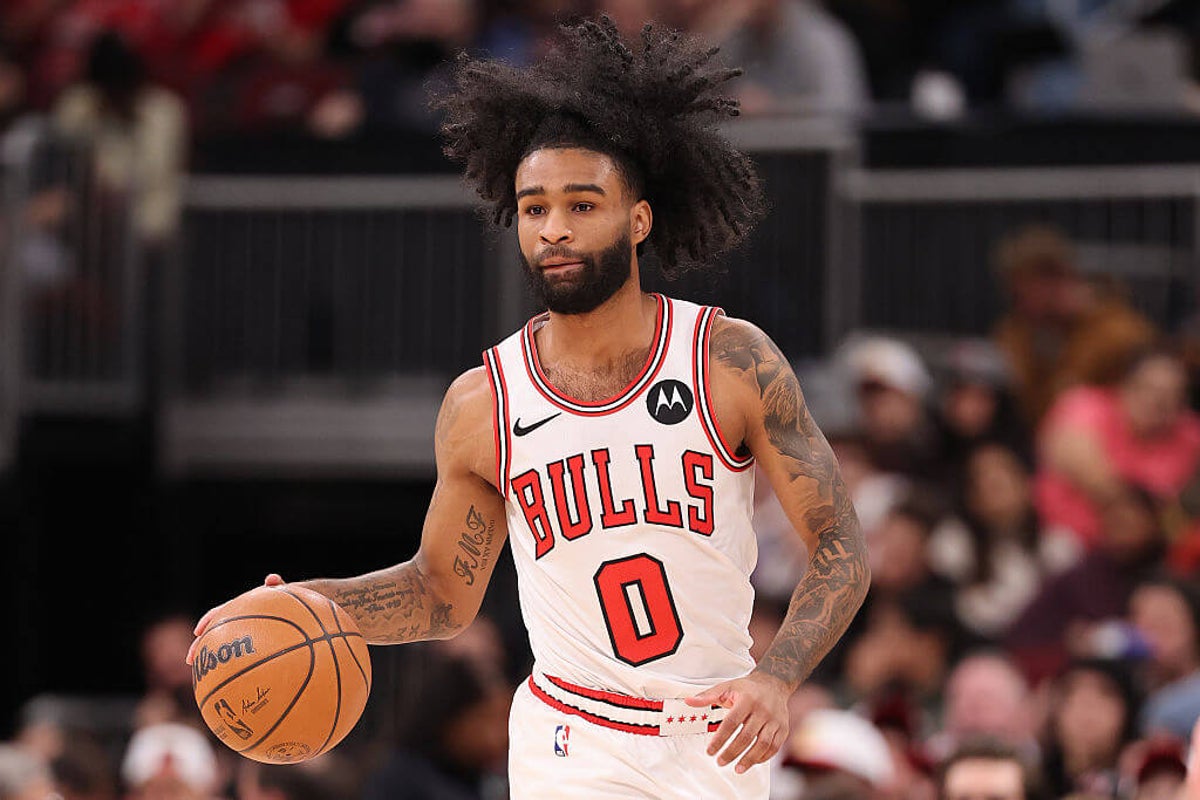
Fifth-year guard and Chicago native Ayo Dosunmu has emerged as one of Chicago’s better assets. He’s been among the league’s best reserve guards, averaging a career-high 14.8 points, 2.8 rebounds, 3.5 assists and shooting 44.1 percent from 3 — a top-10 mark in the NBA — in 26.3 minutes before erupting for a season-high 29 points in Saturday night’s surprising win in Miami.
While the 6-foot-4 Dosunmu could certainly contribute to a playoff contender as an improved shooter, downhill threat, capable starter and secondary ballhandler, one league source told The Athletic that there is some mutual interest between Dosunmu and the Bulls on a potential extension. This isn’t to say the Bulls are married to Dosunmu, who turned 26 last month, and whose stock feels like it’s at an all-time high.
But Dosunmu is portable to the point that he should bend to Chicago’s plans, isn’t a hindrance to Giddey and holds a close-knit relationship with Buzelis. While he doesn’t seem unavailable, it could take a convincing package to pry him from the Bulls.
Among the questions for Dosunmu for any team considering him: Is he truly this improved as a shooter?
Dosunmu is in the final season of a three-year, $21 million deal. He’s making just over $7.5 million this season. Next season’s nontaxpayer MLE is projected at $15.1 million, which feels like a reasonable range in annual value for his next deal and is a reasonable enough number to trade should the Bulls ink him and later decide to move on.
While so few transactions have made the going rate for Bulls guard Coby White difficult to gauge, one league source indicated that Chicago has struggled in early attempts to net a first-round pick in a deal that might involve the seventh-year guard. Any reluctance stems from his expiring contract, the potential figure on his next deal and his nagging calf issues this season.
Karnišovas’ frequent, catch-all use of the word “compete” has scarred Bulls fans, leaving them to assume they’ll perpetually chase a Play-In spot. And for what it’s worth, these Bulls could still stumble into the Play-In under Donovan, who’s wired to win. Only now, it’ll look different, likely in the hands of Chicago’s valued young players.
Sunday’s trade felt like a step in the right direction, like Karnišovas making amends after several short-sighted attempts at playoff runs. The deadline still needs to play out, and Karnisovas has some basketball sins to recover from before this thing trends in the right direction.
But if the move signaled anything, it’s that his Bulls might be trying to repent, one second-rounder at a time. Might the Bulls finally let the kids play?