
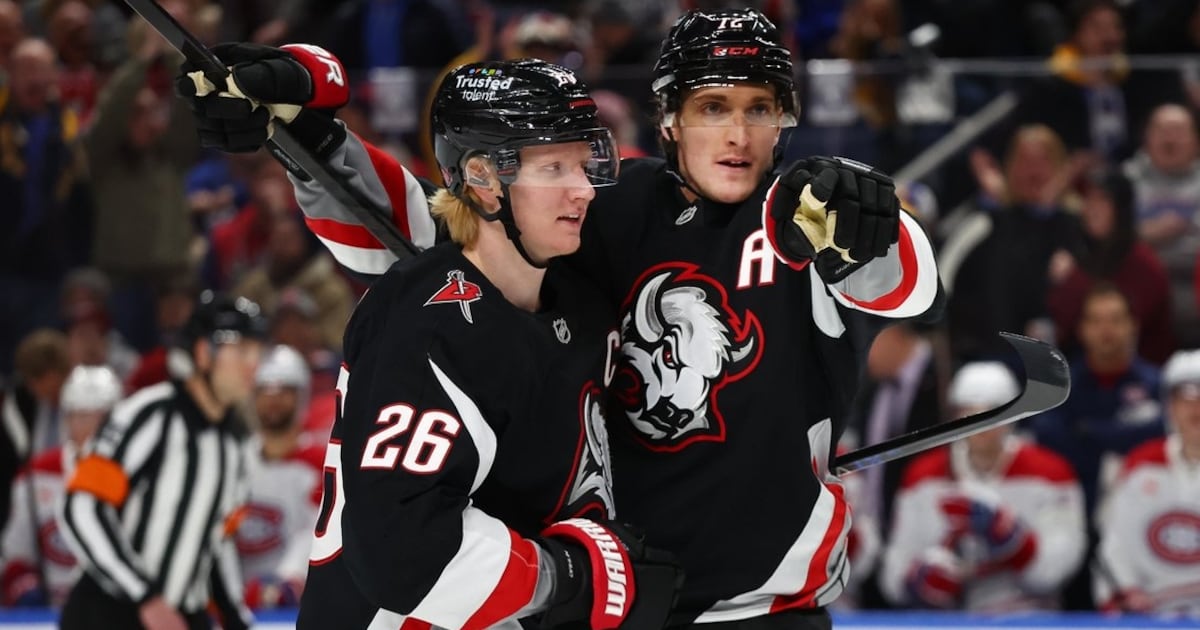
A National Hockey League regular season shaped by the Buffalo Sabres and Utah Mammoth?
Four months ago, that would’ve seemed unthinkable. Yet the winter of 2025-26 has been defined by two franchises with long histories of futility that are poised to reshape the playoff picture.
To say the Sabres and Mammoth have had a rough go of things over the past couple of decades would be a tremendous understatement.
Buffalo has not reached the playoffs in 14 consecutive seasons, a stunning show of futility in a league where half of the teams qualify for the postseason each year. It’s been a persistent debacle of front office ineptitude and underperformance, culminating in what some Sabres fans have called an endless rebuild.
The Mammoth, of course, have a very short history in Utah, but predating their relocation to Salt Lake City was a run as the most mismanaged franchise in professional sports – a financially distressed organization that struggled to reach the salary cap floor each season. There were fleeting moments of success in Phoenix, but fiscal woes hovered over this team like Eeyore’s dark cloud. Their last playoff appearance came in the 2019-20 season.
But my, have things changed. Buffalo and Utah (then Arizona’s) annual futility meant a regular stockpiling of impressive young prospects and many of those young players have now developed into NHL-capable skaters. With strong goaltending behind them, both teams have morphed into genuine contenders.
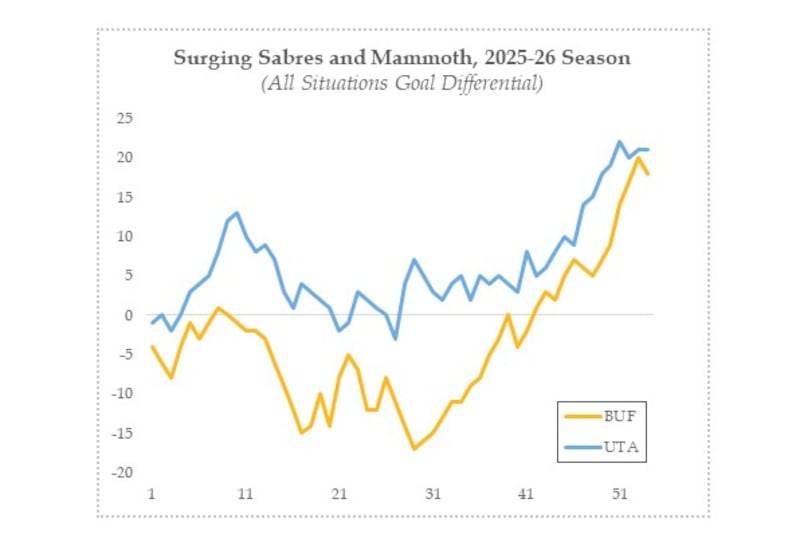
In fact, one could argue they are the two hottest teams in the NHL. Both are now inside of the league’s top eight in goal differential:
 Yost1
Yost1
We knew there were pockets of talent across both lineups to start the year. When we analyzed the depth charts of every roster this past off-season, we raved over Buffalo’s deep blueline and Utah’s forward group.
But sentiment around both teams was still relatively poor. Betting markets placed both teams below the playoff cut line, likely owing to two factors: a recent history of underperformance, and relatively young lineups. The Sabres (25.7) and Mammoth (27.8) have two of the younger lineups in the NHL, which is typical for franchises that have been actively rebuilding and pushing young talent up through the ranks.
But that young talent has positioned both teams for likely playoff qualification as we veer into February. The Sabres are around 70 per cent likely to qualify, the Mammoth an even more impressive 83 per cent.
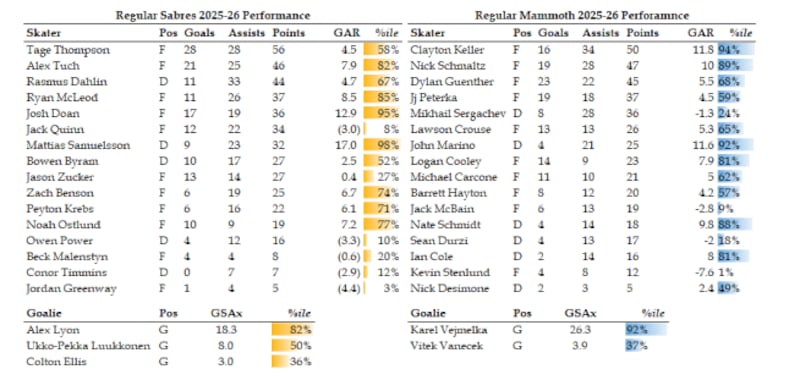
One unifying theme between the two teams is that they are getting meaningful contributions throughout the lineup. What they may lack in extreme top-end skill on their first line or first defensive pairing they are making up for through real depth competency, with few lineup weaknesses observable in either lineup (note: “GAR” stands for Goals Above Replacement, a measurement that estimates the number of goals a player contributes to their team relative to a replacement-level player, across all game states):
 Yost2
Yost2
I would be remiss to not highlight how important goaltending has been for both teams.
The Sabres have been a competitive even-strength team for years offensively speaking, but only this season – primarily through the play of journeyman Alex Lyon, who has stopped 18 goals better than expected relative to the shot profile he has faced – have they been able to bolster the defensive side of the ice.
The Mammoth are getting a frankly dominant season from workhorse Karel Vejmelka, who has a real shot at ending the season as a Vezina Trophy finalist with those numbers.
Setting aside the impact this is having on the playoff picture, a second fascinating dynamic here is that two surprising contenders are entering the trade deadline fray with the requisite cap space to engineer some deals.
Buffalo’s fiscal situation is tighter between the two, but cap estimates show they are carrying around $3-million in cap space, with a sea of prospects and young rostered players that selling teams would likely covet.
And the Mammoth? Well, if they want to go big, they can. Cap estimates there show the Mammoth have in excess of $14-million in space, capable of taking on one (or more) big contracts to upgrade their team.
This, frankly, is the good part of parity the NHL offers. The Sabres have been an afterthought for years, while the Coyotes organization was on life support for decades. Now both are positioned as real contenders heading into the stretch run, armed with the requisite flexibility to upgrade their lineups even further. A scary proposition for the rest of the field!
Data via Natural Stat Trick, NHL.com, Evolving Hockey, PuckPedia