
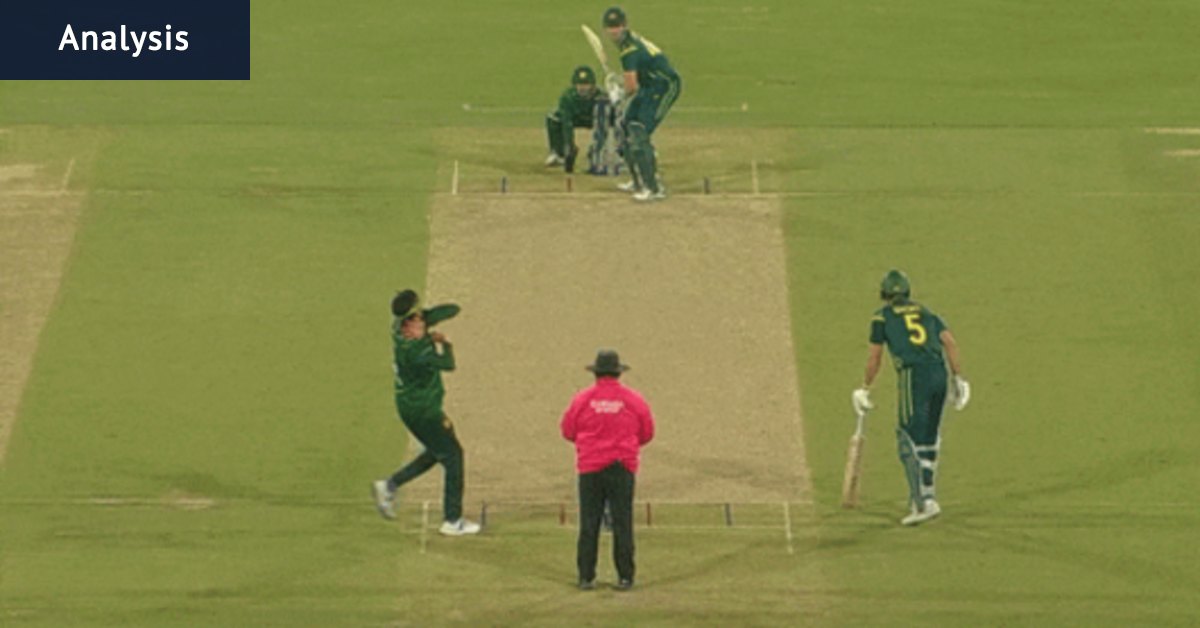
The approach
Nothing particularly different to see here. Tariq approaches the striker very much like most spin bowlers, with a focused trot to the crease from a slight angle.
In terms of a batter’s cues, they are perhaps lulled into a sense that this will be nothing particularly out of the ordinary, despite having doubtless seen video footage of Tariq beforehand.
The pause
This is where things get interesting. Most finger spinners have something of a pause when they get to the crease, as their braced front leg is important to imparting spin and bounce to the ball, rather than rolling through with the same momentum.
But Tariq’s is so pronounced as to make the batter feel like the delivery has been aborted, or at the very least put on excruciating pause.
In the words of one former Australian spin bowler and coach: “You could argue the ethics about him stopping at the crease before he releases, but there’s nothing in the rules to say he can’t.”
Here’s another example from around the wicket to Matt Kuhnemann.
There have been times in the past when such pauses were linked to attempts to run out the non-striker backing up, but in Tariq’s case it is a consistent part of his technique. It is extremely likely to mess with the rhythm of a batter who is, often in the late overs of a T20 match, trying to hit out.
The side-arm
Tariq’s arm is most definitely bent during delivery, and if it is that bent, then it is also likely to straighten somewhat.
But most observers agree it does not straighten anywhere near the 15 degree threshold required for an action to be ruled illegal in 2026 – as proven by two rounds of International Cricket Council-sanctioned testing when umpires previously reported his action.
Most unusual is the extremely low, slingy arm action. Among contemporary bowler’s Tariq’s arm height resembles that of the former Sri Lankan fast man Lasith Malinga, just at nowhere near the same speed.
Loading
A century ago, another spinner who made an art form of bowling with a low arm was the Australian leggie Clarrie Grimmett, who took 216 Test wickets between 1925 and 1936 after making his debut at the late age of 33.
Tariq has a long way to go to get there, but he will be a surprise weapon for Pakistan and franchise teams for some time to come.
As another former Australian player put it: “I don’t believe he’s suspect. Unusual, yes, but not illegal.”
News, results and expert analysis from the weekend of sport sent every Monday. Sign up for our Sport newsletter.