
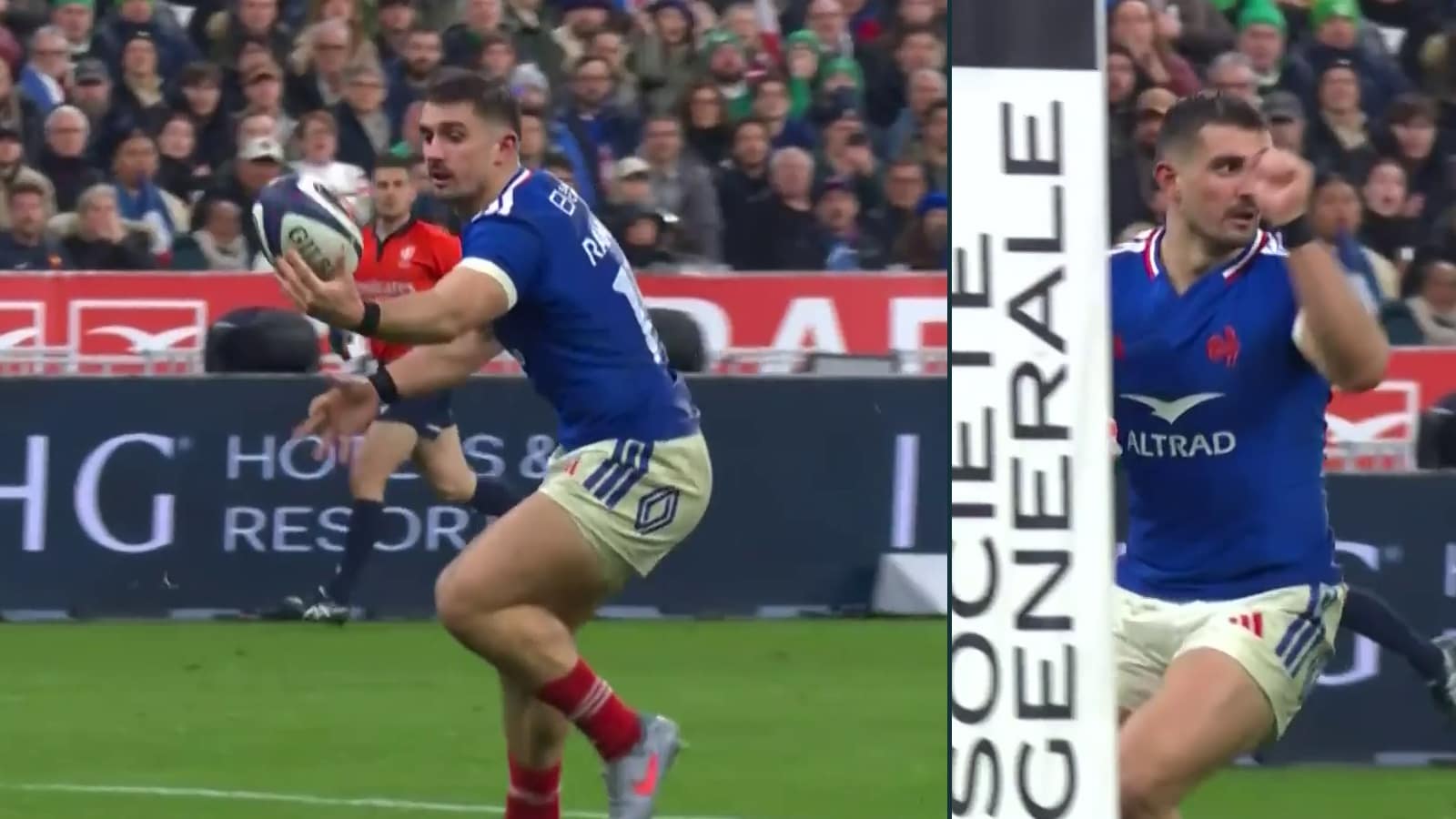
In the 66th minute of the Six Nations match between France and Ireland, a law definition change that has gone largely unchecked for eight years was thrown into the spotlight.
In January of 2018, World Rugby launched an updated lawbook after an extensive review that took almost two years.
World Rugby’s law simplifications
The remit of the review was to simplify the laws of the game, and it resulted in the explanations of the laws being cut down by as much as 42 per cent.
“As our game continues to grow around the world, we continue to strive to make the sport as accessible to all,” then-World Rugby Chairman Bill Beaumont said at the time.
“The laws can be difficult to understand for new participants and fans, and the new law book goes a long way towards simplifying it and making it easier to understand for players, coaches, referees and the viewing public.”
The rewriting of the laws meant that small tweaks have occurred through the definitions of certain facets and laws of the game.
One of which is the mark with Thomas Ramos‘ catch in the latter stages of the opening Six Nations match of the season leaving viewers baffled, including England great Austin Healey.
From a lineout in the 66th minute of the match, Ireland worked the ball out to fly-half Sam Prendergast, who hoisted it into the Paris night sky as his centre Garry Ringrose went tearing after it.
Ringrose put significant pressure on French full-back Ramos, who was unable to catch the ball cleanly a few metres from his try-line, fumbling it backwards before juggling it into his grasp and raising his arm for the mark.
France were duly awarded a free-kick by referee Karl Dickson, with the full-back then punting the ball into touch, giving Ireland a lineout outside the French 22.
Want more from Planet Rugby? Add us as a preferred source on Google to your favourites list for world-class coverage you can trust.
The change
The fact that Ramos didn’t catch the ball cleanly with his first attempt is where the confusion lies with Healey posting, “You can’t mark a juggle’, on social media platform X during the game.
He was not alone in thinking as much, though with other comments reading along the lines of, “That is not a mark. You have to take it cleanly”. That was certainly the case before World Rugby updated and simplified the lawbook in 2018.
In the 2017 World Rugby lawbook, the definition of a mark reads as follows: “To make a mark, a player must be on or behind that player’s 22-metre line. A player with one foot on the 22-metre line or behind it is considered to be ‘in the 22’. The player must make a clean catch direct from an opponent’s kick and at the same time shout “Mark”. A mark cannot be made from a kick-off, or a restart kick, except for a drop-out.”
However, the lawbook, since the update in 2018, omits the need for a player to make a “clean catch” to claim a mark, provided that they complete the catch before it touches the ground or another player.
It further clarifies that a mark can be called even if the ball has hit the goal post or crossbar before being caught.
“A method of suspending play and winning a free-kick by directly catching an opponent’s kick in the catcher’s own 22 or in in-goal and shouting ‘mark’,” the updated definition reads.
Law 17.1 on claiming a mark, adds:
“To claim a mark, a player must:
a. Have at least one foot on or behind their own 22-metre line when catching the ball or when landing having caught it in the air; and
b. Catch a ball that has reached the plane of the 22-metre line directly from an opponent’s kick before it touches the ground or another player; and
c. Simultaneously call ‘mark’.”
It continues: “17.2 A player may claim a mark even if the ball hits a goal post or crossbar before being caught.
“17.3 When a mark is called correctly, the referee immediately stops the game and awards a free-kick to the team in possession.
“17.4 A mark may not be claimed from a kick-off or a restart kick after a score.”
Ramos met the updated requirements with his catch.
Nothing to it 😮💨🙌#GuinnessM6N #Since1883 #FRAIRL pic.twitter.com/kAU9peqTtw
— Guinness Men’s Six Nations (@SixNationsRugby) February 5, 2026
More prevalent going forward?
The changing of the wording of the law undoubtedly means that players no longer have to catch the ball cleanly in order to claim a mark, which has influenced the game as well.
Prendergast’s hoof into the French 22 is a tactic rarely seen nowadays and is somewhat a roll of the dice, hoping to cause havoc in the backfield. Perhaps we may see more of it going forward, following the removal of the escorts, which creates more of a contest in the air for the ball.
Still, the receiving team will have the option to claim the mark in the event that the player is unable to catch the ball cleanly, as Ramos did.
While the tactic from Ireland may well have been viewed by some as a waste of possession, ultimately, Ringrose wasn’t far off from catching the ball himself and had he done so, he would have just needed to flop over the line.
Additionally, when Prendergast received the ball, he did so in between the halfway line and France’s 10m line, with the lineout taking place on the latter. Ramos’ touch finder set up a lineout just outside of France’s 22m line – a significant territorial gain.
Ultimately, Ireland wasted that gain as they failed to set a good platform from the ensuing lineout, with the attack stopped in its tracks by a knock-on.