
CONTRIBUTION:
Canberra has signed deals across the Pacific region and boosted efforts to increase influence as Washington leans on allies to help deter Beijing
Australia and Indonesia’s leaders yesterday signed a security deal, one of a series of agreements that Canberra has secured with neighboring countries to reinforce ties and limit China’s influence in the region.
At a signing ceremony, Indonesian President Prabowo Subianto told Australian Prime Minister Anthony Albanese that “this agreement reflects the determination of both countries to work closely in safeguarding national security and to make a tangible contribution to peace and stability in the Indo-Pacific region.”
“For Indonesia, this represents a firm commitment to the principle of good neighborliness, and to our free and active foreign policy,” Prabowo said.
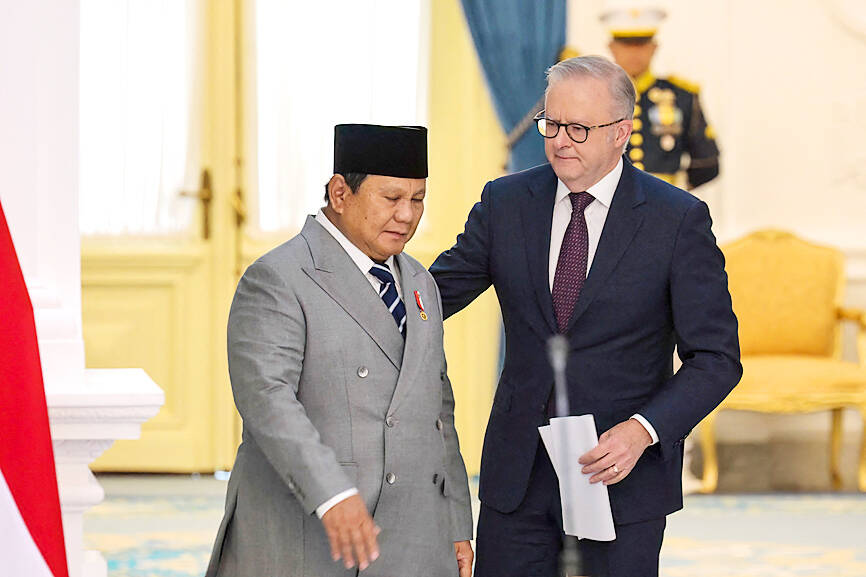
Photo: AFP
Albanese said there was no more important nation for Australia than Indonesia, and that the “treaty reflects the close friendship, partnership and deep trust between our two nations.”
Albanese has signed a series of defense, public security and aid deals across the Pacific region since taking office in 2022, attempting to boost its influence and to try and limit that of China. The effort has intensified under the administration of US President Donald Trump, as Washington leans on allies to take up more of the burden in deterring Beijing’s growing military power.
Late last year, Australia concluded a security deal with Papua New Guinea, which sits north of Australia and east of Indonesia. Albanese visited Timor-Leste last month, signing a new agreement to provide various kinds of aid and support.
Indonesia’s sovereign wealth fund, Danantara, would also explore coinvestments in Australia, a joint statement said, adding that both nations are looking to invest in each other’s critical mineral industries.
“The government can be very pleased with the agreements it signed across the Pacific,” Lowy Institute security program director Sam Roggeveen said.
“Indonesia is in a different category because of its size and also because of this historic commitment to to non-alignment,” he said, referring to the country’s efforts to seek a middle path in the Cold War.
The deal is largely based on an agreement signed by then-Australian prime minister Paul Keating and then-Indonesian president Suharto 30 years ago that Jakarta abrogated following East Timor’s vote for independence from Indonesia. It also builds on a 2006 Lombok treaty between the two nations.