
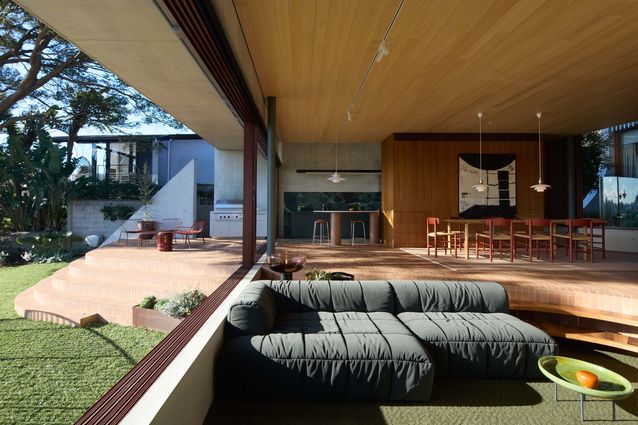
Some houses work so well with their surroundings, it seems as if they had always been there. Despite its relatively new external finishes, this home on Sydney’s Middle Harbour harks back to the mid-twentieth century for design inspiration – specifically the Sydney School. From the 1950s onwards, architects in Sydney experimented with ways of integrating the modernist forms of residential design into the distinct Sydney landscape of steeply sloping sandstone sites, harbour views and bush vegetation. While most Sydney architects are familiar with this movement through their university history courses, it more often serves as a historical reference than an active design methodology.
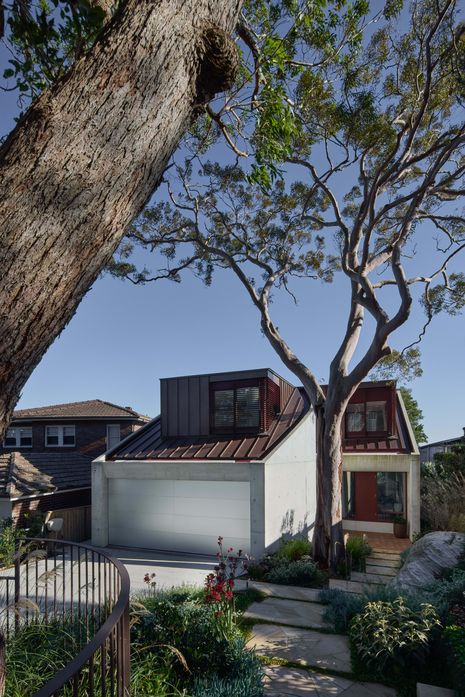
For CO-AP, however, revisiting the lessons of the Sydney School was a logical step in response to a steep harbourside site punctuated with three large, mature trees – around which the house design was developed. Will Fung, founding co-director of CO-AP, explains that the studio’s intention was to design a house that read as a single-storey dwelling, topped with a lighter metal roof punctuated with dormer windows. The client’s love of Brutalism is expressed in the solid concrete base that grounds the house to the earth.
View gallery
Will notes that the angophora tree in the front yard provided the reference for the exterior colour palette, from the cool grey of the concrete to the deep maroon of the aluminium cladding on the second-storey mansard roof. The metal window frames are highlighted in a brighter red, found in the leaves and bark of the angophora, contrasting brilliantly with the concrete. The site’s landscape has also informed the front elevation of the house: the entrance is recessed from the garage line, its path curving around a rocky outcrop and the angophora.
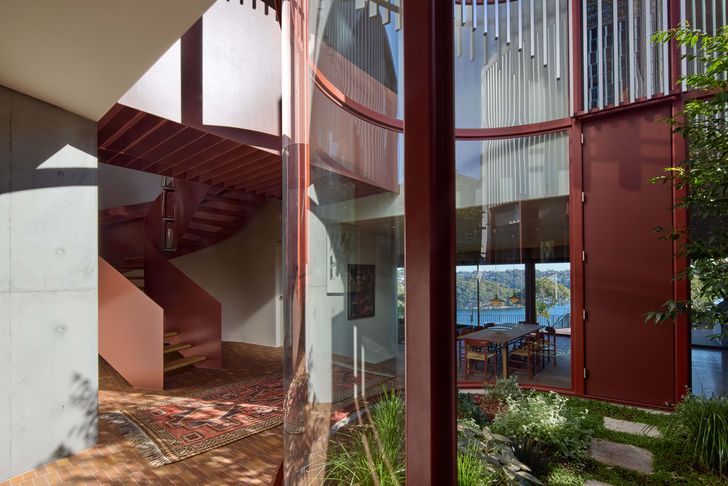
This subtle curvature continues inside the entry vestibule, where walls are deliberately configured without straight lines. Will explains how this approach makes spaces feel less like distinct rooms and corridors, and more like a fluid sequence of interconnected zones. A compression point occurs in the vestibule, where the external courtyard bulges into the space conversing with the twisting metal stair that connects to first-floor bedrooms. The sinuous form of the staircase and its earthy red colour recall the twisting branches of the angophora.
View gallery
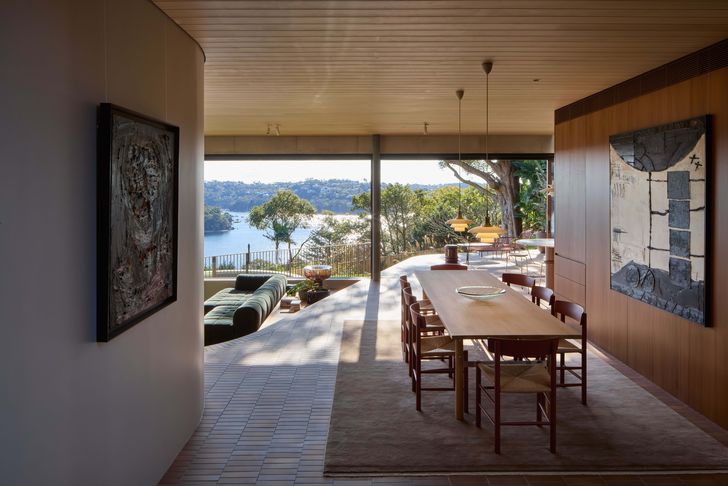
As in Sydney School houses, the floor plan steps down in a staggered progression, following the slope of the land and revealing each space in a carefully choreographed sequence. The vertical drama of the vestibule is counterbalanced by the broad horizontality of the living and kitchen areas, which open out to expansive harbour views. Timber plays a central role in the living spaces – from the dark tones of the Tasmanian blackwood joinery to the lighter-toned Paulownia of the ceiling. Deep greens in the kitchen reference the foliage of the lilly pilly tree in the backyard. Stepping down another level via arced steps leads to the sunken lounge, upholstered and carpeted in a variety of green tones.
The planning and sequencing of this house are exceptionally well resolved. Spaces are open and interconnected, yet each zone retains an intimacy, achieved through the sophisticated use of materials, furniture and colour – allowing for both definition and continuity. While this house acknowledges its historical inspiration, it simultaneously stands as a compelling example of twenty-first-century Sydney residential architecture.
View gallery