
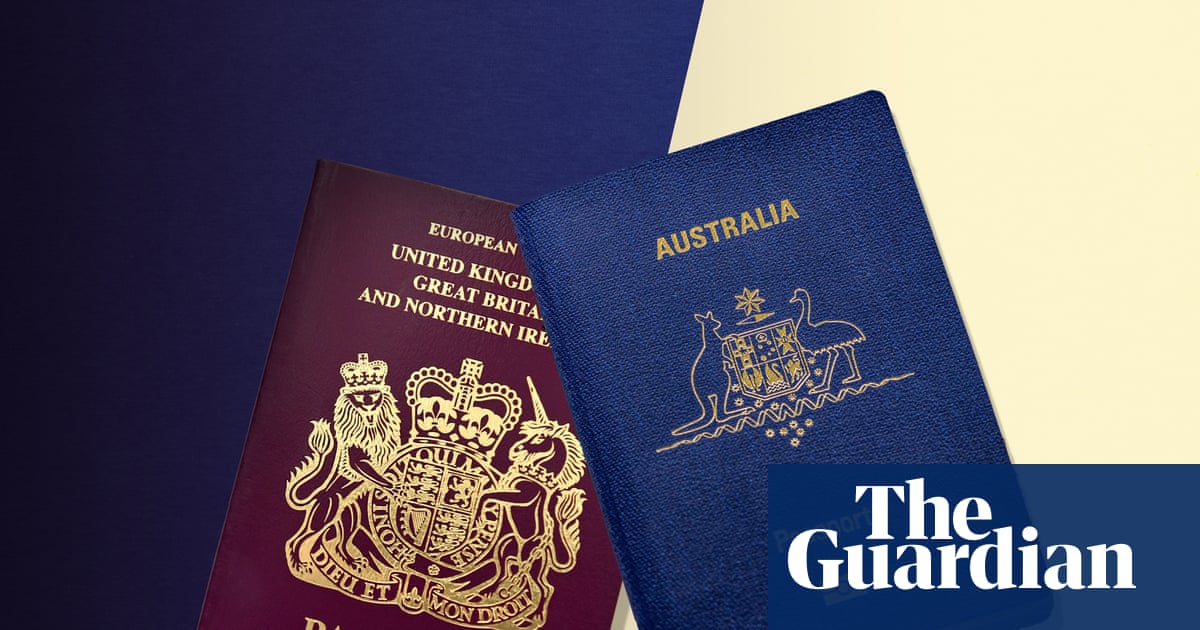
Gabrielle Mordy has travelled for years with ease between Australia and the UK.
In early January, when she accepted an invitation to an academic conference in the UK scheduled for March, she didn’t give a second thought to using her Australian passport.
But the UK government’s recent change of travel rules for dual citizens, which Mordy learned of in late January, has turned her assumption of convenience into a bureaucratic mess, leaving her travel plans in jeopardy.
She has lived in Australia for most of her life, but has British citizenship through her father.
Having last renewed her British passport in 2001, she assumed her Australian travel documents would suffice, as they had for the past two decades.
“In January I heard the new rule was announced,” she says. “I had no hint that this was coming in … If I’d had six months notice I would have been fine, but I’ve only had one month’s notice.”
In a change announced in November, the UK will begin enforcing new pre-departure checks for all international travellers.
From 25 February all visitors to the UK must have digital permission – either an electronic travel authorisation (ETA) or eVisa.
The UK government claims the change will help “digitise the immigration system” in a move towards a “contactless UK border”.
The ETA, which costs £16 ($31), is intended to streamline entry for visa-exempt visitors from countries including Australia, New Zealand and Canada, but it has created a hurdle for dual nationals.
British (and Irish) citizens who are also citizens of another country will be ineligible for an ETA, meaning they can no longer use a foreign passport to enter the UK.
Instead they must present a valid British or Irish passport or a certificate of entitlement (COE) – a document proving a right of abode that costs £589.
The only alternative is to renounce their British citizenship, a process that takes six months and costs £482. (Ireland does not charge a fee to renounce citizenship.)
‘It seems quite cruel’
For Mordy, compliance has been a scramble.
Because her last UK passport expired more than 20 years ago, she had to navigate a full application rather than a simple renewal.
She did not have a long-form birth certificate, which includes parents’ details and ended up having to order it twice due to what she calls a “completely unclear” digital application process.
“I’ve now ordered a second birth certificate and I’m getting it couriered,” she says.
On Friday, almost two weeks after her initial application, she was still waiting.
“It seems like an extraordinarily long time.”
She says if the certificate arrives soon, she will have to ask for her passport application to be fast-tracked to make it in time.
If it doesn’t, she faces the prospect of cancelling her flights.
She says the British High Commission suggested the COE as an alternative, but that would require surrendering her Australian passport for up to eight weeks.
“The only other way would be to renounce my British citizenship, that takes six months and it’s not cheap,” she says.
“It seems quite cruel, there’s no clear timeline, which you need for your travel plans,” she says.
‘No one wants their passport any more’
The effect of the rule change has been felt across the Australian travel industry.
Vicki Hope, a Sydney travel adviser, says some clients have had to change their plans drastically.
“In some cases, we are working to a firm deadline, if the [UK] passport doesn’t arrive, the trip would need to be cancelled and rebooked,” she says.
She says Australian-born dual citizens who never felt the need for a UK passport are now feeling “unsure” and “anxious” as they try to figure out how to comply with the rules.
“They have had to urgently submit documentation and are now waiting, fingers crossed, hoping it’s processed in time,” she says.
“That brings added cost, stress and disappointment, particularly when their travel has been planned and they have been looking forward to their trip for a long time.”
Brisbane-based Kara Przybylski, 26, has dual citizenship, but currently only holds a valid Australian passport.
Born in the UK with an Australian father, she only heard about the new rules in early February.
Przybylski plans to visit the UK soon, but has not booked flights and says she will put off applying for a new passport because she feels “bad for all the people that need to get theirs urgently, I don’t want to clog the system”.
“It sucks for people who have flights booked, the government should have allowed more time before it comes into effect.”
She says she would have preferred to prioritise getting the Polish passport she is also eligible for.
“Since [the UK] left the EU no one wants their passport any more,” she says.
A spokesperson for the high commission confirmed it had received a “significant volume of enquiries from British Australian dual citizens ahead of the enforcement date”.
“We have addressed most frequently asked questions, including through letters via email, social media posts and videos with our deputy high commissioner,” they said.
Mordy says she found the official support channels lacking. When she attempted to call the high commission for guidance, she was redirected to a website or asked to provide credit card details for a paid transfer to the UK for advice.
Public reaction appears divided.
Some social media users argue citizens should always carry their national passport.
But under the commission’s Q&A video, one commenter points out that their four-month-old Australian-born daughter “can’t enter the UK despite being a citizen by birth”, while a non-citizen on the same flight can enter instantly “purely by obtaining an ETA”.
For many dual citizens the new enforcement is creating a difficult choice between their heritage and their bank accounts.
“I’m a UK citizen by descent … now I’ll have to decide between the expense and hassle of renewing my passport or the expense and hassle of renouncing citizenship,” one said. “Better to not bother going at all.”
Another commenter said: “Many of us have elderly parents in the UK … To think with my Australian passport I can pretty much enter [every] country on the planet apart from the one I’m BORN in beggars belief … Regardless of the route I take I certainly don’t feel British any more.”