
Unlock the Editor’s Digest for free
Roula Khalaf, Editor of the FT, selects her favourite stories in this weekly newsletter.
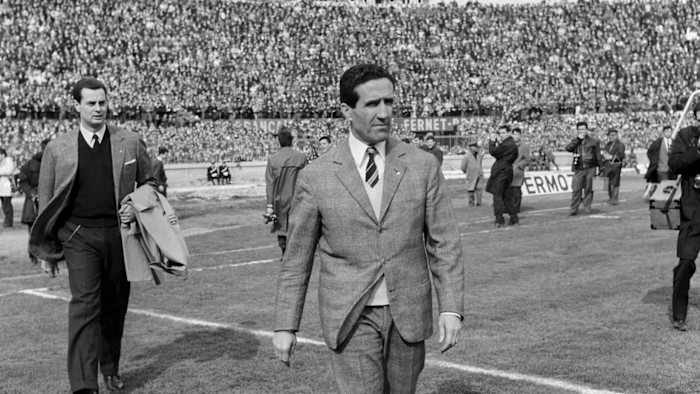
Helenio Herrera is the best manager football has forgotten. In his heyday in the 1950s and 1960s, Herrera won four titles in Spain, three in Italy, and two European Cups. He was the first superstar manager, and promoted the idea that matches were won from the sidelines.
Herrera was notorious. He wore three-piece suits, alligator shoes and a black cape that evoked Dracula. He practised yoga — naked — every morning for 50 years. His managerial style combined the strictness of Alex Ferguson with the antics of José Mourinho. He mixed the energy of Jürgen Klopp with the attention to detail of Pep Guardiola. Moreover, he had the ethics of Lance Armstrong.
In HH: Helenio Herrera, Richard Fitzpatrick tells a story of elite sport, arrant misconduct and exorbitant ego. Fitzpatrick explores “a mysterious man” who “changed the profile of coaches . . . in football”. Before HH, he explains, “football coaches were in the background. No one knew their names.”
To abet his intense game plan, Herrera supplied amphetamines, which he insisted were plain vitamins
Herrera was born in Buenos Aires in 1910, but grew up in French-controlled Casablanca, in a wooden shack on stilts. As a player, he was unspectacular (his memoirs describe him playing for France, but there is no evidence that he did). His qualities were speed and endurance — traits he would lionise as a manager.
Herrera began coaching in France in 1944, but made his name in Spain — first with Atlético Madrid and then Barcelona. When he arrived at Barcelona in 1958, the club was in deep debt and performing poorly. He quickly set to work on morale, and negotiated salary increases for reserve players and backroom staff. In Fitzpatrick’s words, “HH was buying their loyalty.” On the pitch, he changed Barcelona’s style from languid and elegant to swift and direct.
To abet his intense game plan, Herrera supplied amphetamines, which he insisted were plain vitamins. Doping was becoming common across Europe but, in Spain, Herrera was the first. Under him, the club won the Copa del Generalísimo (now known as Copa del Rey) and two Ligas. However, two years after his arrival in 1960, he left Barcelona in disgrace — chased down La Rambla by fans who believed he had taken a bribe to lose to Real Madrid.
Herrera joined Inter Milan where, despite fines and suspensions, he continued doping. He also kept winning — Serie A three times and the European Cup twice. He led Spain at the 1962 World Cup, where they were knocked out following a controversial 2-1 defeat to the champions, Brazil (Spain were denied a clear goal and an obvious penalty, but were using amphetamines).

It can be hard to separate Herrera’s success from his habitual doping, but Fitzpatrick demonstrates that he was a coaching pioneer. Herrera transformed players’ diets, and revolutionised tactical preparation — he kept a personal record of players’ weight, and conducted detailed analysis of future opponents, sometimes attending their matches in disguise. He developed player psychology, and exerted a “hypnotic influence”.
Often, however, this went too far. He was reckless with player health, and when striker Giuliano Taccola died of heart failure in 1969, Herrera was charged with involuntary manslaughter.
HH is assiduously researched. Fitzpatrick provides extensive social, political and sporting context, such as life in Barcelona under Franco; but he often loses focus, and too many quotes overlap in theme. At his best, however, he tells Herrera’s outrageous story with verve.
Thanks to Fitzpatrick, that story might become more familiar. As it is, aside from within Barcelona and Inter Milan, and among football historians, Herrera remains largely unknown.
“I want players to bomb forward at great speed, with no more than three passes to get into the box,” Herrera said. He would regard today’s dominant tactics — the quick passing and the intense pressure to retrieve the ball — as a tribute.
HH: Helenio Herrera — Football’s Original Master of the Dark Arts by Richard Fitzpatrick Bloomsbury £20, 304 pages
Join our online book group on Facebook at FT Books Café and follow FT Weekend on Instagram, Bluesky and X