
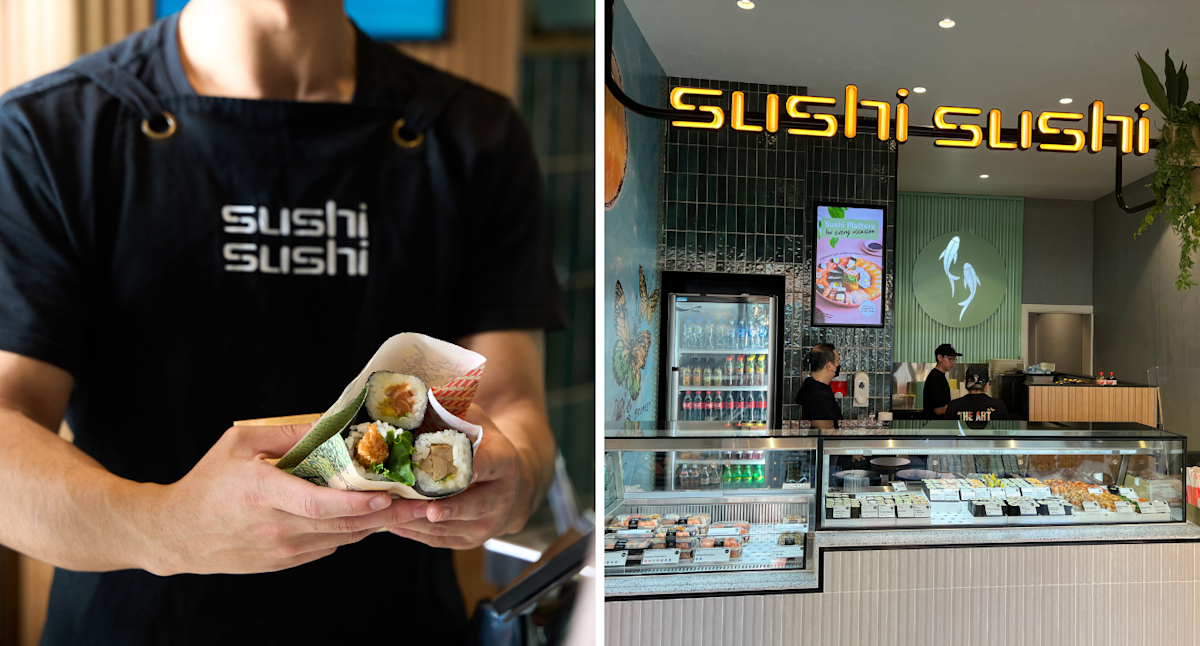
 Aussie chain Sushi Sushi has been bought by Japanese giant Genki Global Dining Concepts. (Source: Sushi Sushi)
Sushi Sushi, one of the biggest sushi chains in the country, has been sold to Japanese business Genki Global Dining Concepts. The Aussie takeaway chain was founded in the late 1990s and has become a staple at shopping centre food courts across the country.
The deal will see Genki acquire Sushi Sushi’s network of more than 180 stores, which include both company-owned and franchised stores, along with some 3,000 staff. The purchase is expected to be completed in April, with the final acquisition cost to be revealed then.
Sushi Sushi CEO Stephen Anders told Yahoo Finance customers won’t actually notice any immediate changes at the stores from the sale, but will see newer technology start popping up in the future.
RELATED
“Over the medium to longer term, Genki is a multi-market player and they’ve been in the industry for 50 years, so there’s a lot of category capability there,” he said.
“So there’ll be opportunities to partner with them around technology, particularly sushi train technology. We’ll be looking to introduce some new train technology into the market in the months ahead.”
Anders pointed to Genki’s return plate technology, which allows you to return your empty dishes on the sushi train.
“Also, from a product innovation perspective, it’s really exciting. We’ve got a global supply chain, they’ve got a global supply chain,” he said.
“They’ve got a significant recipe book, and so that’s really exciting to be able to innovate on the product front with them.”
 Sushi Sushi CEO Stephen Anders said customers wouldn’t notice any immediate changes from the sale. (Source: Sushi Sushi)
Sushi Sushi was sold by co-founder Anna Kasman to private equity firm Odyssey Private Equity in 2019 for a reported $50 million.
Odyssey engaged Luminis Partners to consider exit options last year and was reportedly seeking offers above the $160 million mark.
Sushi Sushi and another brand owned by Odyssey, known as Sushi Musa, generated revenues of $88.7 million in the 12 months to June 30, up from $75.9 million a year earlier. The company reported a profit of $1.5 million in that period.
The business currently has 14 trains in its network and plans to expand the technology in the coming months. (Source: Sushi Sushi)
Genki was founded in 1968 and pioneered the conveyor belt sushi concept. It’s grown into one of the world’s biggest operators of Japanese fast food restaurants and now has more than 430 stores across 13 countries.
“Sushi Sushi is an iconic Australian brand with a powerful consumer proposition, strong franchise performance and significant runway for expansion, both in Australia and internationally,” Genki president and CEO Mitsuzo Fujio said.
“Its focus on quality, freshness and customer satisfaction aligns closely with our philosophy as we build one of the world’s leading Japanese-origin sushi brands.”
Domestically, Sushi Sushi plans to expand to 450 stores by 2035 and is currently growing the network at 20 to 25 stores a year.
Sushi Sushi and its main competitor Sushi Hub account for about 15 per cent of all sushi outlets, but about 40 per cent of total takeaway sushi sales. The majority of the takeaway sushi market is dominated by independent stores.
In the broader quick service market, Anders said the two businesses had about 1 per cent market share each.
The brand recently launched in Saudi Arabia and has three stores currently trading, with a fourth to open in the next month.
“We’re really seeing a terrific consumer uptake around Australian grab-and-go sushi. So we’re really excited about that,” Anders told Yahoo Finance.
Australia has become known for its unique style of sushi. It’s a thick hand roll made from half a sheet of dried seaweed, with its shape different from Japanese temaki hand rolls, which are often cone-shaped.
Aussie Alex Marks notably sparked headlines when she opened an “Australian-style” sushi store in New York in 2023, while Aussie brothers Adam and JJ Miller recently opened the first Aussie-style sushi handroll shop in Britain.
Anders said Sushi Sushi had received “inbound interest” in all markets around Saudi Arabia, along with markets around the globe.
“One exciting aspect with the Genki partnership is we’re actually going to sit down and we’re going to prioritise international development markets that are interesting for us,” he said.
“The US is an interesting market. There are markets in Europe that are attractive as well, as well as the Middle East.
“There’s a lot of opportunity there. Grab-and-go sushi as a concept is either nascent or non-existent outside the grocery channel in a lot of these countries.”
Get the latest Yahoo Finance news – follow us on Facebook, LinkedIn and Instagram.