
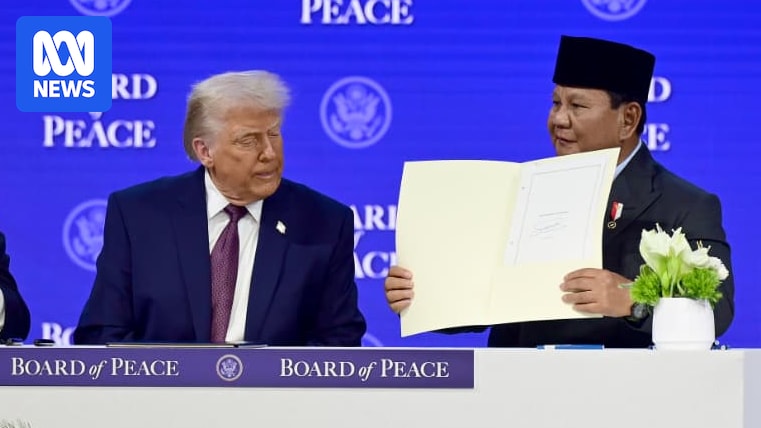
With the United States’ traditional western allies conspicuously absent, US President Donald Trump’s Board of Peace will have its first meeting this week in Washington.
Amid the spectacle of the leaders of more than 20 countries who accepted the invitation to join the board, most eyes will be glued to Trump.
The board will meet on Thursday, local time, with an announcement expected on a reconstruction plan for war-ravaged Gaza, along with plans for a Board of Peace-led International Stabilisation Force.
But the eyes of the Indonesian public will be sharply trained on their own leader, with Indonesian President Prabowo Subianto facing perhaps his most significant foreign policy test yet.
Indonesians have been deeply divided over the president’s decision to accept an invitation to join the Board of Peace.
What he says and does, and what the outcomes of the meeting are, are likely to have significant domestic ramifications for him.
A storm of criticism from within the country
When it was announced, Prabowo’s decision to join the Board of Peace was widely unpopular.
Critics said the decision was rushed, made without consulting the Indonesian public and the parliament, and one that promoted US and Israeli interests.
Two weeks ago, Prabowo summoned several former ministers and deputy foreign ministers, as well as senior diplomats, to the Merdeka presidential palace in Jakarta.
Palace officials said they were summoned to “discuss the direction of Indonesia’s global policy”, but the ABC understands one of the key issues that made Prabowo call them in was Indonesia’s decision to participate in the Board of Peace.
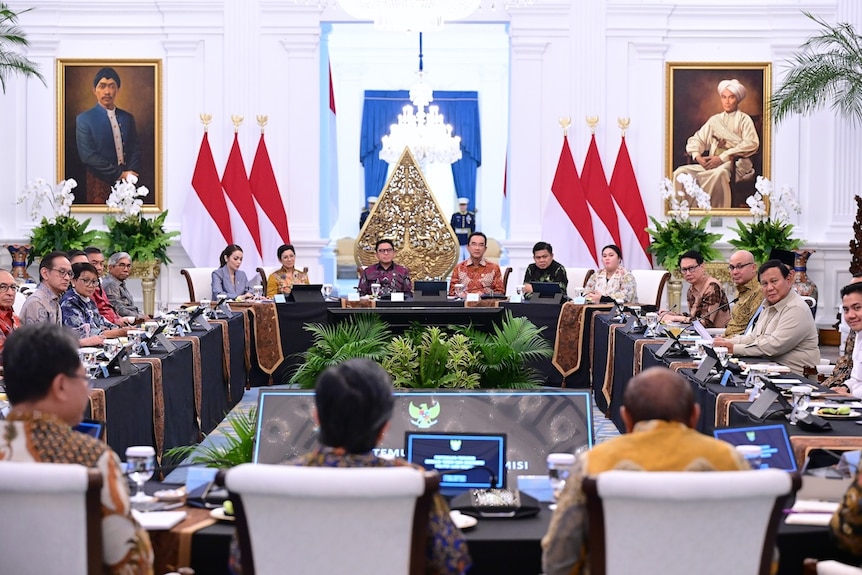
Senior diplomats, including former foreign ministers, provided input to Prabowo Subianto. (Supplied: Press and Media Bureau of the President of the Republic of Indonesia)
Core to Prabowo’s argument for joining is that with Trump challenging international institutions, such as the UN, and setting up this board, it is better to be in the room where it happens and try to organise a coalition of Muslim nations from within.
An international relations professor at Universitas Padjadjaran, Teuku Rezasyah, was at one of those meetings.
“[Prabowo] was very convincing,” he said.
“He stated a lot of scenarios inside the Board of Peace, and he wants to show a leadership role there.
“He knows that [the Board of Peace], among others, is the best channel for Indonesia to help support the independence of Palestine and to ensure that a two-state solution will be mentioned in the meeting.”
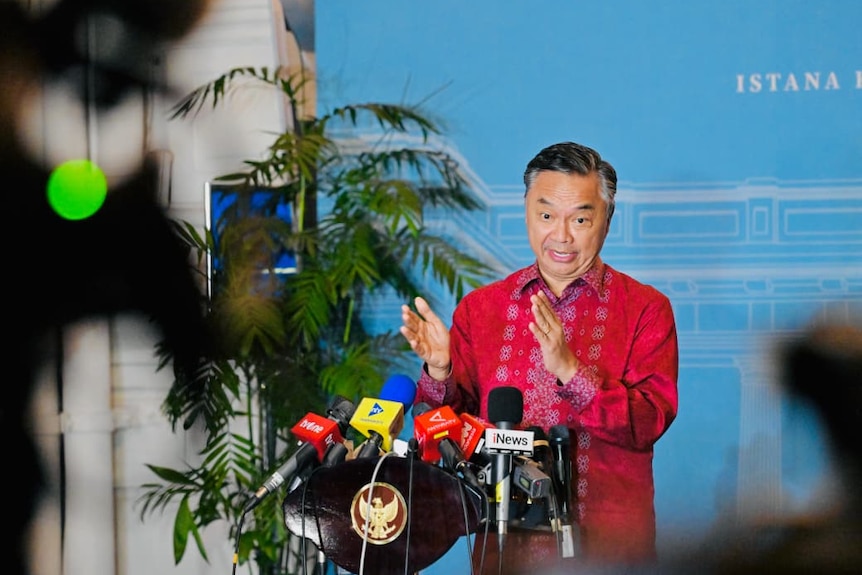
Dino Patti Djalal speaks with reporters after meeting Prabowo Subianto. (Supplied: Press and Media Bureau of the President of the Republic of Indonesia)
Former foreign minister Dino Patti Djalal was also at one of the palace meetings. He was previously deeply critical of the Board of Peace, but after meeting Prabowo told reporters it was “the only option”.
“After Trump’s intervention [in the Gaza war], which produced a 20‑point plan agreed to by Israel, the only solution package available at the moment is this [Board of Peace] … there is none from Saudi Arabia, China, Russia, India, or from Australia,” he told Tribunnews.
“But don’t be naive; we must understand the risks and we must know the limit where we can say, ‘OK, enough. We leave [the board].'”
He also warned Indonesia must not let the Board of Peace “become a tool for Israel to control existing members through Trump”.
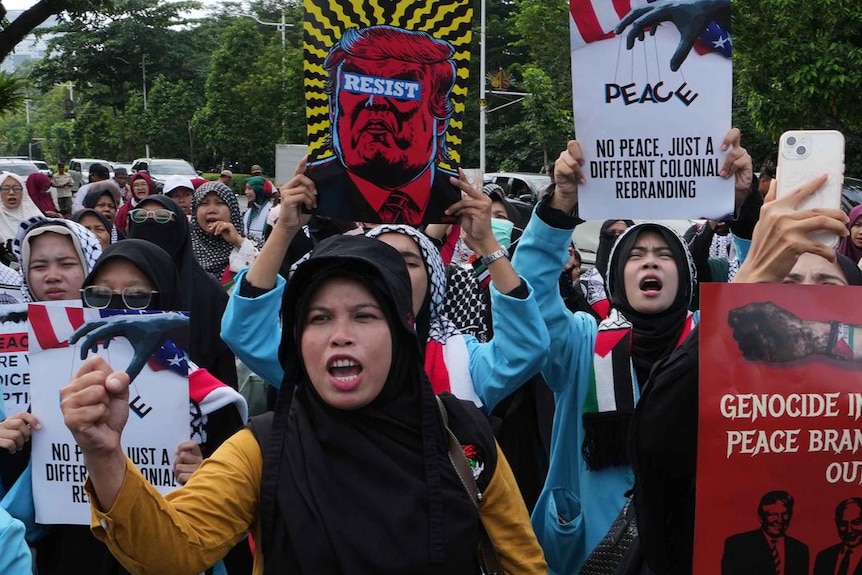
Protesters outside the US embassy in Jakarta demand Indonesia cancel its Board of Peace membership. (AP: Achmad Ibrahim)
Only a few days ago, protests were held against the Board of Peace outside the US Embassy in Jakarta.
“At the grassroots level, it seems that people don’t agree [with joining],” said Hikmahanto Juwana, an international law professor at Universitas Indonesia.
“They know that the Board of Peace charter is completely different to what was envisaged by the UN Security Council resolution.”
Why is Palestine so critical to Indonesia?
Advocating for an independent Palestine is baked into the DNA of Indonesia, the world’s largest Muslim-majority nation.
Palestinian leaders were vocal supporters of Indonesian independence in 1945.
Many in Indonesia feel a debt is owed to Palestinians and Indonesia has been a significant supporter of a two-state solution.
Former Indonesian foreign minister Retno Marsudi once described this view as: “Palestine is always present in every breath of Indonesian diplomacy.”
Any move seen to betray that fundamental view would be politically catastrophic.
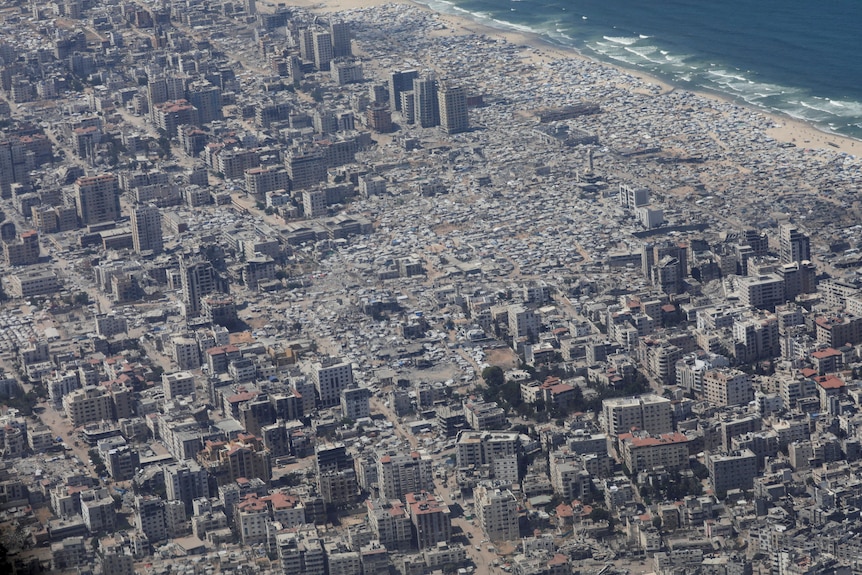
A view from a Jordanian military aircraft of Gaza in August last year. (Reuters: Alaa Al Sukhni)
Teuku Rezasyah said how Prabowo interacted with Israeli leadership would be watched very closely, with Israel’s Foreign Minister Gideon Sa’ar expected to attend the board’s inaugural meeting in Prime Minister Benjamin Netanyahu’s stead.
Indonesia does not have formal relations with Israel, and analysts say recent remarks by Prabowo have suggested he is softening Indonesia’s position.
“This meeting will be very important for Indonesia and also very important for Prabowo Subianto,” Teuku Rezasyah added.
“If Prabowo doesn’t show the leadership, it can affect his leadership inside the country.”
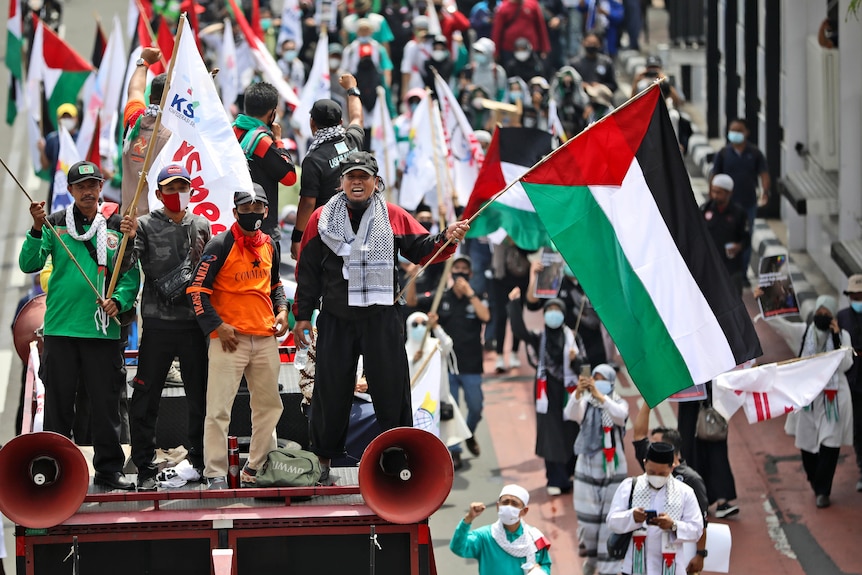
A labour activist holds a Palestinian flag at a rally condemning Israeli attacks on Palestinians, in Jakarta in 2021. (AP: Dita Alangkara)
Indonesia’s Foreign Affairs Ministry spokesperson Yvonne Mewengkang said: “President Prabowo’s presence confirms Indonesia’s commitment to playing an active role in shaping the direction and work of the peace board from the outset.”
Joining the board could come with trade-offs
While in Washington this week Prabowo is also expected to meet with Trump to sign a final agreement on trade, following the imposition of the US president’s “reciprocal tariffs”.
Indonesian media outlet Tempo reported that Prabowo’s decision to join the Board of Peace was also influenced by tariff negotiations.

Christina Clarissa Intania noted several points of criticism regarding Indonesia’s participation in the Board of Peace. (Supplied)
Some analysts feel that if that’s the case, they’re yet to see evidence that joining the board has improved Indonesia’s position.
At the Board of Peace meeting an announcement could also be made about which countries had agreed to the US$1 billion permanent membership fee to join.
Australia–Indonesia relations could get complicated
A researcher from The Indonesian Institute, Christina Clarissa Intania, said if Indonesia was paying, it was “inconsistent” with the government’s domestic spending choices, with Prabowo driving an efficiency agenda to fund major election promises.
“If it turns out that Indonesia decides to pay $US1 billion, of course, it will be a burden for us and create shock among the public,” she said.
The fee is reportedly for rebuilding Gaza, although there’s been little transparency or clarity over what specifically it would be spent on.
In a response to the ABC, Indonesia’s Foreign Affairs Ministry said Prabowo had decided Indonesia would “consider paying voluntary contributions”.
“Further technical details remain subject to continued discussion,” they said.
“Indonesia underscores the importance of ensuring that any international voluntary contributions for Gaza are well‑targeted and focused, particularly toward reconstruction and recovery in alignment with the needs and priorities of the Palestinian people.”
‘Palestinians do not need guardianship’
One outcome of the meeting could be that Indonesia will make up a significant bulk of the International Stabilisation Force, the Board of Peace-led peacekeeping effort in Gaza.
Prabowo told a UN General Assembly meeting last year that Indonesia was willing to put forward 20,000 soldiers for such an effort.
That offer appears to have softened, with a presidential spokesperson suggesting 8,000 armed forces personnel could be sent to Gaza.
Indonesia readies troops for peacekeeping in Gaza
Following that suggestion, a senior Hamas official, Osama Hamdan, told Al Jazeera it had informed the Indonesian government that “we, as Palestinians, do not need guardianship”.
“The last thing the world should be thinking about is sending forces that will replace the occupation,” he said.
Indonesia’s foreign ministry has said any Indonesian role would be strictly humanitarian, focusing on civilian protection, medical services and reconstruction.
But peacekeeping under a Board of Peace command, rather than a UN structure, would be unlikely to be warmly accepted by the Indonesian public.
“Looking at Israel’s track record, it is not impossible for the Indonesian Armed Forces to instead become involved in ceasefire violations frequently committed by Israel,” Intania said.
“This is the worst‑case scenario, where the Indonesian military ends up caught in the conflict between Israeli forces in Gaza, which is not aligned with the goal of promoting peace,” she added.
Indonesia’s Foreign Affairs Ministry said Indonesia had firm “caveats” in participating in the stabilisation force, including personnel working in non-combat roles, not engaging with any party, and Palestinian consent as a prerequisite.
How those caveats play out in practice will be crucial to whether the Indonesian public supports a deployment of its own military, in a place that’s close to their hearts.