
Once there were parking lots
Now, it’s a peaceful oasis
― Talking Heads, “(Nothing but) Flowers”
Between the Bunnings and Dial-a-Tow, opposite Campbelltown Station in Western Sydney there is a new multideck car park, five storeys of concrete, ramps, neatly aligned bays. And palm trees. In Australia, the parking of one’s car has created an industry worth $2.6 billion. In designing for cars, great attention is paid to efficient arrangement, turning circles and clearances – but it is rare for a design to consider and deliver an adaptive future for these structures.
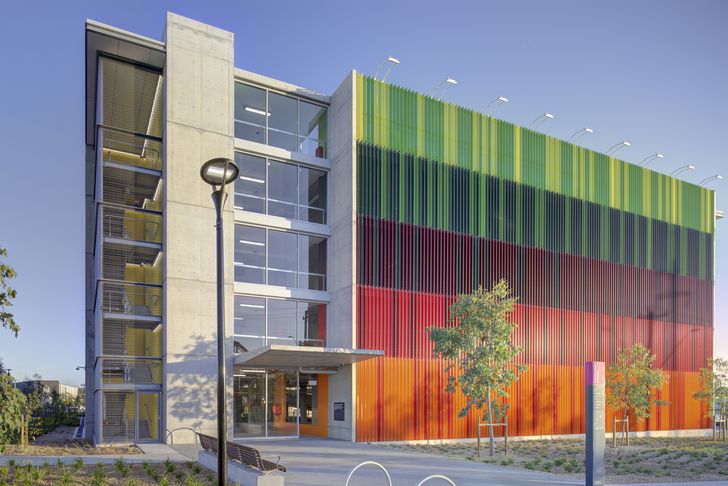
Hill Thalis Architects and Urban Projects with JMD Design landscape architects designed the car park to accommodate the commuter demand of Campbelltown train station, and to be ready for adaptation: commercial, cultural or residential – “future-proofing” in Tenderlink parlance, but perhaps better defined as “future-enabling.” Generous ground level clearance enables future tenancies to plug in, with connection points for plumbing and grease traps already in place, anticipating future activity. Collected water is stored to irrigate the landscape – it has landscape! The facade facing the station, a colourfully banded screen of vertical fins, catches the light, bouncing ambient hues and signalling the building’s progressive civic ambition.
View gallery
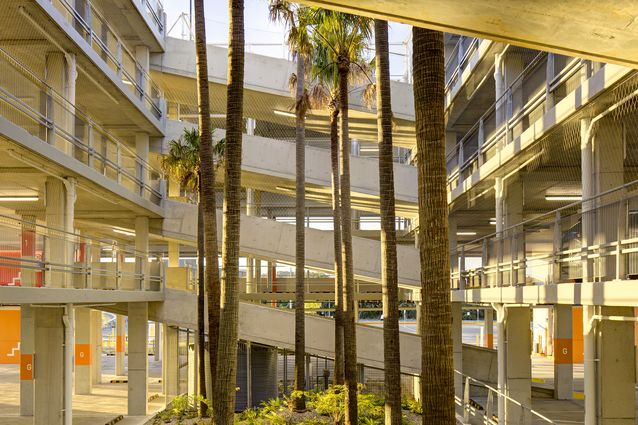
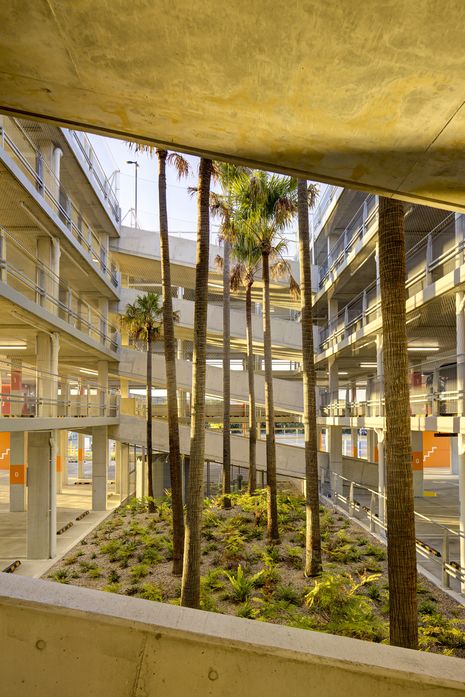
The flat decks of the car park are separated to form a courtyard, a deceptively simple move that reorders expectations of the type. Ramps launch cars between levels, their diagonals completing the perimeter of the courtyard space. Instead of a dim, airless stack, the centre of the building is open to the sky, a volume with the composure of a civic room. The ramps are designed to one day be removed to reconfigure the building for other purposes. Daylight tumbles in, the sky brimming over and only interrupted by palm trees, a nearly comic icon of paradise.
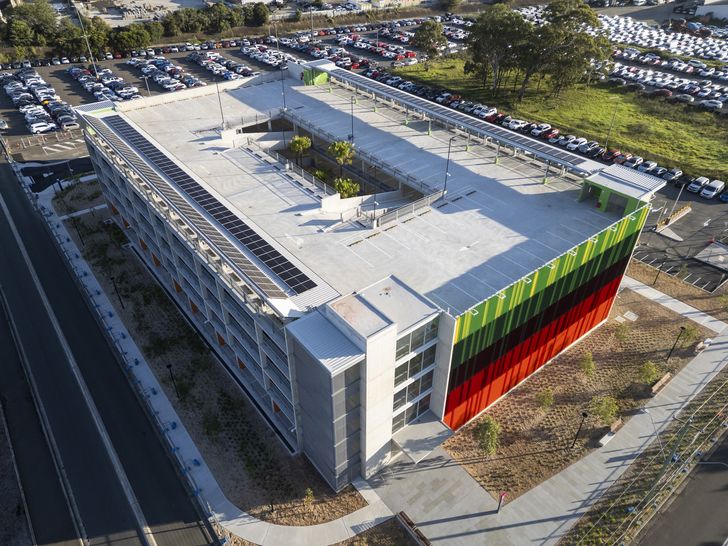
The top floor is similarly scaled for future commercial use, a cold shell awaiting occupation. There are PV cells on the roof for the EV chargers below (where there is bicycle parking, too). The structure uses post-tensioned slabs with band beams, efficient and effective, reducing the mass of concrete by 17 percent.
View gallery
The gridded concrete structure is punctuated by stairs that are open air, if not actually discouraging the typical atmosphere of car park stairs, then at least ventilating it. At night, the security lighting and yellow paint glow, the prosaic necessity of the stair is turned to public benefit, evidence of the design’s humanism and elegant sufficiency.
It would be easy to mistake the car park as generically flexible, a neutral armature. Rather, it sets out a future that is spreading. The form of the grid reincarnates regularly in architecture at all scales: Palladian villas, Maison Dom-Ino, the Fun Palace, the Commissioners’ Plan of 1811. These armatures are not generic but propositions for the future – the home, recreation, the city. Hill Thalis’s multideck shares this DNA. It is readying for a future that will be green, electric and renewable. We will still go to work. We will still drive cars (or they will drive us).
In his book ReThinking a Lot: The Design and Culture of Parking, Eran Ben Joseph asks, “Why can’t parking lots be modest paradises?” The Convertible Carpark, Campbelltown offers a response, and a proposition: that even the most utilitarian structures of our cities can be designed with the dignity of future possibility. It is not a heroic building but a thoughtful one, built with an eye to a future that will be made by us.
View gallery