
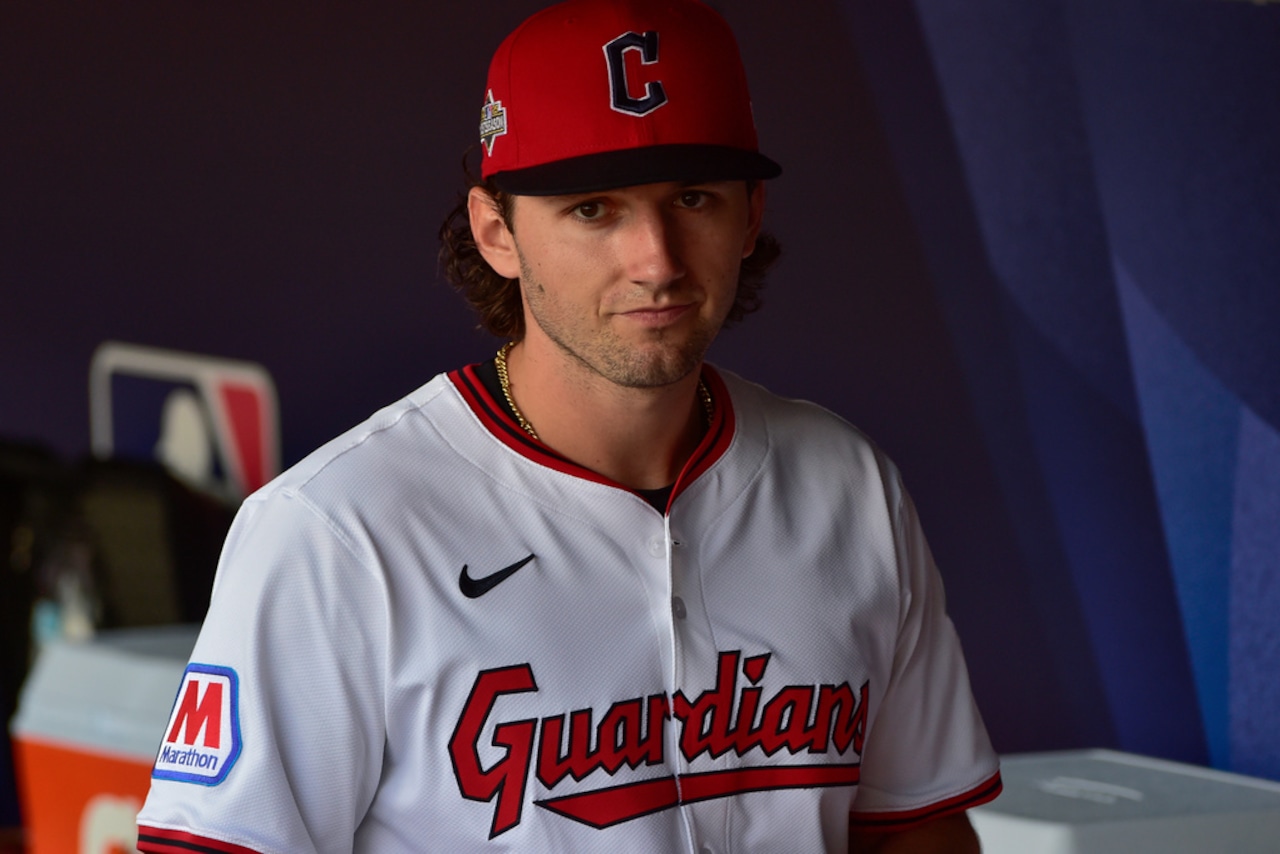
CLEVELAND, Ohio — Chase DeLauter’s major league story already reads like something from a Hollywood script — and now the Guardians are betting their entire offensive strategy on its next chapter.
DeLauter’s journey to the big leagues took a remarkable turn last fall when what began as a season-ending injury unexpectedly led to a postseason debut. Now, after Cleveland’s quiet offseason that prioritized internal development over external additions, the spotlight on the young outfielder has intensified.
“Now there’s real pressure for him to produce because really, the Guardian’s whole off season strategy kind of revolved around him,” cleveland.com Guardians beat reporter Joe Noga explained.
The 24-year-old’s path to the postseason was anything but conventional. After suffering a broken hamate bone that required surgery on July 23, DeLauter assumed his season was finished. Sent to Arizona for rehabilitation, he was mentally preparing for the offseason.
“He had a plan. He was thinking about going to Columbus first, to get his truck, and he was going to drive back to West Virginia,” cleveland.com Guardians beat reporter Paul Hoynes recounted.
Those plans changed dramatically when assistant general manager James Harris called, suggesting DeLauter remain in Columbus “because you never know what could happen.” What happened was a spot on Cleveland’s Wild Card Series taxi squad, followed by his major league debut in Games 2 and 3 against the Detroit Tigers.
“He goes from sitting on the bench watching a series to possibly getting in it. And then he plays the last two games, his first two games in the big leagues. That’s a whirlwind. And I thought he handled it really well,” Hoynes said.
DeLauter’s debut had its challenges — he dropped a fly ball off the bat of Gleyber Torres after losing it in the sun — but he quickly redeemed himself by throwing out a runner to save a run in Cleveland’s victory. The next day, he collected his first major league hit.
Those brief but intense moments in October’s spotlight have given DeLauter the confidence that he belongs at the highest level.
“He’s kind of crossed that line from minor league player to the big leagues, and he said he definitely feels like he belongs right now,” Hoynes reported.
That confidence will be crucial as DeLauter enters a season where Cleveland’s front office has effectively staked the team’s offensive improvement on his potential. After driving home to West Virginia with “Country Roads” playing on repeat — a fitting soundtrack to his remarkable journey — DeLauter now faces the challenge of transforming a two-game sample size into a season-long contribution.
For the Guardians, who made minimal offensive additions despite clear needs, DeLauter’s development isn’t just a hopeful storyline — it’s a cornerstone of their 2026 strategy.
Read the automated transcript of today’s podcast below. Because it’s an AI-generated transcript, it may contain errors and misspellings.
Podcast Transcript
Joe Noga: Welcome, welcome, welcome back to the Cleveland Baseball Talk Podcast. I’m Joe Noga, joined by Paul Hoynes from Goodyear, Arizona. Hoynsie, first real full day yesterday out there, bouncing around the facility and all over the place and a busy day, an active day full with some news out there. First things first. In the morning, the news came out that the Guardians were, were scheduled to meet with Tony Clark and the Major League Baseball Players association representatives for their annual sort of FaceTime meeting out there in Arizona. That, that visit never materialized and there was a pretty good reason why.
Paul Hoynes: Yeah, Tony Clark, the executive director of The MLBPA since 2013, has resigned. Obviously. Joe, they had to cancel that meeting. That was the first meeting, the union’s first meeting, you know, starting their spring training trek through Arizona to meet with all the clubs. So they’ve got to, they’ve got to regroup and I guess name a new executive director and you know, kind of really it was a shocking development. It surprised a lot of the Guardians. I talked to Austin Hedges, who was one of the assistant union reps on, on Cleveland, and he said, you know, the timing was probably the most shocking thing because as everyone knows, basic agreement, it will end in December after the 2026 seasons. You know, they, they were, they were, they had already started negotiations. So I, I’m not sure what this does to it, but obviously the union has to regroup, name a new guy and get back to work.
Joe Noga: Yeah, either way, this is going to be a setback in terms of those, those negotiations that they can’t remain on the same sort of schedule that they would with, with somebody new coming in as the executive director. It’s interesting that Austin Hedges said that the timing of it, it’s not necessarily the timing of it in terms of yesterday and you know, having to cancel the meeting with the Guardians and that kind of thing. It’s, it’s the timing of it in general. When you’re talking about their, their sort of overall big picture in this, this, this year long negotiation, which is basically what it’s going to be up until they’re scheduled for a lockout. What? The basic agreement ends December 1st and the doors are going to be locked on December 2nd. It’s one way or the other. It really does feel like if you talk to a lot of these players, if, you know, a lot of players are coming out and saying that a lockout feels inevitable, unavoidable is what I’ve heard. Does this sort of further that and make it more of a reality?
Paul Hoynes: Yeah, I think it definitely does. It, you know, really, it really puts the negotiations on both sides under the gun. But especially the players association, they’ve got to get a new leadership group in, in place. They’ve got to pick a new director, you know, and it, it kind of, I don’t know if the, if the momentum swings back, swings over to the owners here. So it’s really, you know, an interesting dynamic and we’re just going to have to see how it unfolds. Joe. But you know, every, every negotiation when a basic agreement ends has never been, you know, a walk into sunshine. It’s always been fraught with threats of strikes, work, you know, lockouts. So what. Hopefully it doesn’t end like that, but you know, that’s certainly there’s storm clouds on the horizon for sure.
Joe Noga: As far as Tony Clark goes, this is a guy who like you said, has been in place as the executive director for more than a dozen years and he’s now leaving sort of under a cloud of controversy under this, you know, reportedly this, this, you know, inappropriate relationship with his sister in law who had been hired by the union a couple years ago in 2023 to, to a role within the union administration. You know, that much aside, there’s also an ongoing federal investigation into how the union was, was handling its, its finances and some sort of licensing issues and, and things like that. Did Tony Clark do the union a disservice by the way sort of leadership handled things at the end here and did he leave them in a disadvantageous position when it comes to the God to the.
Paul Hoynes: I think he certainly the union is not in a great position negotiation wise. I mean, I’m sure, you know, they’ll ban together and recover from this right now. This is a, this is a devastating blow. I think it’s, it’s a setback. We don’t know Tony Clark’s involvement right now. It’s just reports and speculation. So we’re going to just have to find out exactly what, what, you know, how this ends up. But you know, Clark was the first player to be executive director of the union. You know, he played in the big leagues 15 years and you know, he’s definitely has some questions to answer right now.
Joe Noga: Yeah. And you know, what was the, the temperature in the room with the guardians? I obviously you talked to Hedges and, and he sort of preached a patient approach to this to, to maybe take a step back and let the, the cards unfold. Not unlike the, the same approach that he sort of preached when the, the Emmanuel Clase and Luis Ortiz Investigation came to light. It helps to have a veteran guy like, like Hedges in the room to sort of keep heads cool. But you could probably tell there was, there was a little bit something simmering underneath there.
Paul Hoynes: You know, I think he’s got some questions. Obviously he’s always been involved in the union. Said a lot of players were coming up to him yesterday asking what was going on and like you said, he was preaching patience, waiting for details to come out. Joy. It was funny, you know, I’m sitting there in the locker room looking, I’m telling myself, you know, I should talk to a veteran here, somebody that’s been around and I’m looking, looking around that locker room. There’s no veterans in this call. They’re all like two and three year guys. I mean there’s a few guys, but. So I had to wait for Hedges. I’m saying, well, Hedges has got to know, you know, he’s been in the league almost 10 years. So I mean, but it was weird, it was a weird feeling.
Joe Noga: Yeah. Very close to 10 years. Hedges supposed to get his 10 years of service time right there within the first couple of weeks of the season, I believe like 11 days in or something like that. He’s, he’s very, uh. Yeah, he was, he was probably a very popular guy. Always a popular guy in the, in the clubhouse. But even more so on a day when there’s a league wide story like that breaking sort of the, the big theme of the day, I guess with, with Clark being absent and not there to, to conduct that annual meeting with the, the players that gave Stephen Vogt his opportunity to, to step in and fill that void and deliver his opening speech. He was going to, you know, maybe because he didn’t want to have the two messages maybe, you know, not conflicting, but overloading players with the two different messages, one from the players union earlier in the day or anything like that, he was going to separate it, but it gave him an opportunity to give him, to give that, that speech yesterday. Was he prepared for it first of all, and how did it go?
Paul Hoynes: Yeah, he was prepared for it, Joe. And like you said, he didn’t want to give it, give his speech, you know, about, you know, the run through the wall speech in the win the World Series speech after, you know, the MLBPA had been talking to the players about a possible work stoppage. Those two things don’t jive. So, you know, he was, I think he was glad to get the message out, get it over with. And he said, as always, the message is to win a World Series, that’s what we’re here for. That’s what we want to accomplish. And I think the message was well received. And. But that’s the message every year, Joe, I think, isn’t it? In Cleveland? I mean, they haven’t won since 1948, so better be the message.
Joe Noga: And you know, Chris Antonetti with the message at the end of the season, he’d been there 28 years or 27 years. He’s over 27, trying to, trying to win the World Series. You know, he, next year he wants to be 1 for 28. So, yeah, I, I get it. And you know, those of us sitting at home reading this, seeing this, the message from Vote, you kind of, you know, maybe give it a side eye, give it a, an offshore, you know, whatever. But if, if Stephen Vogt doesn’t believe that his team can win series, then, then what are these guys doing there in the first place?
Paul Hoynes: Yeah, definitely. That’s a good point. And if we’ve learned anything about Vote is that he’s a straight ahead thinker. You know, he’s, he does not get distracted. We saw that last year. He kind of willed that team, in my opinion, to overcome that 15 and a half game deficit. And we’ve got to remember two years ago, what, in 2024, they were three wins away from the World Series. So it’s, it’s not an impossible dream. It’s a difficult dream. It’s a tall mountain to climb, but it could happen. I mean, it’s hard to bet against Cleveland. I mean, not regarding winning a World Series, but having a successful season, getting into the postseason and taking their swings because they’ve done it so often.
Joe Noga: Contend that there are at least two people on earth that would say it’s pretty easy to bet against Cleveland, but they’re, you know, in a lot of trouble right now. So we’re going to move on from that. One more thing about Stephen Vogt, you know, was a lighthearted moment, a funny moment. One of our colleagues from Channel 5 Mason brought up a fact. We were talking about Stuart Fairchild yesterday. Vogt was. It was pointed out to Stephen Vogt that Stuart Fairchild made his major league debut for the Arizona Diamondbacks in a pinch running situation. And the player that he pinch ran for at the time was none other than Stephen Vogt. So Stephen Vogt and Stuart Fairchild, very familiar with each other vote. When it was pointed out that he was the, he was the, the player who was pinch run for, jokingly said he was insulted by that. He was insulted that that it was pointed out to him, you know, very funny. He said he was going to have to make Stuart take a run an extra lap today. That’s, you know, maybe it sort of peels back the, the curtain and maybe a little more behind the scenes as to why they targeted Stuart Fairchild and why they believe that he can contribute and help is because of a relationship between Vogt and Fairchild in the first place.
Paul Hoynes: Yeah, that’s a great point. You know, managers, you know, they, they have connections, they know people, and especially a manager that just is just what, two, three years removed from being a player. So he’s going to still have connections with active players. And Stuart Fairchild is one of those guys, I think, you know, he’s a versatile guy. He can play all three outfield positions. Really a good center fielder. He can run, steal a base as Vote found out, you know, so it’s going to be interesting to see how he fits on this ball club.
Joe Noga: Speaking of guys that can play the outfield, CJ Kayfus, a guy who can play the outfield, we saw him play the outfield. I believe he started a handful of games out there in right field for the Guardians. But Vogt says that that might not be the case with them wanting to get a good look at some of these guys who are in, in competition for outfield spots during spring training.
Paul Hoynes: Yeah, Joe, I mean, they’ve got counting, you know, a spring training Advice. They’ve got 11 outfielders in, in camp and they’ve got to find out some questions. They’ve got to, you know, who’s going to play center field, who’s going to play right field, who, you know, I mean, there’s not just one guy that’s going to be out in those two positions, but they’ve got to get the mix down, you know, I mean, they’ve got to figure that out. And Kayfus, according to a vote, is going to spend most of the spring, at least, you know, the majority of the spring at first base and then he’ll get worked into the outfield later in camp, but, you know, he’s a first baseman by trade. But last, when he came up in August last year, he played more games in, in the outfield than he did at first base. So, you know, another guy with flexibility, another guy that, you know, kind of came on. Joe, I like the way he swung the bat late in the season.
Joe Noga: I definitely have some positive signs out of him. I just remember the Gavin Williams near no hitter game. CJ Kayfus with diving catch in right field to, to Preserve that late into the late innings there. He, he can play multiple positions. He’s athletic. Like you said, first base is his primary position. He’s probably the, the best defensive first baseman on the roster right now. And, and with David Fry not playing first base much during camp, you know, concentrating behind the plate, that’s, you know, he’s going to get the opportunities there to, to play and that, that should be, you know, interesting to, to, to see him, you know, settle in and maybe that helps him get more comfortable at the plate as well. You spoke to Chase DeLauter yesterday, and a lot has been written, a lot has been made about DeLauter making his debut in the postseason last year. He’s, he’s still sort of riding a wave of good vibes from, from that experience and, and hopefully that carries over into the, the spring training season.
Paul Hoynes: Yeah, Joe, it’s, you know, when you, when you. Everything seemed to happen so fast last season, and when you look back on it, that was a heck of a story. I mean, this is a guy that plays what his final game, really final competitive game on July 17 for Columbus, then has to have hamate bone surgery on July 27. He thinks he’s done for the season, out six to eight weeks, another injury, just kind of, you know, it had to be difficult for him to handle that. So he ends up in Arizona in Goodyear rehab. He plays a couple games with, you know, the Arizona Complex Club, Cleveland’s Arizona Complex Club, then is just kind of rehabbing, and he has a plan. He’s thinking about, okay, I’m gonna, you know, go. You know, when the season’s over, he’s, he’s making plans. He’s going back home. You know, he’s got to go to Columbus first, get his truck, and he’s going to drive back to West Virginia. And before he leaves Arizona, James Harris, the assistant general manager, calls and said, hey, why don’t you go to Columbus, hang out there for a few. Because you never know what could happen. So he goes, goes to Columbus, he continues his rehab, and all of a sudden, you know, they put him on the T. You know, the guardian season ends and they put him on the taxi squad for the wild card game. And then the first day for, you know, the first game of the wild card, they, you know, they, they, you know, they purchase his contract. He’s. And he goes from sitting on the bench, you know, and watching the, watching a series to possibly getting in it. And then he plays the last two games, his first two games in the Big That’s a whirlwind. And I thought he handled it really well. And you’re right, Joe. He’s still kind of vibing off that.
Joe Noga: Yeah, it’s. It’s a weird sort of transition where your. Your most important thought at the end of the season is, where am I going to park my truck to Being told there’s a chance you might be playing in the postseason. And that certainly happened. And we saw what happened, you know, in those first few moments of his major league debut. You know, he drops a fly ball in the center field that he loses in the sun off the bat of Gleyber Torres, but then he recovers. He throws out a runner and saves a run in that game that the Guardians would go on to win. Very important there. And then the next day, gets his first major league hit all, you know, 48 hours that I don’t think anybody had anticipated. Certainly not chased a lottery in that situation. But how does that sort of propel him and move him forward into this year where it seems like the Guardians have just gone about their business all off season. This whole position of we’re not going to add from the outside because we believe in the guys that we have in this clubhouse, and we believe that guys like specifically Chase DeLauter are going to step up offensively. I mean, now it’s. It’s all. It’s almost like he was playing those postseason games with, you know, that kind of pressure. Now there’s real pressure for him to produce because really, the Guardian’s whole off season strategy kind of revolved around him.
Paul Hoynes: Yeah, Joe, that’s a. That’s a great way to put it. And, you know, he thinks, you know, I know it’s only two games. I asked him yesterday, you know, he’s only played two games, but does he feel like he belongs? You know, he’s kind of crossed that line from, you know, from minor league player to the big leagues. And he said he. He definitely feels like he belongs right now. I mean, he knows, you know, there’s a long way to go and he’s got a lot to learn. But he felt like, like those two games really gave him confidence that, you know, he can. He can play in the big leagues. He said the. The part that gets you is the noise, the noise leading up to the game, you know, that white noise outside that every player has to deal with, especially kind of new guys that are making, you know, new to the big leagues. And he says that’s, that’s what gets players. But, you know, running out into the field and just playing the game. That’s the same. We’ll see how this works, Joe. But I. He said when he finally got in his truck after the. The Wild Card Series and drove back to West Virginia, he was playing Country Roads. He was listening to that.
Joe Noga: And his walk off, he said he had it on repeat all the way home. Right. It was that. Just over and over again listening to it. Hey, man, you. Will I. I will stop and listen to that song every time, so. Absolutely. That’s a heck of a way to drive to. Back down to West Virginia. But that’s, That’s. That’s interesting that he, you know, he got in the car. You could sort of almost see. It almost looks like a scene from our favorite MOV Ball where, you know, Brad Pitt as Billy Bean is, you know, driving down the road and is in his truck and, you know, all of a sudden, Country Roads comes on.
Paul Hoynes: I can.
Joe Noga: I can just picture it right now. Speaking of country roads, the road for Cade Smith and Hunter Gaddis will. Will kind of be a slower road, I guess, at the beginning of spring training here. The workload for the two of them over the past two seasons has been pretty high. So they’re going to be smart and sort of take it easy with these guys. Does that make a lot of sense in terms of trying to preserve two of important arms in the bullpen?
Paul Hoynes: Oh, yeah, sure. I think that’s a. That’s a real smart move. You know, they did it last year with both of those guys, and, you know, just, you know, the. The work they put in, I mean, it’s incredible. They’re almost identical. The amount of, you know, appearances and innings pitch these guys have had over the last two years. I think each of them had. Have had 162 appearances. Each of them had thrown around 162 winnings. You know, that counts the postseason, and that’s a heavy workload. Those two guys, they want to keep them fresh, and I think they’ll work them in gradually into the Cactus League season, but there’s really no rush.
Joe Noga: What did Stephen Vogt have to say about David Fry and his road back in terms of getting out there and getting behind the plate and throwing?
Paul Hoynes: Yeah. You know, Vogt is really pleased with the progress Fry has made.
Joe Noga: He was.
Paul Hoynes: Yesterday he said it was just fun to watch him, you know, get behind the plate in the catching position and throw to all the bases and just have. Have him be, you know, like. Like David Fry. You know, he’s. He’s not a guy that that’s you know, worrying about his elbow. He’s not a guy that, you know is rehab in half the day and then getting ready to just only DH or only pinch hit that, you know, he’s a regular player.
Joe Noga: Now as far as guys who are on the field today, what can we expect to, to hear about or, or see out there on the mound and, and getting, getting some of their work in.
Paul Hoynes: This is, you know, the really second full day of full squad workouts. There’s going to be, you know, lot, lots of guys, lots of pitchers thrown off a live bp. You know, Bibee’s going to be on the hill. Armstrong, Trevor Stephan is going to be testing his elbow. So it should be, you know, a lot of, a lot of the younger players are going to be out there. So you know, it’s going to be fun to watch. Bibee especially Armstrong, Colby Allard, Trevor Stephan, those guys are going to be throwing live BP and getting ready getting ready for Saturday’s season opener. Joe. I mean two season openers because it’s a split squad game against the Reds and the Resin brewers. They’re going to have 18 pitchers ready to go Joe for the two games and, and a vote said every player on the 40, every position player on the 40 man and the, and the depth squad, the depth, the depth Roger roster will play in those two games. So he said that’s 36 players so I’d hate to keep, I’m not going to keep score for those games.
Joe Noga: Has he given any IND as to who, you know, whether like the veteran guys will stay back at a good year to, to play in the, the game against the Reds where the, you know that game will be on TV so a lot of folks back home who maybe want to see maybe a Stephen Kwan or a Jose Ramirez, I might be hoping that those guys are on the roster for the first game here in, in Goodyear?
Paul Hoynes: Yeah, I think that, I think that’s the way it’ll probably work. Said who’s going to pitch what game? You know, Joey Cantillo and no. Yeah, Cantillo and Logan Allen are scheduled to start the games and he’s. And he said who starts what game will depend on what pitcher Carl Willis wants to watch the most. So we’ll see how that goes.
Joe Noga: Well Hoynsie, you know, soak up the sun. Have a good day out there in good year and we’ll get the full report tomorrow morning when we talk to you then.
Paul Hoynes: Good deal.