
OPTIMISTIC:
The DGBAS sharply upgraded its GDP growth estimate from 3.54 percent to 7.71 percent after the Taiwan-US trade agreement signing and given AI optimism
The US imported more from Taiwan than China for the first time in decades, as US President Donald Trump’s tariffs reshape trade flows while a global boom in artificial intelligence (AI) fuels demand for tech products.
US purchases of goods from China plunged almost 44 percent in December last year from 2024 to US$21.1 billion, US Department of Commerce data showed on Thursday.
By contrast, shipments from Taiwan more than doubled during the same period to US$24.7 billion.
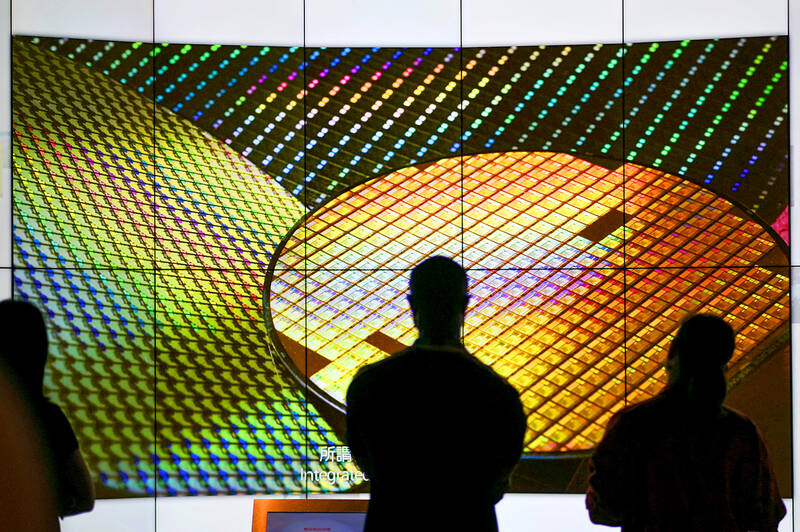
Photo: Sam Yeh, AFP
The soaring Taiwanese shipments to the US reflect the huge expansion in supplies of chips and servers for AI companies, which has completely changed Taiwan’s trade profile and propelled its near US$1 trillion economy into one of the fastest-growing worldwide.
In 2023, Taiwan exported more to China than to the US or anywhere else, but last year, the surge in goods going across the Pacific Ocean from Taiwan was roughly double those going across the Taiwan Strait.
While Chinese exporters have increasingly diversified from the US due to the much higher tariffs imposed by Trump, Taiwanese firms have taken the opposite tack, with the US taking almost one-third of Taiwan’s total exports last year.
Even as China’s exporters have succeeded in escaping Trump’s tariffs by making deeper inroads into markets beyond the US or routing goods via third countries, direct trade between the world’s two largest economies has seen a steep decline.
The latest data also showed the limits of Trump’s efforts to balance out global trade.
The US ran a US$12.7 billion trade deficit in December with China, a gap that only trailed the EU, Taiwan, Vietnam and Mexico.
For the full year, the deficit with China fell US$93.4 billion to US$202.1 billion, while it more than doubled to almost US$147 billion with Taiwan.
The Ministry of Finance said exports have been buoyed by surging demand for the nation’s tech products, with shipments of information, communications and audiovisual products to the US in December rising 200.7 percent from a year earlier.
Last week, Taipei signed a trade deal with Washington that would lower the “reciprocal” tariff rate to 15 percent from 20 percent, while semiconductor products could be shipped to the US duty-free under specific quotas.
The trade agreement and optimism surrounding the AI boom prompted the Directorate-General of Budget, Accounting and Statistics (DGBAS) to sharply upgrade its estimate of GDP growth for this year to 7.71 percent from 3.54 percent.